
 English
 French
 German
How to Read a Bearing Code
Overview Every bearing has a code stamped on its side. That combination of numbers and letters is not random. It follows the ISO 15 standard. If you have ever wondered how do you read a bearing code, the answer lies in five fixed positions that determine type, size, sealing, and internal fit. This guide walks through each one with real bearing examples.
At a Glance
A bearing code packs type, dimension series, bore size, and suffix data into a short string. The system uses 6 for deep groove ball bearings, 2-3 digits for dimensional series, code × 5 for bore size, and suffixes like 2RS or C3 for seals and clearance.
What a Bearing Code Tells You
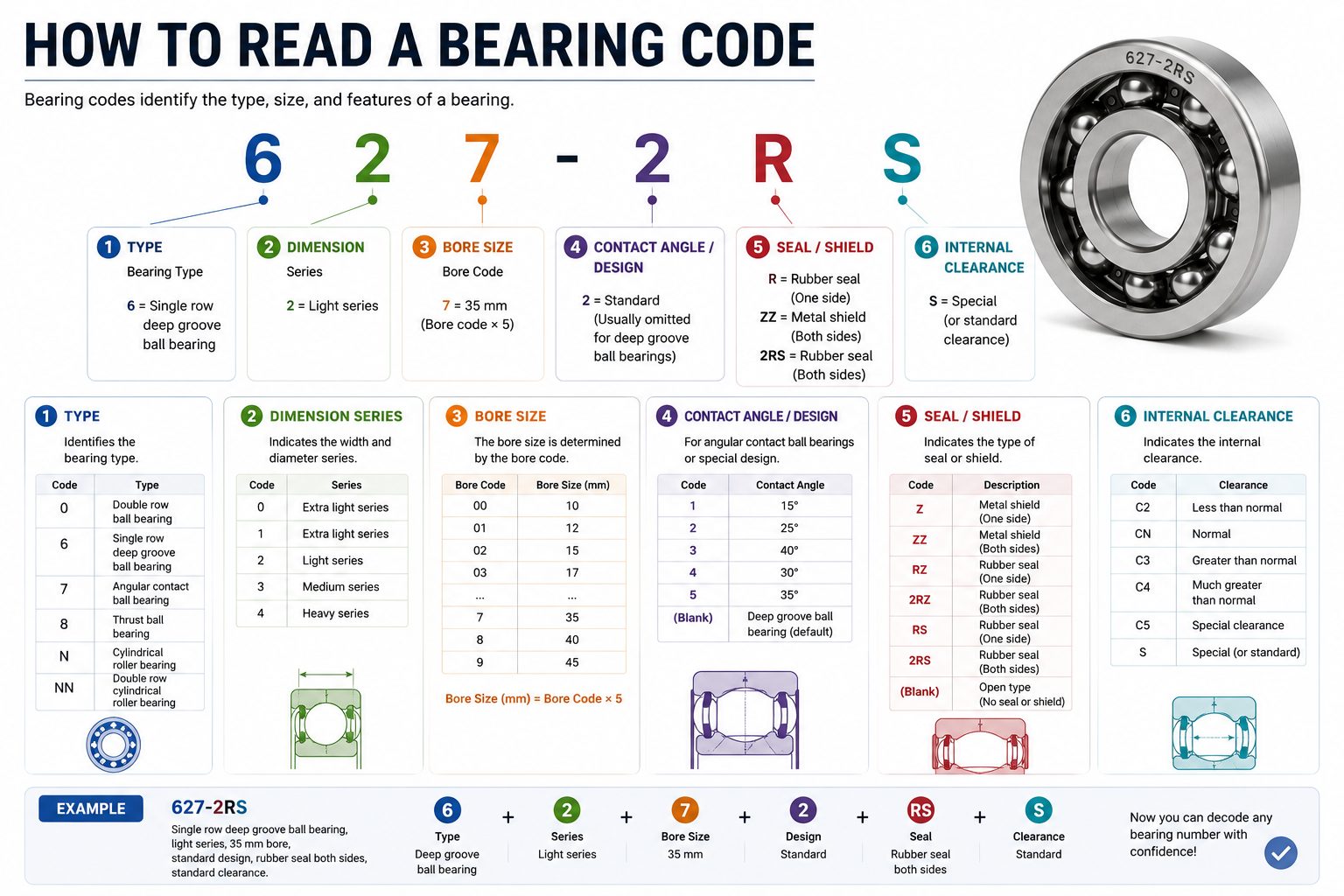
A standard bearing code like 6204-2RS bearing packs four pieces of information into a short string: the bearing type, the dimensional series, the bore diameter, and the suffix for sealing and clearance. Each position has a fixed meaning under ISO 15. The system is consistent across manufacturers, which means a 6204 deep groove ball bearing from one supplier has the same boundary dimensions as a 6204 from another.
The basic designation has three sections. The first digit identifies the bearing type. The second digit or pair of digits defines the dimension series: the width and outer diameter relative to the bore. The last two digits encode the bore size. Suffixes add sealing type, cage material, internal clearance, and precision grade. Learning to parse these parts takes under 10 minutes and pays off every time you order a replacement bearing.
Bearing Type Codes
The first digit tells you what kind of bearing it is. The most common type code is 6, which identifies a single-row deep groove ball bearing. This design handles radial loads and moderate axial loads at speeds ranging from 10,000 rpm for larger sizes to over 50,000 rpm for miniature bearings.
| Type Code | Bearing Type | Typical Application |
|---|---|---|
| 6 | Deep groove ball bearing | Electric motors, gearboxes, pumps, fans |
| 7 | Angular contact ball bearing | Spindles, screw drives, paired sets |
| N | Cylindrical roller bearing | Heavy radial loads, high-speed shafts |
| 2 | Spherical roller bearing | Heavy radial loads with misalignment |
Yuanhe manufactures type 6 deep groove ball bearings in a wide range of standard and custom bore sizes. For the single-row deep groove ball bearing, the type digit 6 is sometimes omitted in short designations. A code like 6204 is understood as type 6, dimension series 2, bore code 04.
Dimension Series
After the type digit comes the dimension series. For 6-series bearings, this is a number like 0, 2, or 3 that encodes the bearing width and outer diameter relative to the bore. Each series targets a different load and space envelope.
| Series | Description | Example (20mm Bore) |
|---|---|---|
| 0 | Extra light, thin section | 6004 bearing (OD=42mm, W=12mm) |
| 2 | Light, standard profile | 6204 (OD=47mm, W=14mm) |
| 3 | Medium, heavier section | 6304 bearing (OD=52mm, W=15mm) |
A 6204 bearing (series 2) has a wider cross-section than a 6004 (series 0) of the same bore. The series 2 bearing supports higher radial loads but needs more radial space in the housing. When replacing a bearing, matching the dimension series matters as much as matching the bore size. A 6004 will not fit the same housing as a 6204 even though both have a 20mm bore.
Bore Size Codes
The bore diameter is encoded in the last one or two digits. For bore sizes from 20mm to 480mm, multiply the last two digits by 5 to get the bore in millimeters. A 6204 bearing has bore code 04, so the bore is 4 x 5 = 20mm. A 6212 has code 12, giving a 60mm bore.
| Bore Code | Bore Diameter (mm) | Example Bearing |
|---|---|---|
| 00 | 10mm | 6000 bearing, 6200 bearing, 6300 bearing |
| 01 | 12mm | 6001 bearing, 6201 bearing, 6301 bearing |
| 02 | 15mm | 6002 bearing, 6202 bearing, 6302 bearing |
| 03 | 17mm | 6003 bearing, 6203 bearing, 6303 bearing |
| 04 | 20mm | 6004, 6204, 6304 |
| 12 | 60mm | 6012, 6212, 6312 |
For bores under 10mm, the code is simply the bore diameter in millimeters: a 608 bearing has an 8mm bore, and a 626 bearing has a 6mm bore. Bores over 500mm and bores not evenly divisible by 5 use a slash separator format like 62/500 for a 500mm bore. This format appears in large industrial bearings and is uncommon in standard catalog sizes.
Bore Size Rule
Bore Code (two digits) x 5 = Bore in mm
Valid for bore sizes 20mm to 480mm. Codes 00, 01, 02, 03 are exceptions.
Suffix Codes
The suffix is where most confusion happens. A single bearing can carry multiple suffix codes stacked together, like 6204-2RS-C3. Each suffix has a specific meaning under ISO standards. The standard order for stacking is sealing first, then cage material, then internal clearance, then precision grade.
Seals and Shields
| Suffix | Meaning | Speed Limit vs Sealing |
|---|---|---|
| (no suffix) | Open bearing | Highest speed, no protection |
| Z | One metal shield | High speed, basic dust protection |
| ZZ / 2Z | Two metal shields | High speed, dust protection both sides |
| RS | One rubber seal | Moderate speed, good sealing |
| 2RS | Two rubber seals | Lower speed, dust+moisture sealed |
A 6204-2RS bearing is sealed on both sides with rubber lips. It comes pre-greased and does not need relubrication during its service life. A 6204-ZZ bearing has metal shields that do not touch the inner ring, allowing notably higher speeds but offering less protection against fine dust and moisture. Open bearings with no suffix for sealing are used inside oil-bath or grease-packed housings where the enclosure already provides protection.
Internal Clearance
| Suffix | Clearance Class | Typical Use |
|---|---|---|
| C2 | Less than normal | High-precision spindles, low temp variation |
| CN (or none) | Normal | General industrial use, moderate speeds |
| C3 | Greater than normal | Electric motors, hot shaft, press fit |
| C4 | Greater than C3 | High thermal gradients, heavy press fits |
C3 clearance is the default choice for electric motors. The extra internal space allows the inner ring to expand from operating heat without preloading the rolling elements. Yuanhe stocks deep groove ball bearings in C3 and CN clearance as standard for OEM orders.
Additional suffix codes cover cage material and precision. TN or TV9 indicates a glass-fiber reinforced polyamide cage rated to 120 C. M means a machined brass cage for higher-temperature applications. P5 and P6 correspond to ABEC-5 and ABEC-7 precision grades for applications demanding tighter bore and runout tolerances.
Reading Real Bearing Codes
Let us decode three common bearing codes found on equipment and in supplier catalogs.
6204-2RS-C3
Type 6 deep groove ball bearing, series 2, 20mm bore (04 x 5). Sealed on both sides with rubber lips (2RS). Internal clearance greater than normal (C3). This is the most common bearing in small electric motors from 0.5 to 2 hp.
6000-ZZ
Type 6 deep groove ball bearing, series 0 extra light, 10mm bore (code 00). Two metal shields, non-contact type. Normal internal clearance (no C-suffix). Used in compact applications like hand tools, small fans, and hobby motors where the 10mm x 26mm x 8mm envelope fits tight spaces.
Type 6 deep groove ball bearing, series 3 medium, 25mm bore (05 x 5). Open design with no seals or shields. Normal clearance. The series 3 profile gives it the highest radial load rating among the three series for the same bore size. Used in gearboxes, conveyor rollers, and pumps.
When the Code Does Not Match the Standard
Not all bearing codes follow ISO 15. Some manufacturers use proprietary numbering systems. Inch-series bearings use a different system with codes like R8 or EE4. Miniature bearings under 10mm bore often use a direct three-digit code: 693 means type 6, series 9, 3mm bore, and 684 bearing means type 6, series 8, 4mm bore.
For OEM replacement applications, send the existing bearing code and the measured boundary dimensions to your supplier. Yuanhe accepts bearing drawings and cross-reference requests against 12,000+ completed OEM projects. The team matches interchange data to find the correct bearing even when the original code is proprietary or worn.
Some codes are stamped incompletely on small bearings due to space limits on the shield face. A 608 ZZ bearing may only show “608Z” on the shield. When in doubt, measure the bore, outer diameter, and width with a digital caliper and check against an interchange table. The measured dimensions resolve the ambiguity every time without needing to guess at worn or partial markings.
FAQ
What does the 6 mean in a 6204 bearing? +
Can I replace a ZZ bearing with a 2RS bearing? +
What does C3 clearance mean and when do I need it? +
How do I read a bearing code on a very small bearing? +
Why does the same bearing code have different suffix combinations? +
Need Bearings? Send Your Code or Drawing
Tell us the bearing code or measured dimensions. Yuanhe supplies deep groove ball bearings in standard and custom configurations with C3 clearance, sealed or shielded.



Related Products