
 English
 French
 German
Deep Groove Ball Bearing Angular Misalignment
Alignment
Deep groove ball bearing angular misalignment is the quiet fault. Nothing breaks, nothing alarms, and the machine keeps running while the load sits on one edge of the groove instead of across the whole raceway.
This page covers the allowance a deep groove bearing actually has, the four causes that use it up, and the measurements that tell you whether to rework a fit or change the design. It stays with the deep groove family we build, from the small 6004 up to the 6305.
01What Misalignment Does Inside the Bearing
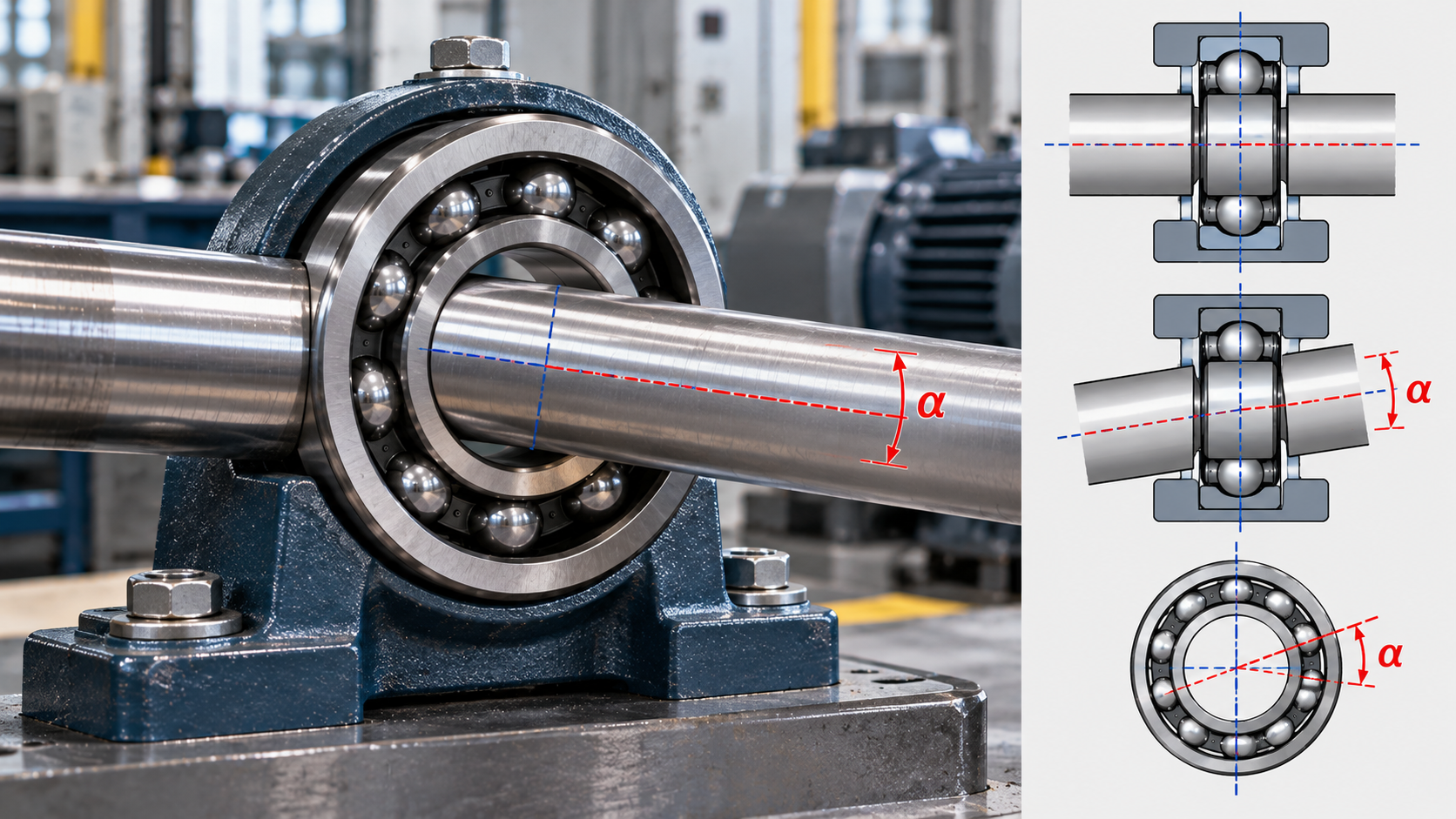
When the shaft axis and the housing axis are not parallel, the inner ring tilts relative to the outer ring. The balls no longer sit square in the groove. On one side of the bearing the ball rides up toward the shoulder, and on the other side it moves toward the open part of the groove.
The contact patch, which should be a wide ellipse spread along the raceway, shrinks and shifts to the edge. The same load now passes through a smaller area, so the contact stress climbs even though the load on the shaft has not changed.
The Load Moves to the Groove Edge
That edge is where the damage starts. A polished band near the shoulder, a narrow wear track, and fine spalling at the track end are the marks of a bearing that spent its life tilted. The rest of the raceway looks almost new, which is the clue.
Our deep groove ball bearing range is ground with a groove radius matched to the ball, so the margin for tilt is real but small. It is a margin for manufacturing tolerance, not for a housing face that was never machined square.
02How Much a Deep Groove Bearing Tolerates
Catalog allowances for a deep groove bearing are quoted in arcminutes, not degrees. That is the honest scale. A bearing that tolerates a whole degree of tilt would need a spherical outer ring, which a deep groove bearing does not have.
Two rules follow from that. First, treat any allowance you read as a maximum under light load, not a target to design to. Second, if the machine needs more than a few arcminutes, the bearing is the wrong place to solve it.
The practical number to work with is the one on your drawing, and if the drawing is silent, ask us for the figure that goes with the size and the clearance group. A 6205 bearing and a thin section bearing of the same bore do not share the same allowance, and guessing between them is how machines get built twice.
03What It Looks Like When the Limit Is Passed
The symptoms arrive in a rough order. Heat first, then noise, then the seal, then the raceway.
• Heat at one side of the housing. The loaded edge does more work, so the housing runs warmer near that side. A hand on the housing at four points will show it.
• A tone that comes and goes. The tilted contact makes the bearing sing at a frequency tied to shaft speed, and the tone changes with load rather than with speed alone.
• Seal lips that wear on one arc. The lip tracks a circle that is no longer concentric, so it wears hard on one side and lightly on the other.
• Edge spalling with a clean raceway. The raceway center looks untouched while the shoulder shows distress. That pattern is the signature of misalignment rather than overload.
None of these are cured by a different grease or a tighter fit. They are cured by putting the two axes back in line.
04The Common Causes on Real Machines
Housing Face Out of Square
This is the most common cause and the easiest to miss. The bore is round, the diameter is right, and the face that the bearing seats against is not square to the bore. The bearing sits true in the bore and tilted against the face, or the cover pushes it over when the bolts are tightened.
Shaft Deflection Under Load
A long shaft between two bearings bends under its own weight and under belt or gear loads. The bearings stay square to the shaft, but the shaft is no longer straight at the bearing positions, so the rings tilt relative to each other. Nothing in the bearing can fix a shaft that bends.
Coupling Alignment
A machine with a motor on one side and a gearbox on the other carries the alignment error of the coupling into both bearing sets. Angular error at the coupling shows up as tilt at the bearings, and it is often the only cause that can be corrected without dismantling the machine.
The 6305 bearing at 25 x 62 x 17 mm is rated 22.5 kN dynamic and 11.6 kN static. It has enough capacity to hide a misalignment problem for a long time, which is exactly why the fault is usually found late.
05Measuring It in the Plant
You do not need a laser to find most of these. A feeler gauge, a dial indicator, and a straight edge cover the four checks below.
1. Check the housing face with a feeler gauge. Seat the bearing, then try the gauge at four points around the face. A gap that appears on one side and closes on the opposite side is an out of square face.
2. Run a dial indicator on the housing face. With the base on the shaft, sweep the indicator across the face while turning the shaft. The total reading is the squareness error at that diameter.
3. Measure shaft deflection at mid span. Support the shaft as it runs, load it as it runs in service, and read the movement at the middle. Deflection at the bearing position follows from that.
4. Check the coupling in two planes. Angular and parallel error both count. Correct the angular error first, then the parallel offset, and recheck both after tightening the foundation bolts.
Write the numbers down with the machine cold. A hot machine has already moved, and a reading at running temperature mixes thermal growth into the result.
If the machine is new, compare the readings with the installation record from our guide to how to mount a deep groove ball bearing. A machine that was square at installation and is not square a year later has a foundation or thermal problem, not a bearing problem.
06When to Machine the Fit and When to Change the Design
Rework the fit when the error is in the housing and the machine is otherwise sound. A face that is out of square by more than the drawing allows can be machined, provided there is material to take and the bearing seat stays where it is.
Change the design when the error comes from the shaft or the frame. A shaft that deflects too far at the bearing position needs a third support or a larger diameter. A frame that twists under load needs stiffness, and no amount of machining on the bearing seat will hold it.
One more case belongs here. If the machine is built with a deliberate angular offset, such as a pulley on a spring frame, the bearing choice has to match that intent. A deep groove bearing in a mount that moves shows up as edge wear within a season.
07What Self Aligning Bearings Do
Self aligning ball bearings have two rows of balls running on a common spherical raceway in the outer ring, so the inner ring can tilt while the outer ring stays put. They exist for exactly this problem, and they trade radial capacity and speed for that freedom.
We do not build them, and we do not offer them as a deep groove substitute. If a machine needs that much tilt, the honest answer is a self aligning bearing from a supplier who makes them, or a redesign that removes the tilt.
What we can do is tell you which case you are in. Send the measured error and the shaft length, and we will say whether a deep groove bearing has the allowance or the design needs something else.
08Preventing It at Assembly
Most misalignment is created during assembly by a sequence that skips one check. The four steps below are the ones that catch it before the machine runs.
• Clean and check the seating face. A burr or a chip under the outer ring tilts it by more than the bearing allowance, and it takes one minute to find with a straight edge.
• Seat on the ring that is being fitted. Press on the inner ring when fitting to the shaft and on the outer ring when fitting to the housing. Driving through the balls tilts the rings and damages the raceway.
• Torque covers in a cross pattern. A cover tightened on one side first pulls the outer ring over. Two passes, opposite bolts, half torque then full torque.
• Recheck after the first run. Run to temperature, stop, and repeat the face check. Thermal growth moves housings, and the first run is when that shows.
Sizes such as the 6004 bearing at 20 x 42 x 12 mm are often fitted by hand into light housings where a burr is easy to miss. Run a finger around the seat before the bearing goes in, every time.
09What to Send With an Inquiry
When a machine keeps eating bearings at one position, the bearing is usually the last thing to change. The data below lets us tell you whether the application is asking too much of a deep groove bearing.
| Item | What we need | Why |
|---|---|---|
| Bearing position | Which end of the shaft, drive or non drive | The two ends rarely carry the same error |
| Measured tilt | Total indicator reading and the diameter it was taken at | Converts to an angle we can compare with the allowance |
| Shaft span | Distance between bearing centers | Deflection and tilt are linked to span |
| Load direction | Belt pull, gear thrust, or pure radial | Sets how much of the allowance the duty already uses |
| Running temperature | Housing temperature at steady state | Thermal growth changes alignment after start up |
| Failure pattern | Photos of the raceway and the seal track | Edge wear and a clean center confirm the diagnosis |
10Questions Buyers Ask
How much misalignment can a deep groove bearing take?
Only a small amount, quoted in arcminutes in most catalogs. Treat that figure as a maximum for a light load, not as a design target, and confirm it for the size and clearance group you ordered.
Will a wider bearing tolerate more tilt?
Not in the way buyers hope. A wider bearing spreads the load over a longer contact, but the groove geometry still limits how far the rings can tilt before the ball climbs the shoulder.
Can I correct misalignment with a shim under the housing?
Sometimes, when the error is small and the housing foot is accessible. Shim the foot, recheck the face with a dial indicator, and confirm the coupling alignment after the shim goes in.
Does misalignment always show as noise?
No. A lightly loaded machine can run quietly for a long time while the edge of the groove takes the load. Heat at one side of the housing is often the first sign.
Do you supply self aligning bearings?
No. We build deep groove and crossed roller bearings. If the measured tilt is beyond what a deep groove bearing allows, we will say so rather than sell a bearing that will not hold.
A Bearing That Keeps Failing at One Position
Send the measurements and a photo of the raceway. If the cause is alignment we will point at the face or the shaft, and if the duty needs a different bearing we will say that too.