
 English
 French
 German
Deep Groove Ball Bearing Axial Clearance in the Field
Field Measurement
Deep groove ball bearing axial clearance is the movement you feel when you push a shaft one way and pull it back. In a catalog it is a number in a table. On a machine it is the difference between a shaft that sits where the drawing says and one that walks under load.
This page is about the second version. It covers what the number means, how to read it with a dial indicator, how shims and preload move it, and what a machine looks like when the setting is wrong. The clearance grades have their own guide, so this one stays on the bench.
01What Axial Clearance Means on the Bench
Axial clearance, also called end play, is the total distance the shaft can move along its own axis when the bearing is installed and no external load is applied. The inner ring moves relative to the outer ring by that amount, and everything bolted to the shaft moves with it.
That movement exists because the balls sit in a groove that is slightly wider than they are. The gap is built in on purpose. It gives the bearing room for thermal growth, for a small amount of misalignment, and for the film of grease that has to form between ball and raceway.
Our deep groove ball bearing range is supplied in the standard clearance groups from the 600 series up to the 6900 series, so the axial number you measure always traces back to a radial group in the catalog.
02What Counts as Normal
There is no single normal number. The axial clearance of a deep groove bearing follows the radial clearance group, and the group is chosen for the fit and the temperature rise of the application. A bearing in a tight housing on a hot shaft needs more internal room than one running cool in a loose housing.
Two practical markers. If the shaft moves far enough that you feel a knock by hand, the setting is loose enough to measure. If it will not move at all when you push it, the bearing is preloaded or the fits are too tight, and both are worth stopping for.
The Drawing Wins Over the Rule of Thumb
Every machine has a number on the drawing, even if nobody has looked at it in years. Use it. A rule of thumb borrowed from another machine will be wrong by the amount that the two machines differ in fit, speed, and running temperature.
When the drawing is missing, ask the bearing supplier for the axial figure that goes with the clearance group you ordered. That is a published value, not a guess, and it is the number to measure against.
03Measuring End Play With a Dial Indicator
A dial indicator is the only tool that gives a number you can record. Feeler gauges tell you that a gap exists. They do not tell you how big it is, and on a bearing they cannot reach the surfaces that matter.
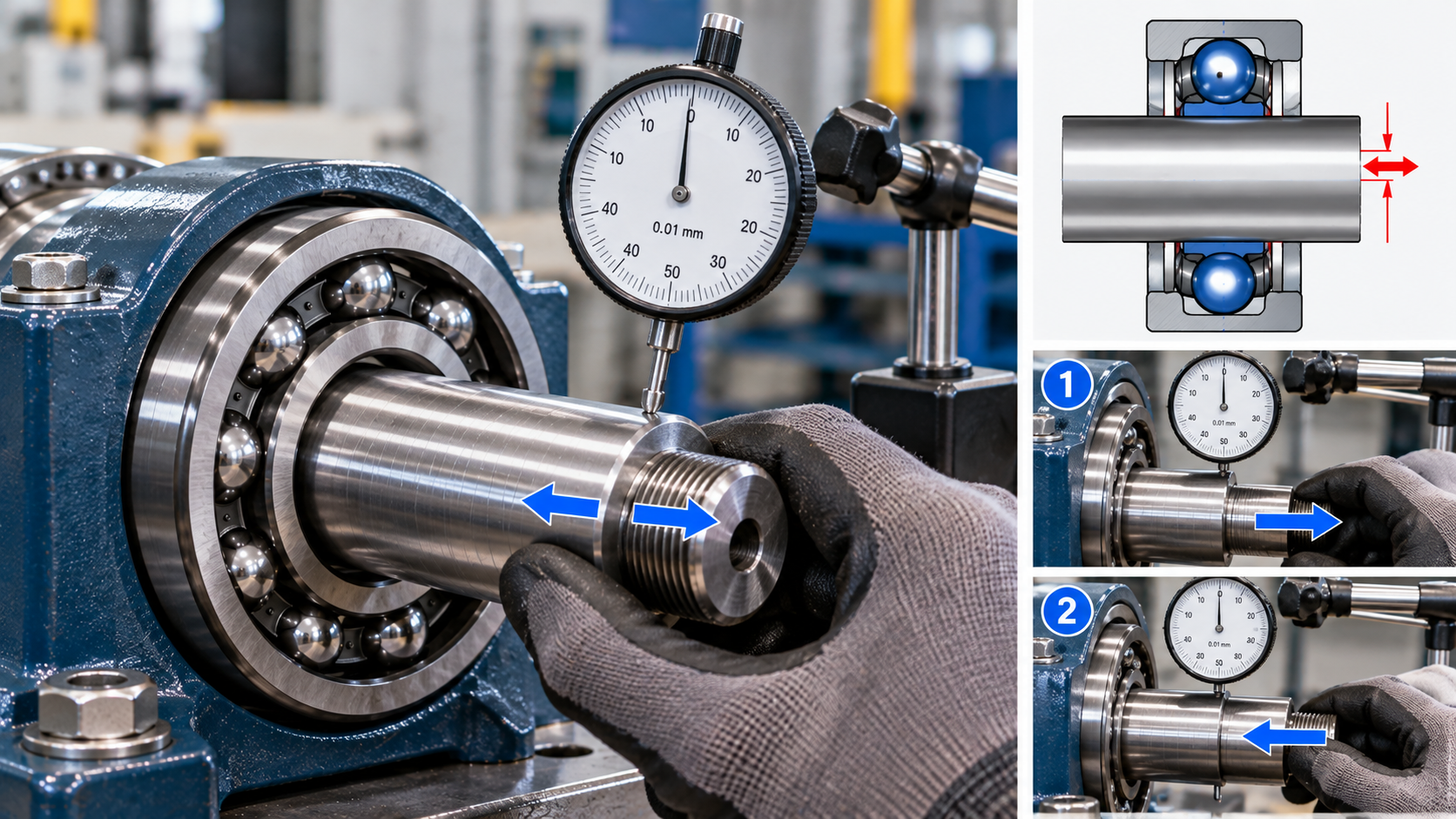
1. Mount the base on the housing. Put the magnetic base on a machined face of the housing, not on a guard or a cover. The indicator plunger touches the end of the shaft or a machined shoulder.
2. Zero the indicator. Push the shaft fully one way, set the dial to zero, and keep the plunger in contact for the rest of the check.
3. Push, release, read. Push the shaft the other way by hand or with a lever, let it settle, and read the dial. That reading is the total axial movement.
4. Repeat three times. Take three readings and use the average. A single reading catches the moment the shaft sticks in its fit rather than the clearance in the bearing.
5. Turn the shaft 90 degrees and repeat. The second position catches a cocked ring or a burr on the shoulder. If the two positions disagree, fix the fit before you record anything.
Fixtures and Load During the Reading
Do the check with the machine cold and unloaded. A warm bearing has already grown, and a belt or coupling that is still tensioned will hold the shaft against one side of the clearance.
If the shaft is heavy, support it so its own weight does not sit on one raceway. Gravity does not change the clearance, but it does change which side of it the shaft rests on when you zero the dial.
04Reading the Number Against the Radial Group
Axial clearance and radial clearance are two views of the same internal gap. Open up the radial clearance and the axial movement grows with it, which is why the axial figure is never quoted alone.
The practical use of this is simple. When the measured axial number is larger than the drawing allows, check the marking on the bearing before you blame the fit. A looser group fitted by mistake looks exactly like a worn bearing on the dial.
The group definitions and the ranges behind them are set out in our guide to bearing internal clearance. What matters here is the link between that table and the number on your dial.
05How Shims and Preload Change It
Clearance is set by the distance between the two bearing positions, so anything that changes that distance changes the clearance. A shim under a cover, a spacer between two inner rings, or the grind on a shoulder all move the number.
Adding a shim between the outer ring and its cover pushes the two rings apart and opens the clearance. Removing a shim closes it. On a shaft with two bearings, the pair works against each other, and the shim stack between the cover and the outer ring is the usual adjustment point.
What Preload Costs You
Preload is negative clearance. Take out all the axial movement and keep going, and the balls are held against both raceways before any load arrives. That removes the shaft movement and stiffens the assembly, and it also removes the margin that the bearing had for thermal growth.
A preloaded deep groove bearing runs hotter than one with a small clearance. If the shaft grows more than the preload allows, the load climbs fast and the bearing fails at the shoulders. Preload belongs on a duty that needs stiffness, not on every shaft.
06Too Much Clearance on a Running Machine
A loose setting shows up in four ways, and most maintenance teams see the first one long before they measure anything.
• The shaft knocks. A dull knock at each start, stop, or load change is the shaft crossing the clearance and hitting the other side.
• Position drifts. A tool, a sensor, or a belt pulley that will not stay where it was set, because the whole shaft is moving along its axis.
• Noise at low speed. Rattling or ticking that disappears as speed climbs and the balls stay loaded on one side.
• Seal lips wear unevenly. The seal follows the shaft as it moves, so the lip wears on one face and the track widens.
None of these are bearing defects. They are setting defects, and the fix is a shim or the right clearance group, not a new bearing.
07Too Little Clearance
A tight setting is harder to spot because the machine often runs quietly at first. The evidence builds as heat, and heat is what finally gets noticed.
• The housing runs warm within minutes. A bearing with no room to grow loads itself as soon as the shaft reaches running temperature.
• Grease turns dark early. The film breaks down at the contact, and the grease at the raceway edge shows it before the whole bearing does.
• The cage starts to rub. With the balls held tight, the retainer takes load it was never meant to carry.
• Life falls short of the calculation. A bearing that should last a full service interval fails at a fraction of it, with no visible overload on the machine.
If the axial movement measures zero on a cold machine, check heat next. A rise that keeps climbing after the first hour points at the setting, not the lubricant.
08Setting It During Assembly
Setting clearance is a sequence, not one adjustment. Follow it in order and the number will hold.
1. Fit both bearings dry first. Measure the axial movement with no shims and no cover torque, and write the number down. That is your starting point.
2. Add the shim for the target. The difference between the dry reading and the drawing target is the shim thickness you need, allowing for cover compression.
3. Torque the cover in steps. Snug, then half torque, then full torque, checking the dial at each step. A cover that pulls the outer ring square will change the reading as it tightens.
4. Check hot and cold. Record the cold number, run the machine to temperature, stop it, and read again within a minute. The difference tells you how much of the clearance the machine uses up in service.
Bearings such as the 6204 bearing at 20 x 47 x 14 mm sit in housings where a thin shim makes the difference, so keep shim stock in steps of a hundredth of a millimeter on the bench rather than trimming by hand.
09Recording the Result
A reading that is not written down gets taken again next year. Six fields on the job sheet are enough.
| Field | What to write | Why it matters |
|---|---|---|
| Bearing size and marking | Size, seal type, clearance group | Tells the next fitter what was actually installed |
| Cold reading | Average of three readings, one decimal place finer than the drawing | The baseline for the trend |
| Second position reading | Reading taken 90 degrees round the shaft | Catches a cocked ring |
| Hot reading | Reading taken within a minute of stopping | Shows how much clearance the machine uses |
| Shim stack | Total thickness and number of shims | Makes the setting repeatable |
| Ambient and housing temperature | Both, with the time of day | Explains a reading that looks odd later |
Why a Cold Reading Is Not a Running Reading
A 6304 bearing at 20 x 52 x 15 mm is rated 16.0 kN dynamic and 7.88 kN static. It carries that load for years with a correct setting and fails in months with a tight one. The rating does not change. The setting does.
10Questions Buyers Ask
Is axial clearance the same as end play?
Yes. End play is the shop floor name for the same measurement. Both mean the total axial movement of the shaft relative to the housing with no load applied.
Can I measure it with a feeler gauge?
You can confirm that a gap exists, but not its size with any accuracy. A dial indicator on the shaft end is the only method that gives a number worth recording.
Does a sealed bearing have the same clearance as an open one?
The internal clearance group is the same. The seal adds drag, which is why a sealed 6305 bearing is rated 5,500 RPM against 9,000 RPM for the open version, but the axial movement you measure does not change.
Why does my reading change between cold and hot?
The shaft grows faster than the housing, so the clearance the machine had when cold is partly used up at running temperature. That is why the cold setting is not the running setting.
Should I preload a deep groove bearing to remove the movement?
Only if the duty needs the shaft held to a tight axial position and the thermal growth has been allowed for. Otherwise a small clearance is the safer setting.
Measured a Number You Are Not Sure About
Send the bearing size, the reading, and the running temperature. We will tell you whether it sits inside the group you ordered and what to change if it does not.