


Crossed Roller Bearings

Crossed roller bearings arrange cylindrical rollers at 90-degree alternating angles in V-shaped raceways, with each roller making line contact across both inner and outer rings. This configuration allows a single bearing to support radial loads, axial loads in both directions, and overturning moment loads simultaneously — a capability that normally requires multiple bearing sets. The result is three to five times the moment stiffness of an equivalent ball bearing.

Yuanhe specializes in RAU series crossed roller bearings. The RAU design features integrated inner and outer rings — a one-piece construction with no split rings — which simplifies mounting, improves structural rigidity, and eliminates the assembly clearance issues common in split-ring designs. Rollers are packed at high density into the V-groove raceway, secured by a spacer retainer, and delivered with factory-set preload. No field adjustment is needed. The integrated-ring architecture delivers consistent preload and runout accuracy from the first installation.

Available from 20mm to 350mm bore, with standard precision grades P5, P4, and P2. The thin rectangular cross-section keeps overall height to a minimum, making RAU bearings the specified choice for semiconductor wafer handlers, medical CT and MRI gantries, precision rotary measurement stages, and industrial robot joints where axial space is the binding constraint. Materials are GCr15 bearing steel through-hardened to HRC 60-64, with stainless steel for corrosive environments. Every bearing ships with dimensional inspection data: bore tolerance, radial runout, and assembly height verified at four quadrant positions.

Designs And Variants

RAU series: integrated inner and outer rings, spacer retainer, thin rectangular cross-section. Bore range 20mm to 350mm. Core product line for precision rotary applications where mounting simplicity and consistent preload matter.
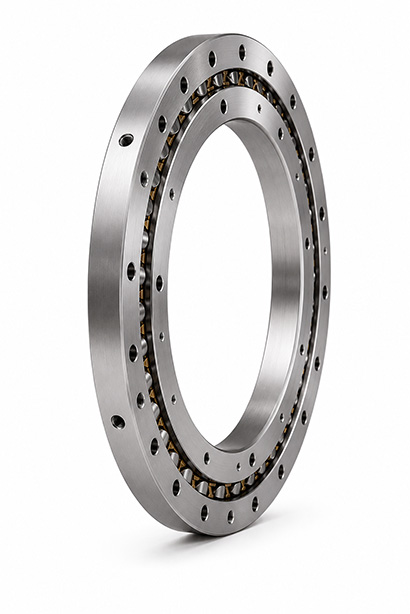
Crossed Roller Bearings
Shaft Diameter Model No. Main
Dimensions
Shoulder
Dimensions
Basic Rated
Radial Load
Mass
Inner
Diameter(d)
Outer
Diameter(D)
Roller Pitch
Diameter(dp)
Width
(BB1)
Lubrication
Hole(d0)
r
min
ds
max
Dh
min
C
kN
C0
kN
g
10 RAU 1005 10 21 14.7 5 1 0.15 12.5 17 1.12 0.809 9
15 RAU 1505 15 26 19.7 5 1 0.15 17.5 22 1.32 1.10 12
20 RAU 2005 20 31 24.7 5 1 0.15 22.5 27 1.49 1.40 15
30 RAU 3005 30 41 34.7 5 1 0.15 32.5 37 1.89 2.14 21
40 RAU 4005 40 51 44.7 5 1 0.15 42.5 47 2.14 2.74 27
50 RAU 5005 50 61 54.7 5 1 0.15 52.5 57 2.43 3.49 32
60 RAU 6005 60 71 64.7 5 1 0.15 62.5 67 2.63 4.09 38
70 RAU 7005 70 81 74.7 5 1 0.15 72.5 77 2.81 4.68 44
80 RAU 8005 80 91 84.7 5 1 0.15 82.5 87 3.05 5.43 50
90 RAU 9005 90 101 94.7 5 1 0.15 92.5 97 3.19 6.03 56
100 RAU 10005 100 111 104.7 5 1 0.15 102.5 107 3.37 6.63 61
Shaft Diameter Model No. Main
Dimensions
Shoulder
Dimensions
Basic Rated
Radial Load
Mass
Inner
Diameter(d)
Outer
Diameter(D)
Roller Pitch
Diameter(dp)
Width
(BB1)
Lubrication
Hole(d0)
r
min
ds
max
Dh
min
C
kN
C0
kN
g
50 RAU 5008 50 66 57 8 1.5 0.5 53.5 60.5 5.10 7.19 0.08
60 RAU 6008 60 76 67 8 1.5 0.5 63.5 70.5 5.68 8.68 0.09
70 RAU 7008 70 86 77 8 1.5 0.5 73.5 80.5 5.98 9.80 0.1
80 RAU 8008 80 96 87 8 1.5 0.5 83.5 90.5 6.37 11.3 0.11
90 RAU 9008 90 106 97 8 1.5 0.5 93.5 100.5 6.76 12.4 0.12
100 RAU 10008 100 116 107 8 1.5 0.5 103.5 110.5 7.15 13.9 0.14
110 RAU 11008 110 126 117 8 1.5 0.5 113.5 120.5 7.45 15 0.15
120 RAU 12008 120 136 127 8 1.5 0.5 123.5 130.5 7.84 16.5 0.17
130 RAU 13008 130 146 137 8 1.5 0.5 133.5 140.5 7.94 17.6 0.18
140 RAU 14008 140 156 147 8 1.5 0.5 143.5 150.5 8.33 19.1 0.19
150 RAU 15008 150 166 157 8 1.5 0.5 153.5 160.5 8.82 20.6 0.2
Shaft Diameter Model No. Main
Dimensions
Shoulder
Dimensions
Basic Rated
Radial Load
Mass
Inner
Diameter(d)
Outer
Diameter(D)
Roller Pitch
Diameter(dp)
Width
(BB1)
Lubrication
Hole(d0)
r
min
ds
max
Dh
min
C
kN
C0
kN
g
160 RAU 16013 160 186 172 13 2 0.8 165 179 23.3 44.9 0.59
170 RAU 17013 170 196 182 13 2 0.8 175 189 23.5 46.5 0.64
180 RAU 18013 180 206 192 13 2 0.8 185 199 24.5 49.8 0.68
190 RAU 19013 190 216 202 13 2 0.8 195 209 24.9 51.5 0.69
200 RAU 20013 200 226 212 13 2 0.8 205 219 25.8 54.7 0.71

Industries We Service

Crossed roller bearings combine high moment stiffness, compact one-piece ring construction, and factory-set preload into a single bearing unit. Compared with paired angular contact or thrust-plus-radial arrangements, they reduce part count, eliminate field preload adjustment, and fit into roughly half the axial space.

Robot joints
Rotary indexing tables
Medical imaging equipment
Optical inspection systems
Automation equipment

Looking for Custom Bearings or OEM Solutions?

Share your specific requirements to get a quick and accurate quotation from our factory.

Frequently Asked Questions

What is a crossed roller bearing and how does it work?

Cylindrical rollers are arranged at 90-degree alternating angles in V-shaped raceways. Each roller makes line contact with the inner and outer rings. One roller takes radial load plus axial load in one direction. The adjacent roller at 90 degrees takes radial load plus axial load in the opposite direction. Together they resist overturning moment. A single crossed roller bearing handles radial, axial, and moment loads simultaneously, a combination that normally requires two angular contact bearings or a thrust-plus-radial bearing pair.

What is the difference between RAU, RB, and RE crossed roller bearings?

RAU bearings use integrated one-piece inner and outer rings with a spacer retainer. Both rings are solid with no split. RB bearings have a split outer ring that clamps together after roller installation, with an integrated inner ring. RE bearings have a split inner ring with an integrated outer ring. RAU is the simplest to mount because there are no split-ring bolts to torque and no assembly clearance to manage. RB is common for inner-ring rotation applications. RE is used when the outer ring rotates with the housing.

What loads can a crossed roller bearing handle?

Radial load, axial load in both directions, and overturning moment load, all in a single bearing unit. Moment stiffness runs three to five times higher than an equivalent-diameter ball bearing. This is because cylindrical rollers make line contact across a rectangular contact zone, while ball bearings concentrate load at an elliptical point contact. The exact load ratings depend on bore size and roller count. Provide your radial, axial, and moment load values for a bearing selection recommendation.

What precision grades are available?

P5 (ISO) for general industrial positioning. P4 for CNC machine tools, collaborative robots, and CT gantries where runout under 0.005mm matters. P2 for metrology-grade rotary stages, optical inspection, and surgical robots with runout under 0.002mm. The precision grade directly affects bearing cost. Specify the grade that matches the system positioning requirement rather than defaulting to the highest available.

What applications use crossed roller bearings?

Industrial robot wrist, elbow, and shoulder joints. CNC rotary tables and trunnion tables. Medical CT scanner gantries, MRI patient tables, and surgical C-arms. Semiconductor wafer transfer robots and inspection stages. Assembly automation dial indexers and rotary positioners. Optical inspection and CMM rotary axes. Radar antenna azimuth and elevation axes. Any application where a rotating platform must stay flat under off-center loads.

Do RAU crossed roller bearings need field preload adjustment?

No. RAU bearings ship with factory-set preload. The spacer retainer between rollers fixes internal clearance during bearing assembly. The one-piece rings then lock this preload mechanically. There is no locknut to torque, no wave spring to set, no shim stack to adjust. The bearing bolts into the housing and runs. Running torque and stiffness stay consistent from first installation through the bearing’s service life.

What materials are available?

Standard material is GCr15 bearing steel through-hardened to HRC 60-64. GCr15SiMn for larger cross-sections. Stainless steel for corrosive environments and MRI applications where ferromagnetic materials cannot be used. Ceramic rolling elements are available for MRI and vacuum applications. Cages are machined brass for high-speed and high-temperature operation, or polyamide for standard industrial applications. Chrome plating on rings is available for added corrosion resistance.

What is the minimum order quantity and lead time?

One prototype. Yuanhe manufactures to your drawing or specification with full dimensional inspection documentation: bore tolerance, radial runout, and assembly height measured at four quadrant positi

Looking for a reliable OEM manufacturer?

Talk to Our Engineering Team