
 English
 French
 German
Deep Groove Ball Bearing vs Angular Contact Ball Bearing
Comparison
The deep groove ball bearing vs angular contact question shows up whenever a shaft has to be held in place while something pushes against it. Both bearings roll on balls. Both often fit the same housing bore, and both are stocked in the same size ranges.
The difference appears when the axial load arrives. This page compares the two on the six points that decide a purchase order, then hands you a table you can read from the duty instead of from the catalog. The sizes quoted here come from our own deep groove range, from the 6004 up through the 6205 and the 6305.
01The Short Answer
If the axial load is a small share of the radial load and the shaft is short, a deep groove bearing does the job and costs less. If the axial load is close to the radial load, if the shaft position has to hold to a tight number, or if the machine runs fast with preload, you need an angular contact bearing in a pair.
That rule covers most cases. The expensive mistakes happen in both directions. Buyers order a matched angular contact pair for a duty a single deep groove bearing would handle, then pay twice for the bearing and again for the mounting work. Others buy a deep groove bearing for a duty that needs axial location and lose the shaft position after a few months of running.
Our deep groove ball bearing range covers the 600 to 6900 series in ABEC-1 through ABEC-5, in chrome steel and stainless steel. Every size in it carries axial load in both directions, which is the property that makes the comparison worth having.
02What Each Bearing Does With Axial Load
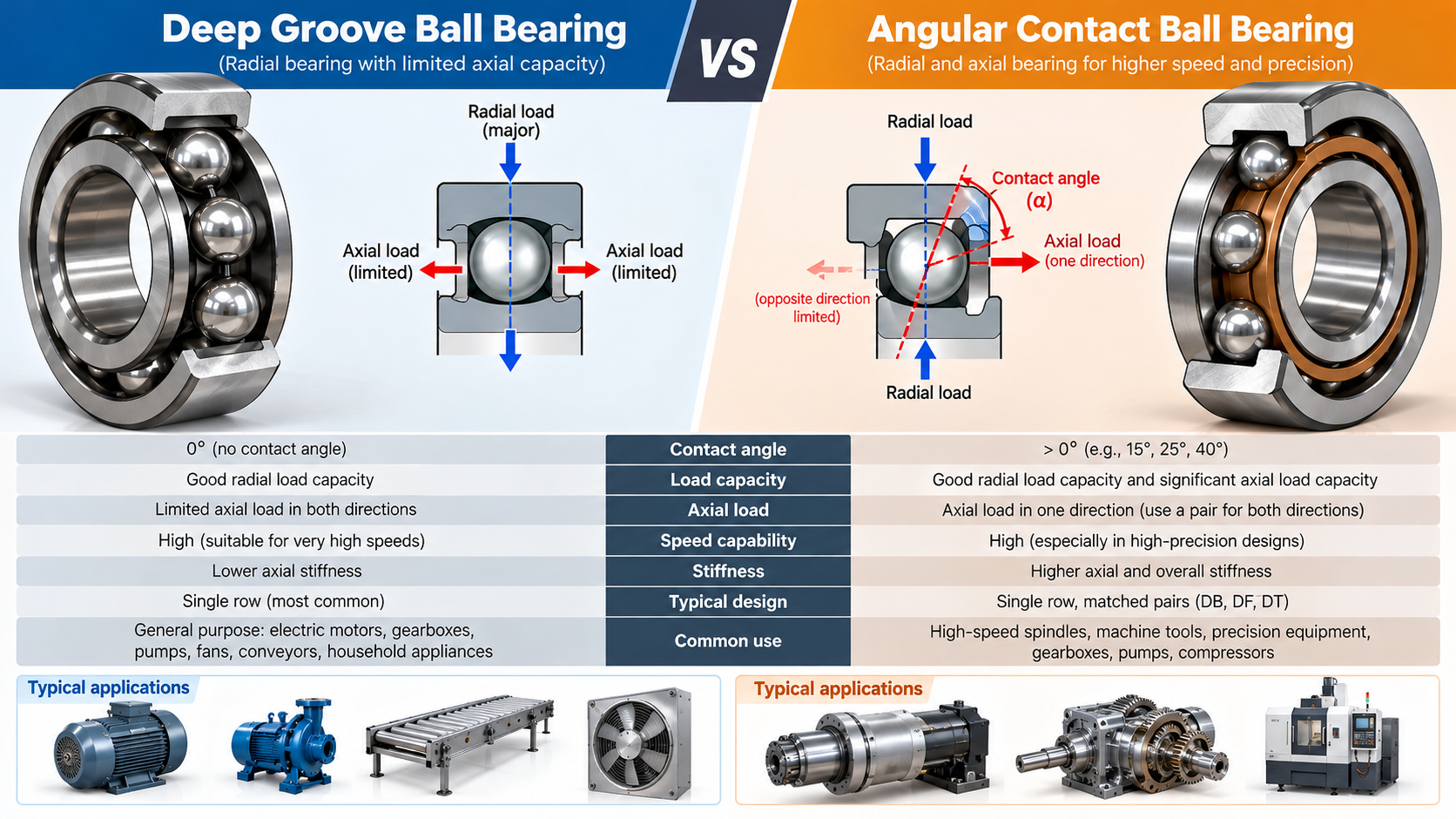
A deep groove bearing has a continuous raceway shoulder on both sides of both rings. The balls sit in a groove that wraps around them, so when the shaft pushes one way, the balls climb the shoulder and pass the force into the housing. Push the other way and the opposite shoulder takes it. One bearing handles thrust in both directions.
An angular contact bearing has one shoulder ground away on the outer ring. The contact line between ball and raceway sits at a fixed angle to the axis, and the bearing can only take thrust that pushes the balls up that line. Reverse the load and the balls try to leave the raceway. That is why single row angular contact bearings are almost always used in pairs facing each other.
Where the Deep Groove Groove Runs Out
Axial capacity in a deep groove bearing is a fraction of its radial capacity, and that fraction falls as the load grows. The catalog publishes an axial load line for each size, and the honest way to use it is to read that line rather than assume the bearing can share the load evenly.
Push a deep groove bearing past that line and the ball contact moves toward the edge of the groove. The loaded area shrinks, contact stress climbs, and the raceway starts to show a narrow polished band near the shoulder. It still turns. It just stops lasting.
03Contact Angle and What It Changes
Contact angle is the number that separates the two families. A 15 degree bearing puts its balls closer to the radial direction, so it carries radial load well and runs at high speed. A 40 degree bearing tilts the contact line toward the axis, which buys axial capacity at the cost of radial capacity and speed.
Deep groove bearings do not have a useful fixed angle. At rest the nominal angle is close to zero, and it opens up as axial load is applied. That is fine for locating a shaft. It is not a number you can design a preload schedule around.
The size you pick sets the ceiling before the angle does. A 6204 bearing is rated 12.8 kN dynamic and 6.55 kN static with a 16,000 RPM limit in open or shielded form. A 40 degree angular contact bearing of the same bore trades radial rating for thrust capacity, and it gives up speed to do it.
04Stiffness and Deflection
Stiffness is where the two bearings feel different on a real machine. A deep groove bearing carries axial load through a contact angle that only exists while the load is applied, so the shaft moves a little before the bearing takes up. For a fan or a conveyor pulley that movement is invisible.
For a tool spindle, a ballscrew support, or an encoder mount, that same movement is the error budget. A preloaded angular contact pair removes the axial play before the machine ever runs, so the shaft sits where the drawing says it sits and stays there as the load changes direction.
A 6205 bearing handles 14.0 kN dynamic and 7.85 kN static, and it will outlast most machines it is fitted to. It will not hold a 5 micron axial position under a reversing load. No single row deep groove bearing will.
05Speed Limits in Real Machines
Catalog speed for a deep groove bearing depends on the ball complement, the cage, the lubricant, and the seal. A 6305 bearing is listed at 9,000 RPM open or shielded and 5,500 RPM with two rubber seals. Same bearing, same load rating, 40 percent less speed because of the seal drag.
Angular contact bearings in a light preload pair run faster than most buyers expect, and 15 degree versions are the usual choice for high speed spindles. The preload has to be right. Too little and the balls skid. Too much and the contact stress turns the extra speed into heat.
The trap here is comparing two catalog numbers that were measured under different conditions. A sealed deep groove bearing against an open angular contact bearing is not a fair speed comparison, and it is the one buyers make most often.
06Mounting and Pairing
One Row Means One Direction
Angular contact bearings are mounted back to back, face to face, or in tandem. Back to back puts the load lines outside the bearing pair, which gives the widest support base and the best resistance to tilting. Face to face is used where the housing bore is short. Tandem is for one direction only, when a single bearing cannot carry the thrust.
Universal Pairing and Preload
A universal pair is ground so that any two bearings from the box will mate at the specified clearance or preload without matching or shimming. The marking on the rings tells you the arrangement. Do not mix a universal bearing with a standard single row bearing from another batch, and do not split a matched pair across two machines.
Preload is set by the bearing maker or by the spacer grind, not by tightening the locknut harder. Light preload suits high speed. Heavy preload suits stiffness. The mechanics of the arrangement are covered in our guide to how angular contact ball bearings work.
Deep groove mounting is simpler. One bearing locates the shaft and takes the thrust, the other floats in its housing so thermal growth does not load the pair. That floating fit is not a shortcut. It is the reason a two bearing deep groove shaft can run hot and still survive.
07The Decision Table by Duty
| Duty | Axial demand | Better fit | Why |
|---|---|---|---|
| Conveyor pulley, fan, blower | Light, one direction | Deep groove, single | Radial load dominates and the shaft is short |
| Centrifugal pump, small | Light to moderate | Deep groove, single | Seal choice matters more than the thrust line |
| Gearbox input shaft | Moderate, reversing | Deep groove pair or angular contact pair | Depends on helix thrust and shaft length |
| Machine tool spindle | Moderate, must hold position | Angular contact, preloaded pair | Axial stiffness sets the finished part size |
| Ballscrew support end | Moderate, reversing | Angular contact, back to back | Reversing thrust needs both directions |
| Vertical shaft with weight | Steady, one direction | Angular contact pair plus a locating shoulder | Constant thrust on one row |
| High speed servo motor | Light | Deep groove, light preload if needed | Speed and low drag come first |
Read the table from the duty. If two rows describe your machine, the tie breaker is shaft length. A long shaft between two deep groove bearings tilts under thrust, and no bearing choice fixes that.
Send the Duty and We Will Check the Choice
Tell us the radial load, the axial load, the speed, and the distance between bearings.
We will confirm whether a single deep groove bearing holds the position or whether the duty needs a preloaded pair.
If the answer is a deep groove size, we quote it with the seal and clearance you need. If it is not, we say so before you order.
08When the Deep Groove Bearing Is Enough
Most machines do not need an angular contact bearing. The list below covers the duties where a deep groove bearing is the right purchase and the extra cost of a pair buys nothing.
• Radial load is the main load. If axial load sits well under the radial figure, the groove shoulder is not working hard and a single bearing locates the shaft.
• The shaft is short and stiff. Short spans do not tilt much, so the small axial movement inside a deep groove bearing never turns into a visible position error.
• Speed comes from the seal, not the balls. Shielded and open versions run at catalog speed. A buyer who needs 2RS protection is choosing a lower speed either way.
09When You Have to Move to Angular Contact
Move up when any one of these is true. Two of them together and the decision is settled.
• Axial load approaches the radial load. The groove shoulder in a deep groove bearing is not built to carry that share for a full service life.
• Position error shows up in the product. Tolerance stack on a machined face, an encoder reading, or a belt tracking problem that will not settle.
• The load reverses. Reversing thrust walks a single row bearing and hammers the shoulder on both sides.
• You need stiffness at speed. A preloaded pair holds the shaft still while the speed stays high, which is what a spindle asks for.
The Cost Side of Each Choice
The cost is real. An angular contact pair costs more than one deep groove bearing, needs a matched set, and needs a housing that keeps the pair square. Budget for the mounting, not just the bearing.
10Questions Buyers Ask
Can a deep groove bearing replace an angular contact bearing?
Only where the axial load is a small share of the radial load and the shaft position is not tight. The bore and outside diameter often match, but the axial capacity and the stiffness do not.
Do angular contact bearings carry radial load at all?
Yes. A 40 degree bearing still carries radial load, just less of it than a deep groove bearing of the same size. A 15 degree bearing carries more radial load and less thrust.
Why are angular contact bearings sold in pairs?
A single row takes thrust in one direction only. Two rows facing each other take thrust both ways and let you set preload, which is what gives the pair its stiffness.
What do you need to quote the right one?
Bore size, radial load, axial load, speed, and the distance between the two bearing positions. Send those and the seal and clearance preference, and we will confirm the fit.
Comparing Two Options for One Shaft
Send the duty and the drawing. We build deep groove bearings from 600 to 6900 series and we will tell you plainly when the duty needs a different bearing instead.



Related Products