
 English
 French
 German
What Is a Ball Bearing and How Does It Work
What is a ball bearing, and why does it matter so much in a machine? It is one of those parts that disappears into the machine until it stops working. It carries the shaft, keeps it centered and lets it turn with almost no resistance. This guide explains what is inside one, how it takes load, the types you are most likely to be quoted, and how to order the right part the first time. It is written for buyers and maintenance engineers rather than for a design office.
What a Ball Bearing Is
What is a ball bearing? It is the part that lets a shaft spin inside a housing with very little drag. Hardened steel balls roll in grooves cut into two rings, so the load passes through rolling contact instead of sliding friction.
The idea sounds simple and the effect is large. Rolling resistance is far lower than sliding resistance, so the shaft needs less torque to start, runs cooler at speed, and holds its position instead of drifting. That is why the design appears in almost every machine with a rotating shaft, from a ceiling fan to a servo motor.
A ball bearing is also not one piece of steel. It is an assembly of rings, balls, a cage and usually a lubricant, held together as a single unit so it can be fitted without any assembly work at the machine.
The Parts Inside a Ball Bearing
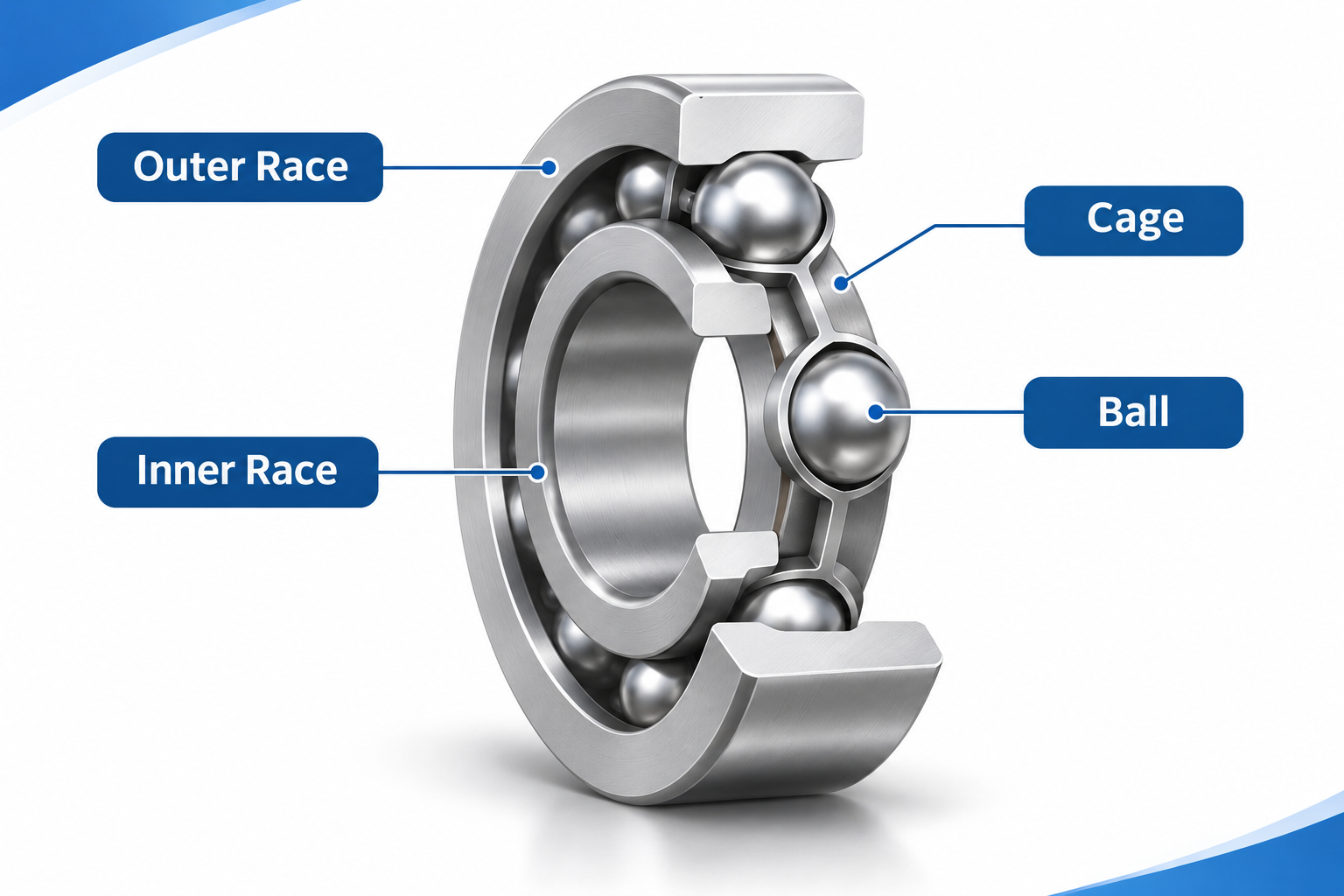
A deep groove ball bearing has five components doing different jobs. Knowing which one has failed tells you more about the cause than the failure itself.
- Outer ring. Sits in the housing and carries the load into the machine frame.
- Inner ring. Fits on the shaft and turns with it.
- Balls. Carry the load between the two rings and roll rather than slide.
- Cage. Keeps the balls evenly spaced so they do not crowd and rub.
- Seal or shield. Keeps dirt out and grease in, and in most cases is already fitted when the part arrives.
The Two Rings
Both rings carry a hardened, ground groove called the raceway, and that groove is where the balls run. The rings also set the boundary dimensions: bore (d), outer diameter (D) and width (B). Those three numbers are what a drawing or a catalogue row is built from, and they are what any replacement has to match before anything else is checked.
The Balls and the Cage
The balls carry the load. They are hardened and ground to a very tight roundness, because an out of round ball shows up as noise and vibration as soon as the shaft turns fast.
The cage holds the spacing. Steel, brass and nylon are the common materials, and the choice usually follows speed, temperature and how much shock the application delivers.
Seals, Shields and Grease
A metal shield (ZZ) keeps coarse dirt out and leaves a small gap, while a rubber seal (2RS) closes that gap and holds grease in more firmly. Sealed parts generally run slower than open ones of the same size, because the seal adds drag.
The lubricant is a separate decision from the metal. Grease is chosen for the temperature range and the speed, and the quantity matters as much as the type. Overfilling a housing is a common cause of hot running.
How a Ball Bearing Carries Load
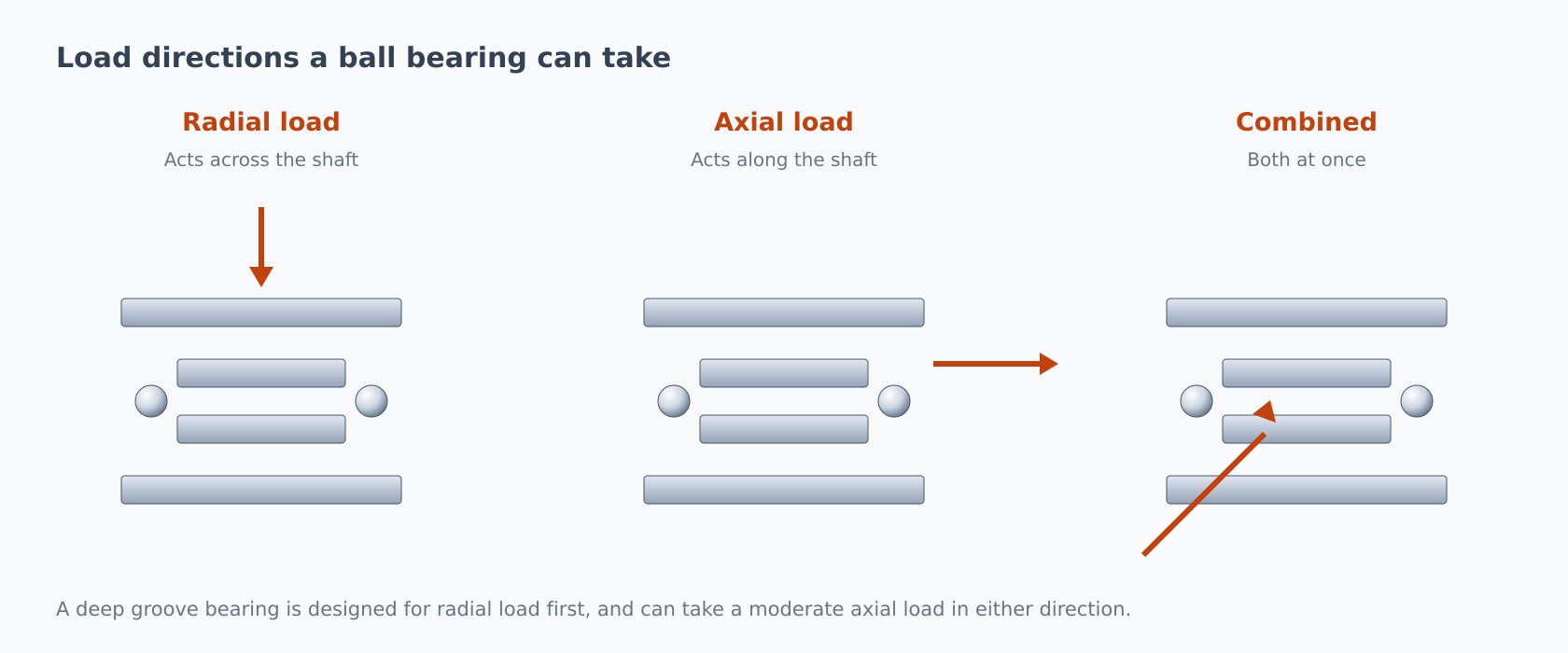
Load direction decides which bearing you can use. Three cases cover most applications, and the answer is different for each.
Radial Load
Radial load pushes across the shaft at a right angle to the center line. A belt pulling on a pulley, or the weight of a fan rotor, is radial load. Deep groove bearings are designed for this case first, and it is where they are strongest.
Axial Load
Axial load pushes along the shaft. A vertical pump shaft, or a gear with helical teeth, produces some axial load as a side effect. A deep groove bearing takes a moderate amount in either direction, which is one reason it is so widely used.
Combined Load
Most real applications load the bearing both ways at once. The deeper the groove and the larger the balls, the more axial load the part can accept alongside the radial load.
When axial load becomes the main load rather than an extra, the family changes. Angular contact and thrust bearings exist for that case, and using a deep groove part there is a common and expensive mistake.
Ball Bearings and Roller Bearings
A ball touches its raceway over a small patch. A roller touches along a line. That single difference explains most of what separates the two families.
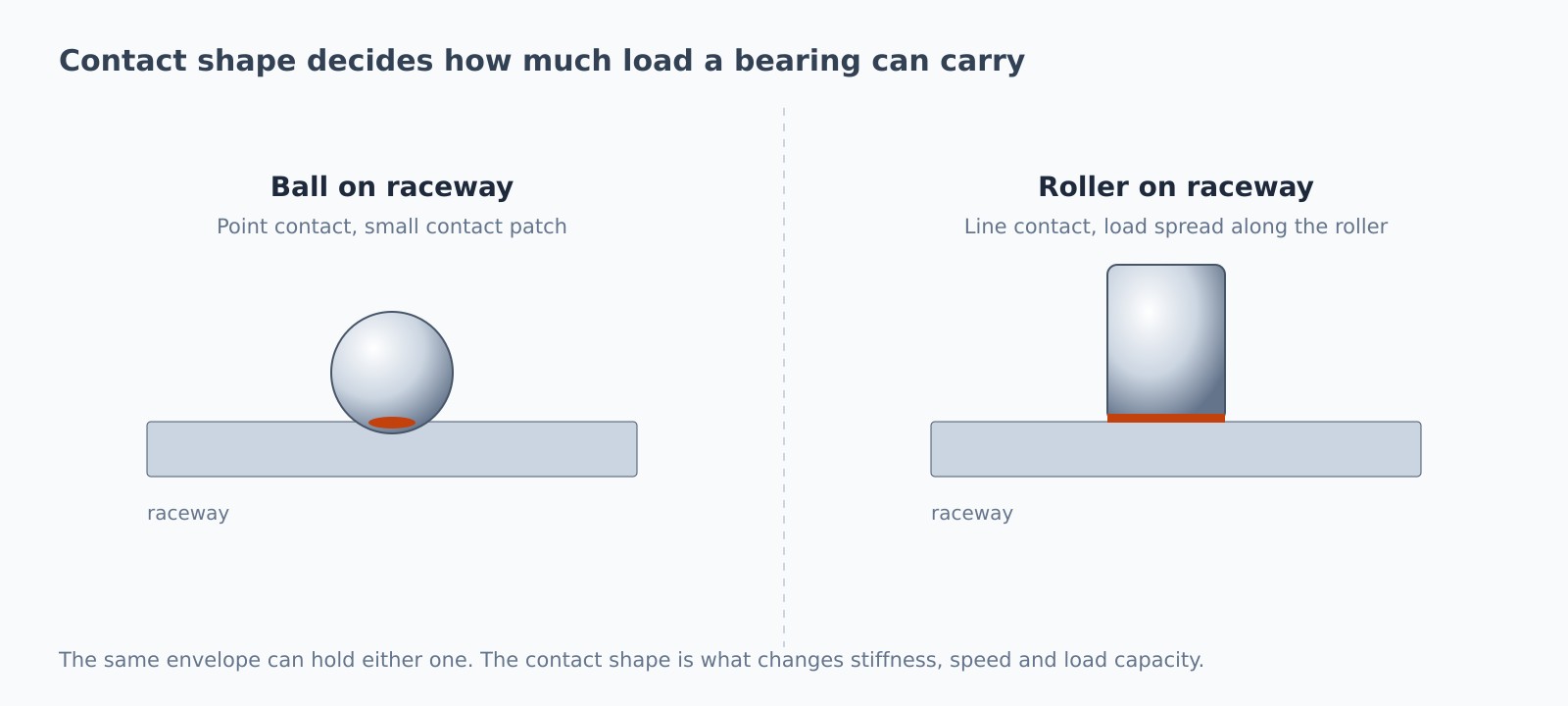
A ball bearing runs with less friction, so it suits higher speed and quieter running. A roller bearing spreads load over a longer contact, so it carries more load in the same envelope, but runs slower and is less forgiving of misalignment.
The practical rule is short. Moderate load with speed in the picture points to balls. Heavy load with modest speed points to rollers. When both are heavy, the answer is usually a larger envelope rather than a cleverer bearing.
Types of Ball Bearings
Five families cover most of what a buyer will be offered. Each is a different answer to the same question about load direction, speed and space.
Deep Groove Ball Bearings
The default choice. Symmetrical grooves, a wide size range, and the ability to take radial load plus a moderate axial load in both directions. Most of the deep groove ball bearings sold for motors, pumps and conveyors come from this family.
Angular Contact Ball Bearings
The rings are offset so the balls meet the raceway at an angle. That makes the part stiffer in one axial direction, which is why they are normally used in pairs facing each other, or in a matched set.
Thrust Ball Bearings
Built for axial load only, with two flat washers and a ball set between them. They do not guide the shaft, so they work alongside a radial bearing rather than instead of one.
Self-Aligning Ball Bearings
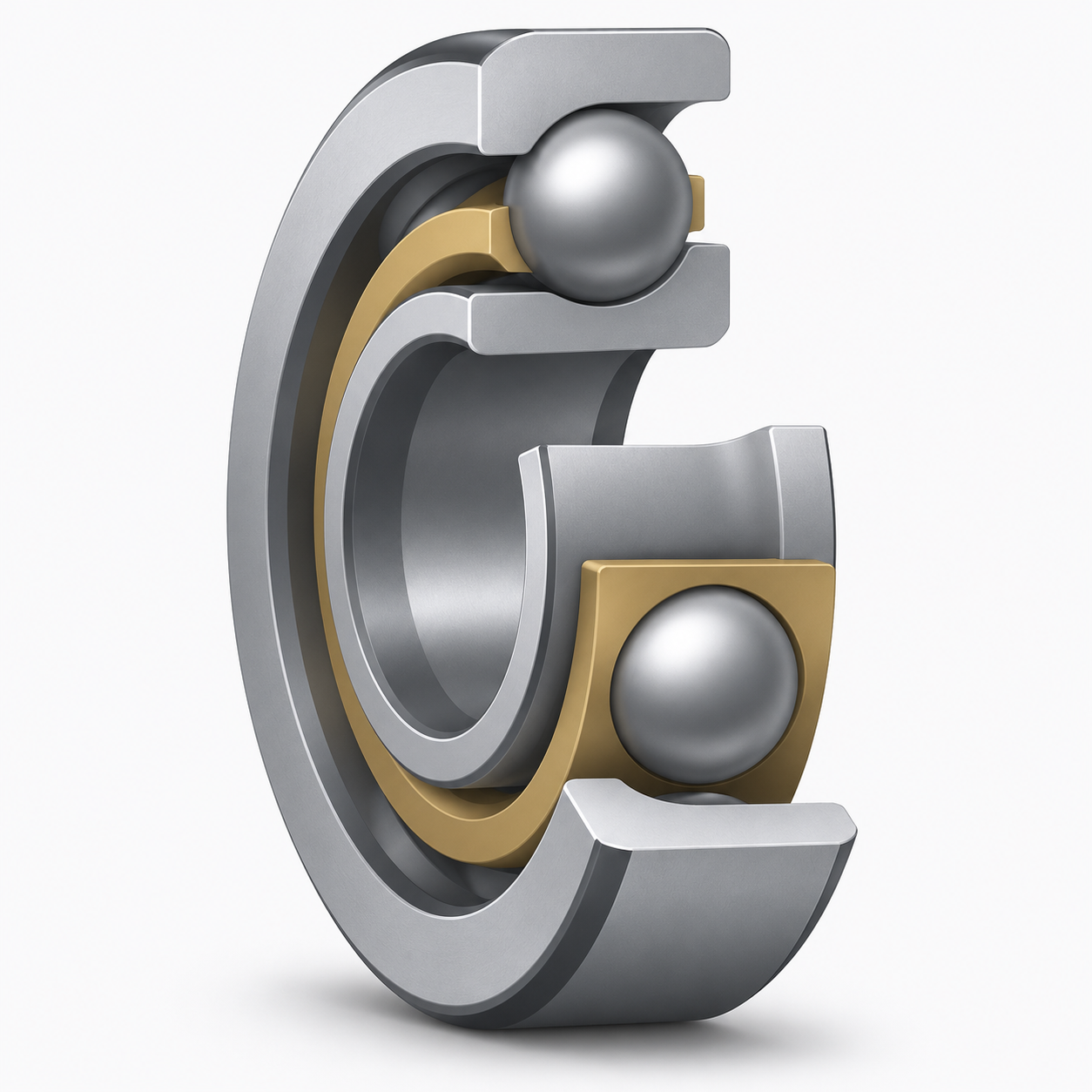
Two rows of balls run in a spherical outer raceway, so the inner ring can tilt a little without loading the balls unevenly. Useful where a long shaft sags or the housing is not perfectly aligned.
 Miniature and
 Miniature and
Thin Section Ball Bearings
Small parts for instruments, drones and small motors, and thin section parts for applications where radial space is tight. A part such as the 6804 bearing is typical of the small end of the range.
Reading the Number on the Bearing
The number is a code, not a random label. Take 6204 as an example. The first digit gives the type, the second gives the dimension series, and the last two give the bore code.
The bore rule is the one worth memorising. Multiply the last two digits by five and you have the bore in millimeters, so 04 means a 20mm bore. The full part is 20mm bore, 47mm outside diameter and 14mm wide, and those figures appear on the 6204 bearing page.
What the code leaves out matters just as much. Seals, shields, clearance and precision are carried by suffixes, so two bearings with the same base number can be different parts. Our guide to reading a bearing code takes the suffix side apart in detail.
Materials and Cages
Most ball bearings are made from through hardened chromium steel, described as 100Cr6 or AISI 52100 depending on where it was produced. It takes a hard, wear resistant surface and holds its shape under load.
Stainless steel appears where moisture or washdown is routine. Common metric sizes are produced in stainless grades for food and beverage equipment, and the load capacity is lower than the equivalent standard steel part.
Ceramic balls are used where speed or electrical insulation matters. Each substitution changes load capacity, speed limits and cost, so it is a decision to make with the application in hand rather than by default.
Cages follow the same logic. Steel is the general purpose choice, brass handles higher temperature and shock, and nylon runs quietly in low load, moderate temperature work.
Where Ball Bearings Are Used
Electric motors are the largest single use, because almost every motor carries a bearing at each end of the shaft. Pumps, fans, conveyors and gearboxes follow close behind.
Smaller parts turn up in power tools, household appliances, office equipment and medical devices, and a size like the 6004 bearing is typical of a small pump or tool spindle. In automation, a part such as the 6205 bearing sits on the motor side of a gearbox, while crossed roller bearings take the joint load on the output side.
The range is wide, but the questions do not change much. What size is the shaft, which way does the load push, how fast does it turn, and what is the environment.
How to Choose One
Five questions settle most of the choice, and they are worth answering in this order.
- Shaft size. Measure the shaft rather than trusting the old bearing, especially if the part has been running hot or has spun on the shaft.
- Load direction. Radial only, axial only, or both. This decides the family before any other detail matters.
- Speed. Sealed and grease filled parts have lower limits than open parts of the same size, so the speed figure has to be read with the configuration in mind.
- Environment. Dust, water, washdown chemicals and heat each push the choice toward a different seal, grease or ring material.
- Noise and precision. Motors, instruments and machine tool spindles are sensitive to runout, and that is where a higher precision class earns its price.
Once those five are settled, reading a catalogue row becomes straightforward, and the risk of ordering the right size in the wrong configuration drops sharply.
Signs a Bearing Is Wearing Out
Bearings rarely fail without warning. The early signs are easy to miss and cheap to act on.
- Noise that changes with speed. A whine or rumble that appears at one speed band and fades at another is usually the first signal.
- Heat. A housing that runs warmer than it used to, with no change in load.
- Vibration. A faint buzz through the frame that was not there last month.
- Grease condition. Dark grease, or grease thrown out past the seal.
- Play. Visible movement when the shaft is rocked by hand, with the machine stopped.
Catching the first group matters. A bearing replaced at the noise stage usually leaves the shaft and housing in good condition. One left until it seizes often takes the shaft with it, and the repair grows from a bearing to a shaft and a housing.
Questions Buyers Ask
What is the difference between a ball bearing and a roller bearing?
The rolling element. Balls touch the raceway at a point and rollers along a line, so rollers carry more load while balls run faster and quieter.
What does 2RS mean on a bearing?
Two rubber seals, one on each side. ZZ means two metal shields instead, which keep out coarse dirt but do not hold grease in as tightly.
Can a ball bearing take axial load?
A deep groove bearing takes a moderate axial load in either direction. When axial load is the main load, an angular contact or thrust bearing is the better choice.
How long does a ball bearing last?
It depends on load, speed, lubrication and contamination. There is no fixed number, which is why the same bearing can run for years in one machine and months in another.
Need help identifying a bearing?
Send the shaft size, the load direction and a photo of the old part if you have one. You will get the right family, the right suffix and a quote against a named part instead of a range.
Related Reading



Related Products