


 English
 French
 German
Bearing Failure Analysis. How to Read a Failed Bearing
DAMAGE READING
Bearing failure analysis starts the moment you set the dead part on the bench and look at the steel instead of the label. The mark on the raceway is the evidence, and it usually points somewhere other than the bearing.
Two bearings can carry the same number and fail in completely different ways. A deep groove ball bearing is a simple stack of two rings, a set of balls and a cage, so nearly every problem it meets leaves a mark on one of those surfaces.
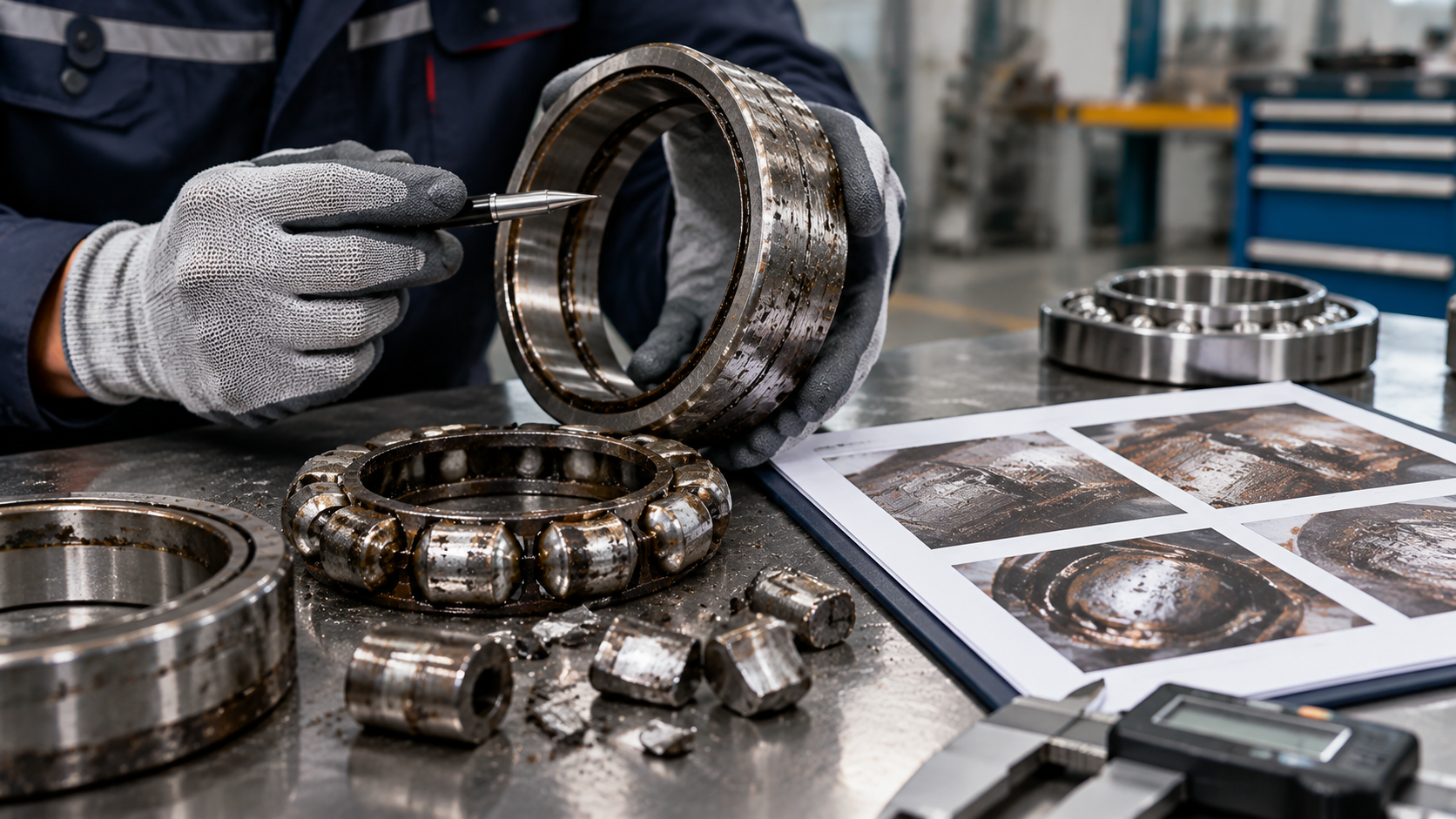
What the Surface Tells You
The number stamped on the ring says what the part was built to do. The pattern on the raceway says what actually happened to it. Only the second one keeps the next bearing alive.
Damage has families, and the trade shares one vocabulary for them. ISO 15243 is the standard that classifies bearing damage and failures.
Work from the mark outward. Note where the damage sits on the ring, how deep it cuts and whether the grease nearby is clean or burnt.
The Six Marks and What Each One Means
Use the table as a first pass, then read the section that follows for the full story behind that mark.
| Mark | What it looks like | Usual cause | What to change |
|---|---|---|---|
| Spalling | Flaking, rough pits on a rolling surface | Metal touched metal after the film broke down | Fix load path, fit, lubrication |
| Fretting | Rust colored smear, black powder, shiny band | Tiny movement between ring and seat | Tighten the fit, rework the seat |
| False brinelling | Polished dents spaced like the ball set | Shaking while the shaft sits still | Isolate vibration, or index the shaft |
| Smearing or skidding | Torn, dragged metal, often blue from heat | Rolling parts slid instead of rolling | Check clearance, load, grease stiffness |
| Corrosion | Dark staining, water lines, rough patches | Moisture reached the steel or the grease | Change seals, grease, storage |
| Electrical pitting | Fine ripples, dark craters, burnt grease | Current passed through the bearing | Fix the ground path, insulate the part |
Spalling and Fatigue
Spalling is metal flaking off a rolling surface. The shape of the flaked area shows whether the stress spread across the whole ring or landed in one place.
When the Whole Raceway Is Affected
A raceway pitted all the way around was overloaded for the film of oil or grease that separates the surfaces. Once that film is gone the balls touch steel directly, and every pass widens the pit.
When It Is One Spot
A single pit, or a ring of pits at one clock position, points to a local event rather than a load problem. A hard particle was crushed into the surface, or the part took an impact.
A part with plenty of rated capacity can still fail this way. A 6204 bearing is rated 12.8 kN dynamic and 6.55 kN static at 20 x 47 x 14 mm, far more than a small blower demands, yet a dent from a dropped housing starts a pit at that spot.
Fretting and False Brinelling
These two marks get confused because both leave a light, polished trace with little metal removed. They happen for opposite reasons, so the fix is different.
Marks on the Outside of the Ring
Fretting shows up where the ring meets its seat, on the outside diameter of the outer ring or in the bore of the inner ring. It looks like a rust colored smear with black powder beside a worn, shiny band.
That band means the ring was moving in its seat. A shaft or housing that is too loose lets the ring creep, the slow walk of a part that is not held tight.
Fit and internal clearance work together here. A seat that squeezes the ring removes clearance the assembly needed, which pinches the balls and loads the raceway harder.
Marks Where the Balls Sat Still
False brinelling looks like rows of shallow dents, spaced the way the ball set is spaced. The dents are polished and the metal around them is intact, with none of the tearing of a real overload.
It appears on machines that stand still while something nearby shakes. A standby pump beside a running compressor, or a unit riding on a truck, rocks the balls a tiny amount and pushes grease out of the contact.
Smearing, Skidding and Electrical Damage
Smearing is metal that moved rather than metal that left. The surface looks torn or dragged, sometimes with a blue tint from heat, because the rolling parts slid.
Rollers do this as well as balls. On a crossed roller ring the rollers can skid when the joint creeps under load, and the damage lands on the flat of the raceway instead of a ball track. The crossed roller bearing failure modes guide covers those patterns.
Looking for Current Damage
Current damage has a signature you can spot from arm’s length. The raceway shows fine ripples like a washboard, the grease turns dark and smells burnt, and small craters appear.
The current came from outside the bearing. A motor with a poor ground path, welding done on the frame with the shaft connected, or a damaged cable shield pushes current through the contact.
Where that path cannot be closed, some builders fit ceramic balls so the bearing blocks the current instead of passing it along.
What Four Marks Have in Common
Step back from the individual marks and a pattern appears. Damage that travels back to a supplier usually traces to four things, and none of them is a defect in the steel.
1Fit. A loose seat lets the ring creep, and a tight seat takes away clearance the assembly needed.
2Lubrication. The wrong grease, too little, too much, or grease that stiffened in the housing. Each one lets metal touch metal.
3Load path. Belts pulled tight, supports that settled, couplings that fight each other. The bearing often reports a problem created elsewhere.
4Environment. Washdown water, dust, process heat, vibration from a neighbor. A seal can only hold back so much.
How to Read a Bearing Before You Replace It
Five minutes on the bench saves a second failure. Run these checks before the old part goes in the scrap bin.
1Photograph it while it is dry. Wipe the surface with a clean rag, then shoot it with side light so the depth of the mark shows.
2Note the clock position. Record where the mark sits as if the ring were a clock face, and which way that face pointed in the machine.
3Check the shaft and housing seats. Look for a worn band or a burr where the old part sat. A marked seat will mark the new bearing too.
4Look at the grease. Color, smell and how much is left tell you whether the bearing ran dry or ran wet.
5Keep one sample. Tag the failed part with the machine, the date and what the operator reported.
When to Ask for a Failure Review
The clear signal is a repeat. When two replacements in the same seat fail the same way, the bearing is reporting a condition that lives in the machine.
Send the photo and the application details. A clear picture of the damage plus the machine type, the load it sees and how it is lubricated is enough for a written read of the damage mode and the change it points to. Start at the contact page and attach the image.
The part itself is on record. Yuanhe measures bore tolerance, radial runout and assembly height at four quadrant positions on every crossed roller ring, so the geometry of the ring you received can be checked against the sheet.
Frequently Asked Questions
What does a spalled bearing raceway mean?
It means the oil or grease film between the balls and the steel stopped working, and the surface broke up under repeated stress. Damage around the whole raceway points to overload, while one spot points to a single event.
Can a bad fit cause bearing failure?
Yes, in two directions. A loose seat lets the ring creep and frets its own mounting surface, while a tight seat squeezes out the clearance the assembly needed.
Is fretting the same as false brinelling?
They look alike but they are not the same. Fretting happens at the fit, where a ring moves inside its seat, so the mark appears on the outside of the ring. False brinelling happens at the ball contacts while the shaft stands still.
How do I tell electrical damage from corrosion?
Corrosion stains the steel and often follows a water line, leaving red or dark patches. Electrical damage leaves fine ripples or small craters in the rolling track, with grease that smells burnt.
Can I reuse a bearing that looks fine?
Once a bearing is pulled it has taken the removal forces, and any dirt it picked up is now inside the assembly. Keep it as a sample, then fit a new part and fix the condition that brought you there.
FIRST STEP
Take a clear photo of the failed part, note which way the damage faced, and send it with the machine details. That is the shortest road from a dead bearing to a change that holds.
Request a failure review and an engineer will write back with the damage mode and what it points to.