
 English
 French
 German
How to Spot Counterfeit Bearings Before You Buy
Goods In Desk
Counterfeit bearings are rarely obvious. The carton looks right, the label copies a familiar layout, and the ring has a part number on it. The problem shows up months later, as noise on a line that used to run quiet.
Most counterfeit bearings enter a plant through a normal purchase order, not through a back alley. A trader quotes a price that is hard to refuse, the paperwork looks official, and nobody opens the carton until the parts are on the shelf.
01Why Counterfeit Bearings Reach Good Factories
A counterfeit bearing is a real bearing with someone else’s identity on it. The steel may be a lower grade, the heat treatment may be skipped, and the marking may be applied in a back room rather than at the plant named on the box.
It reaches a good factory for boring reasons. A maintenance team needs a part this week, the authorized channel quotes a lead time, and a trader offers stock today. The buyer is not careless. The order simply goes to whoever can ship. The most copied sizes are the everyday motor and pump sizes, such as the 6204 bearing and the 6205 bearing, because volume lets a fake carton pass unnoticed.
The cost lands later and somewhere else. A failed bearing stops a line, damages a shaft, or contaminates a product, and the purchase file shows a part number that looked correct at the time.
Between the plant and the maker sits a layer of traders, repackers, and jobbers. Most are honest and simply move stock. A few buy unbranded parts, print a carton, and sell the result as something it is not. The plant never sees that layer, only the invoice.
02Check the Marking Method
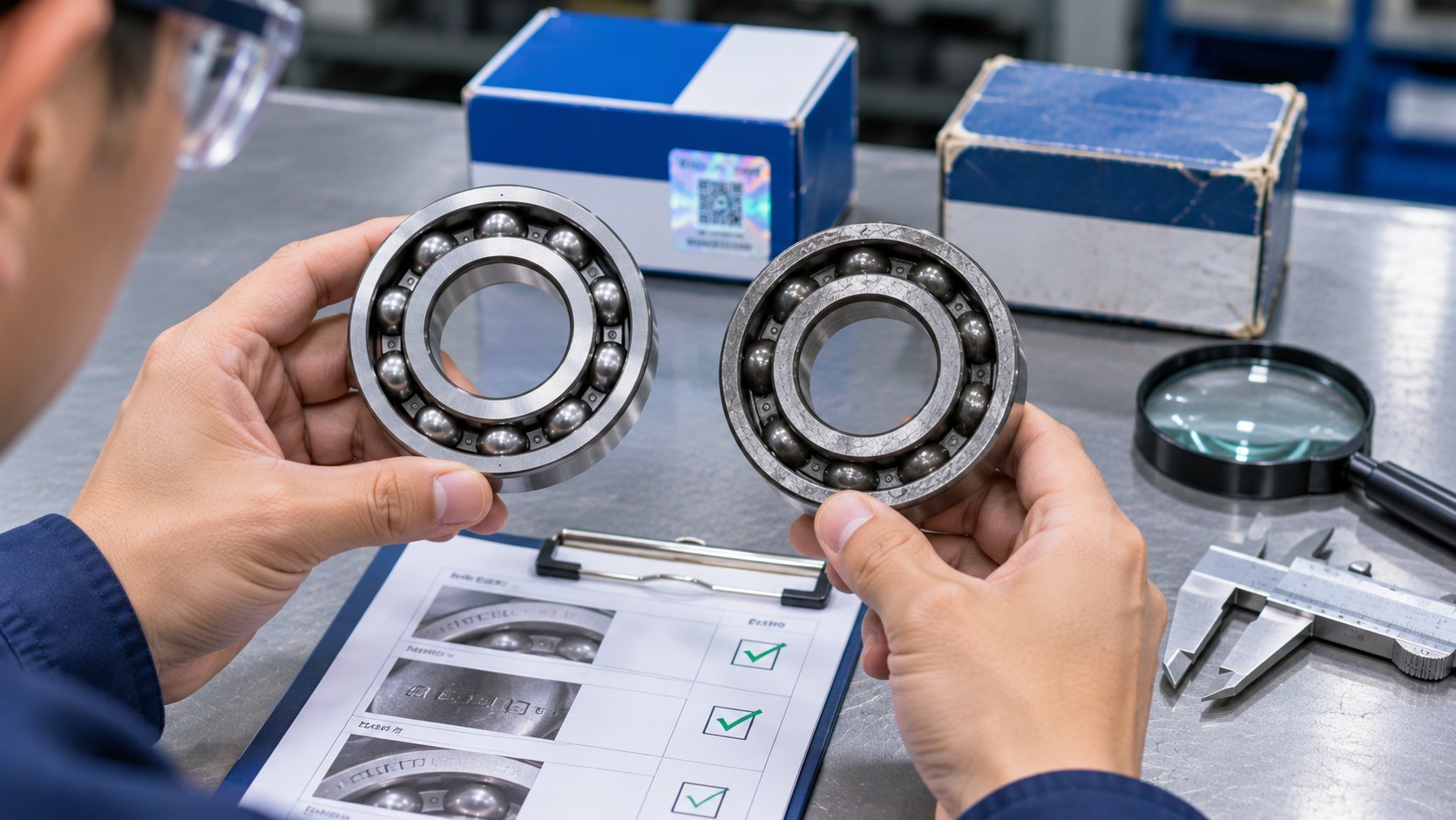
The marking is the first place a copy shows itself. A genuine deep groove ball bearing carries a code that was applied by a controlled process at the plant, with even depth, clean edges, and a font that matches the maker’s own.
Laser marking versus a stamped ring
Laser marking leaves a shallow, sharp, slightly darkened trace with no raised metal. Stamping leaves a defined groove with a small displacement of material at the edge. Both are legitimate. What is not legitimate is a mix of the two on one ring, or a stamped code that was ground away and replaced.
What a re marked ring looks like
Tilt the ring under a lamp and look along the surface. A re marked part often shows a shallow ground band where the old text sat, fine scratch marks across the band, or ghost edges of letters underneath the new code. Character spacing is another tell, because hand set stamps drift.
03Check the Package Print
Boxes are easier to copy than bearings, but printing is where cheap copies slip. Offset printed cartons have solid edges, consistent ink density, and small text that stays readable at arm’s length.
A copied carton often shows a dot pattern under a magnifier, ink that fades across the panel, or a logo that is slightly off center on one face. Look at the folding, too. A carton that bulges or has glue squeeze out on the seam did not come off a high volume line.
Bar code and batch label deserve a close look. Scan the code and check what it returns. Then compare the number printed on the label with the number etched on the ring, because a copy often gets one and not the other.
04Compare Weight and Feel
Put a known good part in one hand and the new one in the other. A thinner wall or a lighter cage changes the weight, and the difference is often large enough to feel without a scale.
Spin the bearing by hand. A clean part turns with a light, even resistance and a faint sound. A copy may feel loose, grind at one point, or stop abruptly, because the raceway was finished to a rougher standard.
Check the cage as well. Rivets that sit proud, a cage that rubs the balls, or a cage material that looks different from the sample all point to a part that was assembled somewhere other than the plant on the box.
05Look at the Seal
Seals and shields are cheap to swap and easy to fake. A seal that does not sit square in the groove, or a shield with a burr on the outer edge, tells you the assembly was not controlled.
Rubber smell and hardness
A new seal has a faint rubber smell. A strong solvent smell usually means a low grade compound that will harden and crack. Press a thumbnail into the lip and release it. Good rubber returns; a stiff or waxy compound stays dented.
Check the color match against the sample, and look for mold flash on the sealing lip. Flash that was not trimmed will lift the lip off the ring and let contamination in from the first shift.
Grease visible on the outside of a sealed part is another sign. A controlled fill leaves the seal dry. A hand packed copy squeezes grease past the lip during assembly, and that film of grease collects dust before the part is even installed.
06Check Batch Consistency Inside the Carton
Open a carton and compare the parts against each other. A genuine batch comes from one run, so the marking depth, the grease quantity, and the cage finish should look the same on every piece.
One carton, three date codes
Mixed date codes in a single box are a warning. So are mixed marking styles, one part with a shield and one without, or grease that has leaked onto some parts and not others. A repacker assembles orders from whatever is on hand.
Weigh three parts from the same carton. If the spread is wider than you would expect from one production run, the carton is not one batch, whatever the label says.
Before you place the order
Send photos of the carton, the label, and the marking on the ring. We compare them against the process we run and tell you what does not fit, even when the order is not ours to fill. Send the photos here.
07Question the Price and the Paper Trail
Price is a signal, not proof. A quote far below every other offer for the same part and the same delivery window has to be explained. Sometimes the explanation is surplus stock. Often it is a part that was made somewhere the seller will not name.
Read the paperwork as carefully as the part. A mill certificate should name the steel grade, the heat number, and the mill that rolled it. A certificate issued by the trader, with no mill name and no heat number, proves only that someone typed a document.
Check that the certificate matches the batch on the label. A number that appears on the box but not on the paper, or the reverse, is the sort of gap a repacker creates without thinking.
08Ask What the Supplier Can Show
A supplier who makes bearings can describe the plant. Ask which line ran the part, what the inspection steps are, and whether they can send a batch report. A trader who is guessing will answer in general terms and change the subject.
Ask for the last inspection record for the size you are buying. A maker keeps them. A repacker does not have them, and the answer usually arrives as a promise rather than a document.
For sizes that move in volume, such as the 6203 bearing or the 6004 bearing, the same questions apply. Cheap copies cluster around the sizes that sell fastest, and a small 6804 bearing in a mixed order is easy to slip past a busy goods in desk.
09Frequently Asked Questions
Is a counterfeit bearing always a bad bearing?
Not always in the short term, which is what makes it dangerous. It may run for months in a light duty position and fail in the one application where the load or the speed matters.
Can I tell a copy from a photo?
Sometimes, from the marking and the carton print. A photo cannot show weight, seal hardness, or how the bearing turns, so it confirms a suspicion rather than clearing a part.
What is the single fastest check at goods in?
Compare the marking on the ring with the label on the carton, then weigh the part against a known good one. Most copies fail one of those two within a minute.
Should I reject the whole shipment for one bad carton?
Yes, until the supplier explains where the parts came from. One mixed carton usually means the rest of the order came through the same hands.
Does a lower price always mean a copy?
No. Surplus stock, a currency move, or a clearance can produce a low price. The price only becomes a warning when nobody can explain it.
Goods In Checklist
We can send a one page inspection sheet your receiving team can run in ten minutes, covering marking, carton, weight, seal, and paperwork.
For the wider purchasing picture, read our importer quality checklist. It covers supplier audits and the documents to request before a first order.



Related Products