


 English
 French
 German
Sourcing Bearings From China. An Importer Quality Checklist
IMPORT CHECKLIST
Sourcing bearings from China is a normal part of buying for many plants and distributors. The country runs more bearing production than anywhere else, and the price and capacity can be hard to match elsewhere. The question is not whether to buy there. It is how to buy there without getting a bad batch.
Most bad first orders come down to a single mistake. The buyer treated every factory as the same and every quote as the same product. They were not. Two factories can quote the same part number and deliver two different bearings, because one held the grade and the other did not.
This guide is a checklist you can use before you send a purchase order. It covers what to ask, what to demand in writing, and how to test a sample before real money changes hands.
1Why Buyers Look at China in the First Place
Three reasons keep pulling buyers to China. Price is the first, and it is real. Capacity is the second, because few places can run the range of standard sizes and custom work at the scale China can. The third is skill, which is often forgotten.
China has built bearing factories for decades. The best of them run controlled heat treatment, fine grinding, and full inspection. They can hold tight tolerances on standard parts and on custom designs. The catch is that the market also holds many companies that only trade, or that cut corners to win a price war. Both kinds answer the same emails.
2The Real Risk Is Not China, It Is Buying Blind
The risk in overseas sourcing is not the country. It is buying without evidence. When you buy from a local distributor, you can walk in and see what you are getting. Overseas, you cannot, unless you build a paper trail that replaces the visit.
Three problems show up most often with buyers who skip that trail.
Grade Substitution
A supplier quotes a genuine high grade, then ships a lower grade at the same part number. On paper the order looks right. In the machine, the part wears fast, runs hot, or fails inside warranty. Grade substitution is the hardest problem to spot, because the bearing still turns smoothly when you open the box.
Loose Tolerances
Parts run wide of the spec, so the same size fits tight on some shafts and loose on others. A loose fit lets the ring slip and rub. A tight fit squeezes out the internal clearance. Either way the machine tells you in noise, heat, and short life, not in a catalog number.
Thin Paperwork
No material certificate, no inspection records, and no traceable batch. Without paper, there is no way to check a bad lot against a good one, and no way to prove a claim when a batch fails. The savings on the order are small next to the cost of an untraceable failure.
Each of these problems is cheap to prevent and expensive to fix. A returned container, a line stoppage, or a warranty claim can wipe out the savings on the order many times over.
3Questions to Ask Before a Trial Order
Send these questions before you ask for a price. The answers tell you more than the quote does.
1. Do you manufacture the bearings or trade them? Ask which plant runs the grinding.
2. Which steel grade do you use, and which mill supplies it?
3. What precision grade can you hold, and how do you measure it?
4. What inspection do you run on a finished batch, and can I see a sample report?
5. What is your minimum order quantity and lead time for this size?
6. What documents ship with the batch as standard?
A factory will answer these with detail and specific numbers. A trader will answer in general words and promises. Both answers are information, and the general one tells you to keep looking.
4Documents a Serious Supplier Will Send
Paper is how you trust a supplier you cannot visit. A real factory can send the following without a fuss.
| Document | What It Proves |
|---|---|
| Material certificate | The steel grade, and often the mill it came from |
| Dimensional report | The main sizes and the tolerance they were held to |
| Inspection record | That the batch was measured and passed |
| Grease data sheet | The temperature, speed, and load range of the grease |
| Batch or traceability number | That this part can be traced back to its production run |
| Country of origin statement | What customs and your own records need |
If a supplier cannot supply these, treat the missing paper as a warning. The documents cost little to produce, so a supplier who will not produce them is often protecting information rather than lacking it. Our note on what to check in a bearing inspection report shows how to read one at goods in.
5How to Test a Sample Before You Commit
Samples are worth the time and the cost. Order a small lot and put it through a simple review before you scale up.
Measure the Part
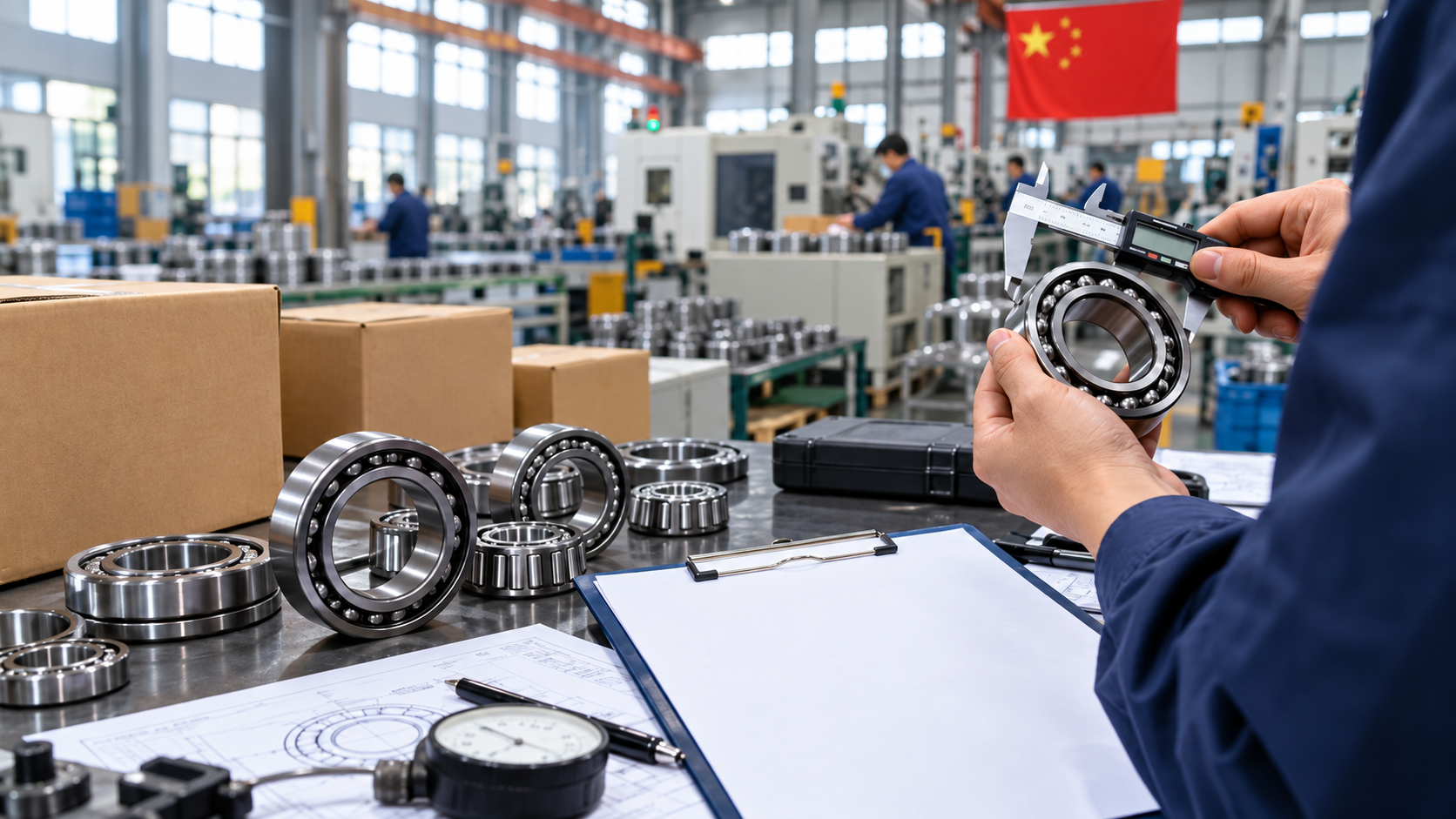
Check the bore, the outside diameter, and the width against the drawing. Then check the clearance and the fit on a known shaft. Measuring catches grade substitution and loose tolerance before they reach the line, and it takes only a few minutes per size.
Run It in a Real Machine
Fit the sample in the machine it is meant for if you can, and compare noise and temperature with the part it replaces. A sample test will not catch every future problem, but it catches the common ones, and it shows you how the supplier handles a request. A supplier who supports a sample well usually supports an order well.
6Red Flags on a First Order
Watch for these signs during a first order. Any one of them is worth a second look.
• A price far below the rest, with no technical reason given.
• Vague answers about steel grade or inspection.
• A quote that gives a part number but no tolerance or grade.
• No batch number on the delivered parts.
• Packaging that arrives damaged or open, with bearings loose inside.
• A sudden change of specification after the order is placed.
None of these proves a problem on its own. Together they describe a supplier who is not set up to give you a consistent part. Consistency is the whole point of an overseas order, because a lot that passes today and fails next quarter is worse than a supplier who was never cheap.
7Factory Direct or Trading Company
Both can work, but they fit different needs. A trading company can offer many product types from one contact and handle smaller mixed orders. A factory direct partner can answer technical questions, control the process, and make a custom part to your drawing.
| Question | Factory Direct | Trading Company |
|---|---|---|
| Can they change the design? | Yes, on request | Usually no |
| Who answers technical questions? | The engineers who make the part | A sales team that asks someone else |
| Traceability to the production run | Direct | Depends on the factory behind them |
| Range of products | Narrow, deep | Wide, shallow |
| Best for | Custom and high risk parts | Mixed, standard orders |
If your part is standard and low risk, a trading company may be fine. If the part must hold a grade, carry a certificate, or match a drawing, work with the factory that makes it. Our page on custom manufacturing explains how that process runs from drawing to delivery.
8Building a Relationship That Lasts
The first order is a test, not a marriage. Treat it that way and the sourcing decision stays low risk.
Start with one size or one part number. Keep the volume small enough that a bad batch is annoying rather than damaging. Record what the supplier sent, when it arrived, and how it performed. Then, if the parts hold up, add the next size and the next.
A supplier who improves after feedback is worth keeping. A supplier who blames the shipping, the machine, or the operator after a clear failure is telling you what the next order will look like. Track performance by batch, so the relationship is built on records rather than on how the sales emails sound.
Is it safe to source bearings from China?
Yes, with checks. Demand the grade in writing, ask for material and inspection documents, test a sample, and confirm the batch is traceable. The risk comes from buying blind, not from the country.
How do I know if a supplier is a factory or a trader?
Ask which plant does the grinding, which steel mill supplies the material, and what test equipment they use. A factory answers with detail. A trader answers in general terms or passes the question on.
Why is one quote so much lower than the rest?
Usually because it is a different product. A lower grade, a looser tolerance, or missing documents all lower the cost. Ask the supplier to match the grade and documents on the other quotes, then compare again.
Do I need to visit the factory?
A visit helps at high volume, but it is not required for a first order. A sample, a set of documents, and a small trial order together replace most of what a visit would show you.
What should the first order look like?
Keep it small and standard. Confirm the grade and the documents, test the parts, and only then scale up. See our guide to how custom bearing manufacturing works for the quality steps a good factory runs on every batch.
Request a Sample and a Document Pack
If you want to source bearings from China without guessing, start with a sample and a full set of documents. We will send the material certificate, the dimensional report, the grease data sheet, and the traceability details with the parts, so you can check everything before you commit to a volume order. We make deep groove ball bearings and custom parts to drawing, and we would rather answer a hard question now than lose your trust on a later order. Send your drawing or part number through our contact page, and tell us what the bearing has to do.