

 English
 French
 German
How to Mount a Deep Groove Ball Bearing
How to mount a deep groove ball bearing correctly decides most of its service life. A bearing can be made correctly and still fail early if it is mounted wrong, and the fit between the bearing and its shaft or housing decides most of its service life. This guide explains the two fits that matter and how to install a bearing without damaging it.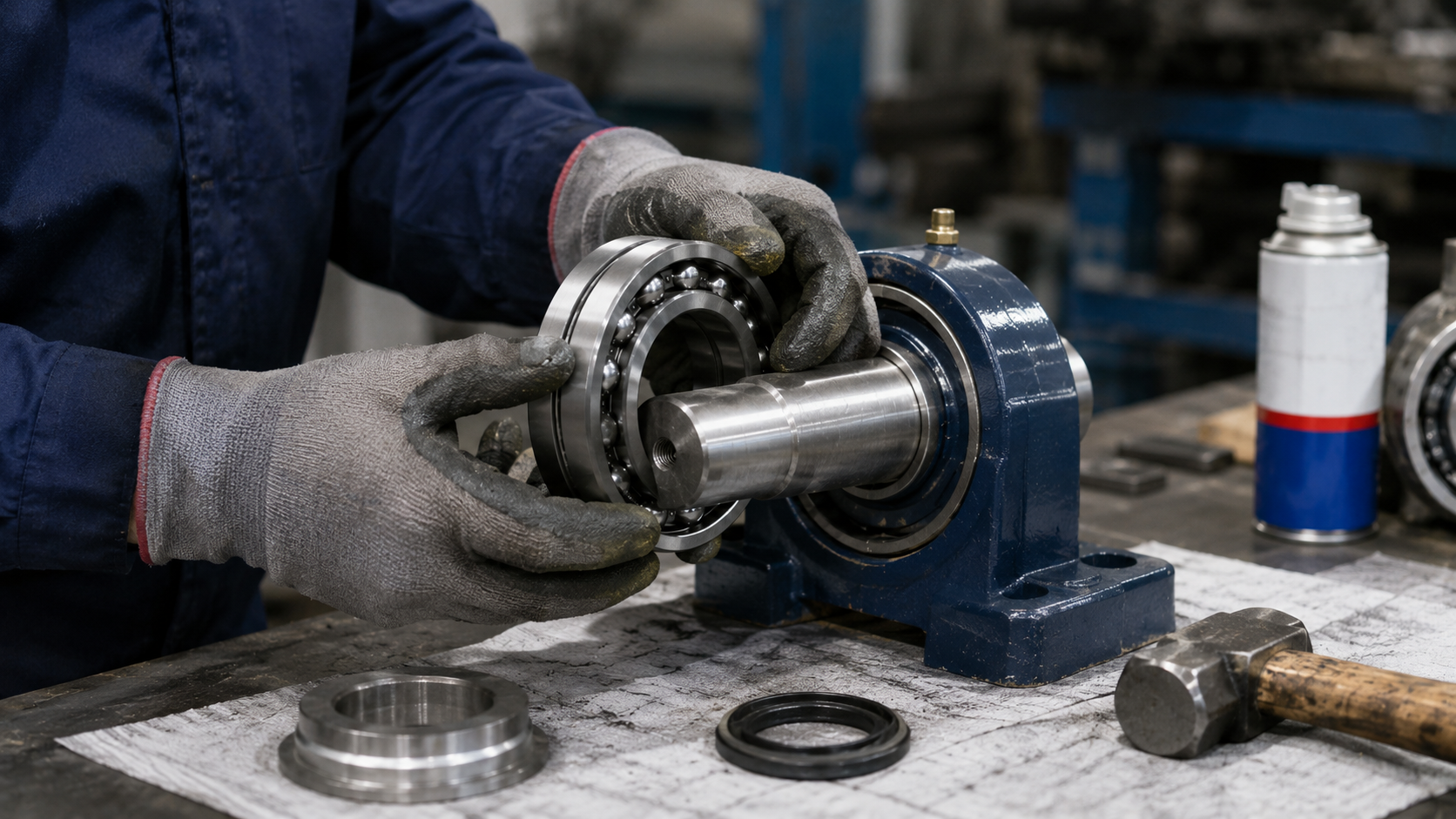
1Why Fit Matters
Fit is how tightly the bearing grips the shaft or housing. Too tight, and the bearing binds or the rings crack. Too loose, and the bearing creeps, spins on the shaft, and wears it down.
The right fit holds the bearing firmly where it must not move, while letting it float where movement is harmless. Getting this balance right is the foundation of a long-lasting installation.
2The Two Fits You Need to Know
Which ring gets a tight fit depends on which ring rotates.
Rotating Inner Ring
When the shaft rotates and the housing stays still, the inner ring must be held tightly on the shaft. A tight, interference fit keeps the inner ring from spinning on the shaft. This is the most common case in motors, pumps, and gearboxes.
Rotating Outer Ring
When the housing rotates and the shaft stays still, the outer ring gets the tight fit instead. This appears in wheel hubs and some conveyor rollers. The rule is simple: the rotating ring gets the tight fit, and the stationary ring gets a looser fit so it can settle without binding.
Why the Stationary Ring Floats
The stationary ring needs a small amount of freedom. That freedom lets the bearing absorb thermal expansion and small mounting errors without loading the balls unevenly. A stationary ring locked tight can cause the bearing to bind as it warms up.
3Mounting a Bearing Without Damaging It
Force is the enemy during installation. A bearing pushed in crooked, or hammered on the wrong ring, is damaged before it ever runs.
Step 1. Prepare the Shaft and Housing
Clean the shaft and housing, and check for burrs, nicks, and rust. Even a small burr can gouge the bearing or cause a crooked fit. A light film of clean oil on the seat helps the bearing slide on evenly.
Step 2. Press on the Right Ring
When fitting a bearing onto a tight shaft, press only on the inner ring. When fitting it into a tight housing, press only on the outer ring. Never press through the balls, since that dents the raceways and ruins the bearing.
Step 3. Heat to Ease Mounting
For larger interference fits, warming the bearing makes the ring expand enough to slide on easily. Warm the bearing roughly 80 to 90 degrees Celsius above the shaft temperature. Do not exceed about 120 degrees Celsius, since higher heat can affect the metal and any plastic cage. An induction heater or a controlled oil bath works best. A flame heats unevenly, so it is not recommended.
Step 4. Check the Result
After mounting, turn the bearing by hand. It should rotate smoothly with no catch or roughness. Check that the bearing seats fully against its shoulder and that nothing is pinched. A smooth hand-spin test catches most mounting mistakes before the machine starts.
4Common Mounting Mistakes
Most bearing damage happens during installation, and the same few mistakes show up again and again.
Pressing through the balls is the most common one. The force travels from one ring, through the balls, into the other ring, denting the raceways. The bearing may feel fine at first but will fail early.
Hammering directly on the rings is another. Impact force concentrates on one spot and can crack or dent the ring. A proper pressing tool or a soft-faced driver spreads the load and protects the bearing.
Mounting on a dirty or burred shaft rounds out the list. Grit and burrs scrape the bore and cause a crooked seat. Cleaning and checking the shaft before mounting avoids both problems.
5Checking Fit With Simple Tools
You do not need a full set of measuring instruments to confirm a fit is right. A few basic checks catch most problems.
A bore gauge or a micrometer measures the shaft and housing diameters before mounting. Compare those numbers to the bearing’s published bore and outside diameter. If the fit is far off, stop and correct it before you force the bearing on.
After mounting, the hand-spin test tells you whether the bearing is seated cleanly. It should turn freely with no catch, roughness, or drag. Feel for play in the shaft and check that the bearing shoulders fully against its seat.
6Interference vs Clearance Fit Explained
Fit comes down to two cases, and the difference is worth understanding before you mount anything.
An interference fit means the shaft or housing is slightly larger or smaller than the bearing ring, so the two grip each other. This is what holds the rotating ring in place. The ring is pressed or heated onto its seat and stays put.
A clearance fit leaves a small gap between the bearing and its seat, so the ring can slide or float. This suits the stationary ring, which needs room to settle as the machine warms up and parts expand.
The two fits work together. The rotating ring is held tight, and the stationary ring floats. Get them backward and the bearing either spins on its seat or binds as it heats up.
7Shaft and Housing Tolerances in Practice
The fit numbers matter, but so does keeping them consistent across the bearing’s life.
For a typical rotating shaft, the shaft seat is machined to a tight tolerance so the inner ring grips firmly. The housing seat for the stationary outer ring is machined looser so the ring can settle. Common sizes like the 6203bearing, 6204bearing, 6206bearing, and 6304bearing all follow the same fit principle.
If a shaft has been worn or damaged by a previous bearing spinning on it, the fit will be off. In that case, the shaft may need repair before a new bearing is mounted. Mounting a fresh bearing on a worn shaft only repeats the failure.
8Ordering a Replacement Without the Part Number
Replacement work often starts without a clean part number. The bearing is worn, the marking is gone, and the manual is missing.
Measure the bore, the outside diameter, and the width with a caliper. Those three numbers identify the bearing in most cases. Note whether it has seals or shields, and whether the inner or outer ring rotates. Send those details to a supplier, and they can match the bearing.
Yuanhe supplies the common deep groove ball bearings used across general machinery, so a measured size can usually be matched directly.
9Common Questions
Which bearing ring gets the tight fit?
Can I hammer a deep groove bearing into place?
How hot can I heat a bearing for mounting?
How do I know if I mounted the bearing correctly?
Getting the fit and mounting right is easier when the bearing itself is made to accurate dimensions. Yuanhe supplies deep groove ball bearings with consistent bore and outside diameter tolerances, backed by ISO 9001:2015 inspection.



Related Products