
 English
 French
 German
Bearing Cage Types. Steel, Brass, and Nylon Explained
Cage Options
Bearing cage types usually come up late in a buying conversation, after the seal, the clearance, and the price are already agreed. That order is backwards. The cage is the part that keeps the rolling elements apart, and it decides how a bearing behaves when the grease thins out, the speed climbs, or the load changes direction.
This page covers what each cage material does, when it earns the extra cost, and when it does not. It is written around the deep groove ball bearings we build every day, from small sizes such as the 6004 up to the 6204 and the 6304.
01What the Cage Actually Does
The cage, also called a retainer or a separator, holds the balls at even spacing around the raceway. Slide a bearing onto a shaft with no retainer and the balls bunch up on the loaded side, rub against each other, and the whole assembly grinds itself apart in a few turns.
That gives the cage three jobs. It keeps the spacing even, it carries the balls through the unloaded zone so they return to the load smoothly, and it guides them so the contact angle stays where the drawing says it should be. Our deep groove ball bearing range lists the standard cage for every size.
A cage failure is one of the few bearing failures a maintenance team can see with the naked eye. When a pocket cracks, the balls gather, and the bearing locks up.
That is also why the retainer is settled early in a project rather than at the end. Once the cage material is fixed on the drawing, changing it later means a new part number, a new inspection record, and a fresh round of approvals.
02Why the Cage Is Named on a Spec Sheet
The cage shows up twice in the paperwork. In the part number it appears as a suffix, and on the drawing it gets its own line. Buyers ask about it because the same outside dimensions can be supplied with a pressed steel cage as standard, or a machined cage on request.
The Cage Is a Wear Part Too
The retainer slides against the balls and against the ring, so it wears like any other sliding surface. Under marginal lubrication it wears first, then sheds fine debris that damages the raceway. Lubrication advice and cage choice belong in the same conversation for that reason.
03Steel Cages for Most Jobs
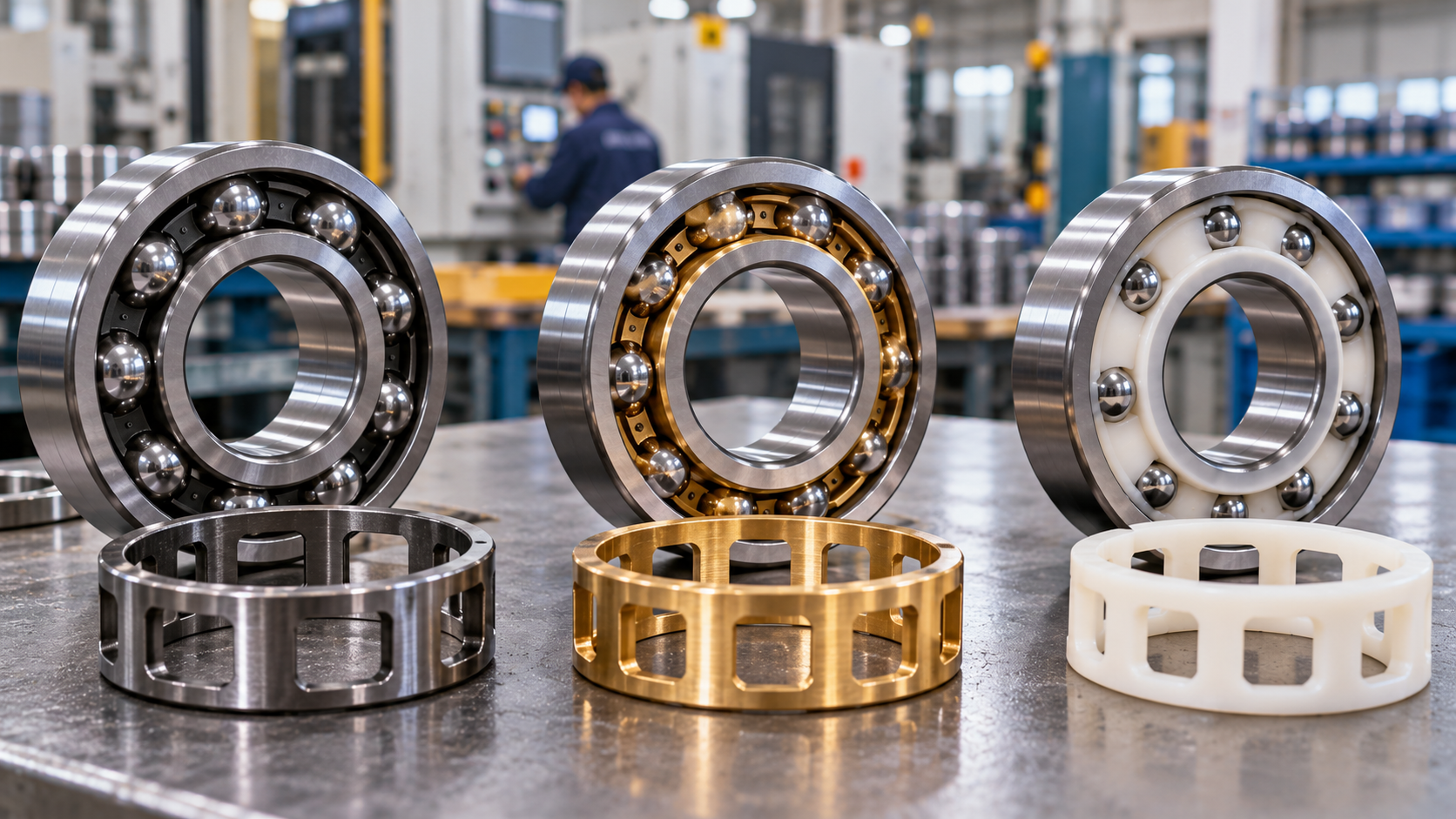
Pressed steel is the default cage in deep groove ball bearings, and for good reason. It is stamped from thin sheet, so it costs little, and it is light enough that it adds almost nothing to the rotating mass. For an ordinary duty such as a small motor, a fan, or a light gearbox, a pressed steel cage is the right answer and paying to upgrade buys nothing.
Pressed Steel
The cage is formed in a press and riveted or crimped together. The pockets are smooth and the whole part is cheap to make in volume. This is what ships as standard on the majority of catalog sizes.
On fast, light duty machinery a pressed steel cage is still the normal choice, because retainer weight matters more at speed than pocket strength does.
Machined Steel
A solid cage is cut from bar stock instead of sheet. The pockets are stronger and the retainer holds its shape when the load reverses quickly or when the bearing sees repeated shock. It costs more because every pocket is machined rather than formed.
04Brass and Bronze Cages
Machined brass and bronze retainers are the traditional choice for heavy duty and for hot running applications. They are stronger than steel cages at the same temperature, they slide more easily against the balls, and they tolerate a leaner lubricant film before wear starts.
Where Brass Earns Its Place
Brass pays for itself on machines where an unplanned stop costs more than the bearing. Think of a process line that runs hot, a machine that cannot be reached easily for greasing, or a drive that sees reversing loads all day. It is heavier than steel and it costs more, so it is rarely the default on a standard size such as the 6304.
Bronze behaves much like brass in service and differs mainly in how it is made and how it wears. When a drawing calls out a bronze cage, the reason is usually the same one, a hot or hard to reach duty where the bearing has to survive a thin film of lubricant.
05Nylon and Polymer Cages
Molded polymer cages are the common choice for small and medium deep groove ball bearings running fast. The surface is smooth, the part is light, and the sliding friction between cage and ball is lower than any metal option. That combination keeps noise and running temperature down.
Where Polymer Fits and Where It Does Not
Polymer belongs on light to medium loads at higher speeds, which is why it turns up so often in electric motors, power tools, and small actuators. It is a poor choice in hot running equipment and in machines that see aggressive solvents or washdown chemicals, because a polymer cage will not hold its shape the way steel or brass will.
06The Cage Decision Table
| Cage material | Weight | Tolerance of poor lubrication | Typical fit | Main limit |
|---|---|---|---|---|
| Pressed steel | Low | Moderate | General duty, standard sizes | Pocket strength on shock loads |
| Machined steel | Medium | Good | Reversing and shock loads | Higher cost than pressed |
| Brass or bronze | Higher | Good | Hot running and hard to reach machines | Cost and mass |
| Molded polymer | Lowest | Moderate | Fast, light duty, quiet running | Heat and aggressive chemicals |
Read the table from the left. Weight and cost climb together as you move down the rows, and what that money buys is tolerance of a leaner lubricant film plus a harder working life. Nothing in the table raises the load rating of the bearing.
07What the Cage Does Not Fix
A cage is often blamed for problems it did not cause. Changing the retainer is a reasonable move only after the real cause is understood.
• A load problem. If the applied load exceeds the rating of the bearing, a stronger cage only delays the damage.
• A fit problem. Wrong shaft or housing fit loads one side of the raceway regardless of the cage inside.
• A lubrication problem. Dry running destroys any retainer. The cage material changes how long it lasts, not whether it survives.
• A speed problem. Above the published limit, ball and cage forces climb together and no retainer choice solves it.
08Reading the Cage in a Part Number
Cage codes are short and easy to miss. A letter or two after the size can mean the difference between a standard part and a special build, and the suffix is often the only place the choice is recorded. The full system is covered in our guide on how to read a bearing code.
When the marking has worn away, the reliable route is to describe the duty rather than guess the code. Send the size, the speed, the load, and the environment, and we will confirm which retainer fits. A common example is the 6204 bearing, which ships with a pressed steel cage as standard and takes a machined retainer on request.
Where the marking is worn and the duty is ordinary, the standard retainer is almost always the right answer. Special cages earn their place on special machines, not on the strength of a catalog page.
What We Confirm Before We Quote
Cage material, clearance group, and seal type for the size you need.
Whether your duty calls for a standard retainer or a machined one.
The size that matches your shaft and housing, including sizes such as the 6004 and the 6304.
09Questions Buyers Ask
Is a brass cage better than a steel cage?
Only where brass strengths matter. Brass holds up better in heat and on a thin lubricant film, and it costs more. On a normal duty bearing a pressed steel cage will outlast the application.
Can I swap a steel cage for a polymer cage?
It depends on speed, load, temperature, and the lubricant in use. Polymer is a good move on fast, light duty with a compatible grease, and a bad move on hot running equipment or in a washdown chemical environment.
Which cage do common sizes such as the 6204 and the 6304 ship with?
Both are normally supplied with a pressed steel cage. A machined retainer can be built for either size when the application justifies it. See the 6304 bearing page for the standard configuration.
Does the cage material change the published load rating?
The rating on the drawing belongs to the bearing as a standard build. A different retainer can change how the bearing behaves under shock or at speed, but it does not raise the catalog figure.
Does the cage affect noise?
Yes. A molded polymer retainer runs quieter than a metal one at the same speed because the sliding contact is smoother. That is why polymer cages are common in small motor bearings.
Tell Us How the Bearing Runs
Send the size, the speed, the load, and the environment. We will confirm the cage build, the clearance group, and the seal that fit the duty, and quote the size you actually need.