
 English
 French
 German
Deep Groove Ball Bearing with Tapered Bore
Tapered Bore
A deep groove ball bearing with tapered bore has a hole that is not a cylinder. The bore is ground on a 1 to 12 taper, so the ring slides onto a matching sleeve and locks as it is driven axially. Everything about the mounting changes with that one feature.
This page covers what the taper does, why a machine would ask for it, how the fit and the clearance are set, and what has to be on the drawing before a supplier can quote. It is written for the buyer or the maintenance engineer who has a shaft in front of them and a decision to make.
01What a Tapered Bore Is
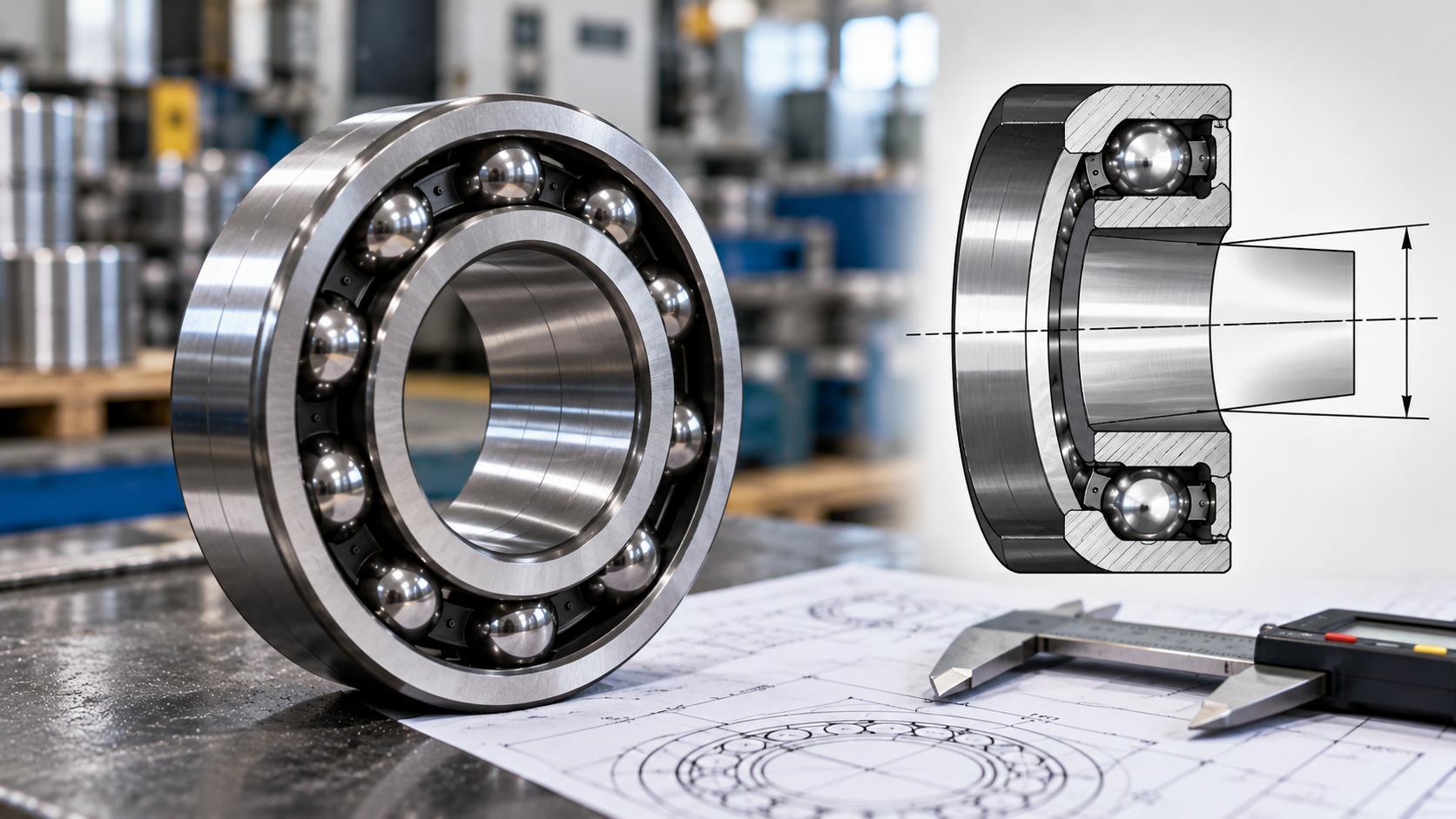
On a deep groove ball bearing, a tapered bore is a bore whose diameter changes along its length. It is ground to a 1 to 12 ratio, so the diameter changes by 1 mm for every 12 mm of axial length. The ring is thinner at one face and thicker at the other.
That taper is not there for looks. It lets the ring clamp onto a shaft or a sleeve without a press fit sized before assembly. Drive the ring along the taper and the bore closes onto the seat. Drive it back and the grip releases.
Why 1 to 12
The 1 to 12 ratio is the standard taper for adapter and withdrawal sleeves, and it is the ratio that most tapered bore bearings are ground to. It is shallow enough that the ring does not slide off under load and steep enough that a small axial movement produces a usable change in fit.
A shallow taper also means the axial travel for a given fit is small, which suits a shaft with limited room at the end.
02Why a Machine Would Ask for It
The reason is almost always assembly and removal, not load capacity. A cylindrical bore bearing needs an interference fit that is decided when the shaft is machined. A tapered bore bearing gets its interference at installation, and it can be released again without a press.
The Machines That Ask For It
That matters on three kinds of machine. Long shafts that are hard to press into, positions that are serviced in place rather than in a workshop, and drives where the same bearing size is used across several shaft diameters with different sleeves.
A second reason comes up in repair work. When a shaft journal is worn or undersized, a sleeve on a tapered seat restores a clean mounting surface without reworking the shaft. That is a repair decision with limits, but a real one.
03How the Bore Changes the Fit
On a cylindrical bore, the fit is set by the shaft tolerance. On a tapered bore, the fit is set by how far the ring travels up the taper. Two bearings of the same size can be mounted with different interference on the same shaft by driving them different distances.
Fit and Clearance Move Together
The fit tightens as the ring moves toward the small end of the taper. The inner ring stretches slightly as it goes, which is why the internal clearance closes at the same time. Fit and clearance move together, which is the property to understand before touching a nut.
The outer ring does not change. A deep groove ball bearing with a tapered bore has the same outside diameter, width, and load rating as the cylindrical version of the same size. Only the bore and the mounting method differ.
04Adapter Sleeves and Withdrawal Sleeves
An adapter sleeve is a thin tapered sleeve with a thread at the small end and a nut. The bearing goes on the sleeve, the sleeve goes on the shaft, and tightening the nut drives the bearing up the taper. A lock nut and washer hold the setting.
A withdrawal sleeve works the other way. It sits between the bearing and a shoulder and is pulled out of the bore with a nut or a withdrawal tool. That makes it the choice where the bearing has to come off a shaft with no room at the end.
Both sleeves are bought to the shaft diameter and the bearing bore, and both are ground to the same 1 to 12 taper. The sleeve belongs in the inquiry, because a bearing quoted without one is half an assembly.
05The Axial Drive In and What It Does to Clearance
Driving the ring up the taper closes the bore, stretches the inner ring, and reduces the internal clearance. The three happen together, and the amount of each is set by how far the ring travels. That travel is the number the fitter has to control.
The control method is a feeler gauge or a dial indicator, not a torque wrench. Measure the clearance before the drive in, drive in small steps, and measure again. Stop when the clearance reaches the figure that goes with the duty. Tightening the nut to a torque value tells you nothing about the fit.
Too little drive in leaves the ring loose on the taper, and it creeps and wears the seat. Too much uses up the clearance, and the bearing runs hot from the first hour. Neither failure shows up at installation. Both show up in the first month.
06Cylindrical Bore and Tapered Bore Side by Side
| Point | Cylindrical bore | Tapered bore |
|---|---|---|
| Fit | Set by the shaft tolerance before assembly | Set at assembly by the axial drive in |
| Mounting | Press or heat, needs access to the shaft end | Sleeve and nut, can be done in place |
| Removal | Press or puller, risk of damaging the seat | Release the nut and the ring slides off |
| Clearance | Fixed by the group ordered | Reduced by the drive in, set on site |
| Shaft surface | Must be ground to tolerance | Sleeve provides a fresh seat |
| Parts to buy | Bearing only | Bearing plus sleeve plus nut and washer |
The table is the whole argument in six rows. A tapered bore buys mounting flexibility and pays for it with an extra part and a setting step that has to be done correctly.
07What Belongs on the Drawing
A tapered bore inquiry that leaves out any of the five fields below will come back with a question, or worse, with a part that fits the wrong sleeve. Write them on the drawing and in the email.
1. The taper. State 1 to 12 and say whether the bore is tapered through or tapered with a straight section. The two are not the same part.
2. The size and the sleeve. Give the bearing designation or the bore at the large end, and name the sleeve if one is already on the shaft.
3. The fit and the clearance. Say what the shaft or sleeve seat measures and what clearance the duty needs. If the sleeve is new, send its drawing.
4. The precision grade. ABEC-1 through ABEC-5 covers most duties. A spindle or a measuring position needs the tighter end of that range.
5. The closure and the lubricant. Open, shielded, or sealed, and the grease or oil the machine will run. A sealed bearing on a sleeve has less room for a relubrication path.
One more line helps more than any of them. Say what the machine does and how it is serviced. A bearing changed in place every two years and one that runs a decade between overhauls get different answers on grade and closure.
08Assembly and Removal Notes
The sequence below keeps the fit and the clearance predictable. Skipping the measurement steps is how a tapered bore gets a reputation for being difficult.
1. Clean the taper. Wipe the sleeve and the bore, then check for burrs with a fingernail. A chip on a taper tilts the ring and shows up as runout.
2. Check the seating. Slide the ring on dry and confirm it seats without rocking. Blue check on the taper shows whether the contact is even.
3. Measure the clearance before the drive in. Record the number. That is the baseline the final setting is measured against.
4. Drive in small steps. Nut on, a fraction of a turn at a time, clearance check between steps. Stop at the target and lock the nut.
5. Record the drive in and the final clearance. Both numbers, with the date. The next fitter needs them more than the drawing does.
Measuring the Drive In
Measure the axial movement of the nut or the ring, not the number of turns. Turn count depends on thread pitch and on how far the nut started from contact, so it is not a number you can compare between machines.
For removal, release the nut and let the ring come back down the taper before pulling. A ring that is still tight on the taper will fight a puller and take the seat with it. On a 6204 bearing size, that seat is small enough that a scored journal means a new shaft.
09Where a Tapered Bore Is a Bad Idea
The taper is not an upgrade. It is an interface choice, and it is the wrong choice in four situations.
• The shaft end is short. The sleeve and nut need axial room. On a stub shaft there is nowhere for them to sit.
• Nobody will measure the clearance. A tapered bore set by feel and torque alone will be wrong on some machines. If the maintenance team cannot measure, use a cylindrical bore.
• The duty needs a tight axial position. Every drive in changes the clearance, and the clearance sets the axial movement. A shaft where axial position matters is easier to control with a fixed bore.
• The sleeve would be the only thing locating the shaft. A sleeve carries the bearing. It does not replace the shoulder or locknut that holds the shaft in place.
A 6304 bearing at 20 x 52 x 15 mm is rated 16.0 kN dynamic and 7.88 kN static in the cylindrical version. A tapered bore version carries the same rating when it is mounted correctly, and less when it is over driven. The bore does not add capacity. It changes how the capacity is delivered.
10Questions Buyers Ask
Is a tapered bore bearing stronger than a cylindrical one?
No. The rings, balls, and groove are the same. The tapered bore changes the mounting interface, not the load rating, and an over driven ring reduces the life rather than raising it.
Can I mount a tapered bore bearing without a sleeve?
Only if the shaft itself is ground to the same 1 to 12 taper. Most machines use a sleeve because grinding a taper on the shaft is more work than buying one.
How do I know when to stop driving it in?
When the measured internal clearance matches the target for the duty. Stop on the clearance, not on a torque value and not on a turn count.
Does a tapered bore change the speed limit?
Not by itself. The closure and the lubricant set the speed limit, and a sealed version runs slower than an open one at the same size, as with any 6305 bearing in the range.
Do you make tapered bore deep groove bearings?
Yes, to drawing. Send the taper, the size, the sleeve if there is one, the precision grade, and the closure, and we will quote it as a custom part.
Send the Taper and the Seat Dimension
Tapered bore deep groove bearings are built to drawing, so the drawing is where the quote starts. Send the bore taper, the sleeve or shaft seat, the grade, and the closure, and we will come back with a part that mounts the first time.



Related Products