
 English
 French
 German
Bearing Fit Too Tight or Too Loose: Reading the Damage
Failure Analysis Desk
Bearing fit problems leave marks on the shaft and the housing, and those marks say which way the fit went wrong before anyone reaches for a micrometer.
A bearing that came out with a polished bore and a blue tint did not fail from load. It rotated where it should have been held. This page reads four common witness marks, then sets out how to measure and correct each one.

01What the Witness Marks Tell You
A correct fit leaves almost nothing behind. The ring sits still, the seat keeps its surface, and the bearing comes off with a puller and no drama. Anything else on the seat is information.
Read the marks in this order. Is the damage on the bore or the outside diameter. Is it a continuous band or a set of patches. Is the metal polished, smeared, or oxidized.
02Inner Ring Creep and the Polished Band
What it means. The inner ring turned on the shaft. That is a loose fit, and it usually happens where the inner ring is the rotating member, such as a shaft in a gearbox or a fan. The ring walks around the seat, polishing both surfaces as it goes.
How to measure. Measure the shaft at the wear band and again at an unworn section next to it. Compare the two readings, then check roundness at several points around the band. A shaft that is smaller at the band has lost material.
How to correct. Replace or repair the shaft, or fit a repair sleeve if the design allows it. A new bearing on a worn seat will creep again, and the second failure usually comes faster because the seat is now smoother. If the seat reads good and the ring is the wear item, fit the original size, for example a 6207 deep groove ball bearing, in the same clearance class.
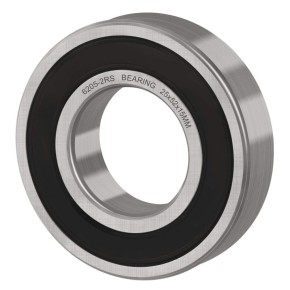
The ring bore shows the same slip: a polished band with a friction tint. Check it against the outer ring from the same housing, as you would on a 6205 bearing.
03Bright Spots on the Shaft Seat
Bright patches with a reddish brown powder are a different fault with a similar cause. This is fretting: micro motion under a fit loose enough to move, not loose enough to rotate.
What it means. The machine vibrates, or the load reverses, and the ring rocks on its seat by a few microns. The oxide powder that forms is abrasive, so the fit gets looser as the powder works its way around.
How to measure. Clean the seat first, then measure. Oxide powder hides the depth of the damage, and a reading taken over it will be wrong. Check for a step at the edge of the seat.
How to correct. Restore the seat dimension, then remove the vibration source if it can be found. A fit that was correct for a smooth machine can be marginal on a machine that shakes.
A mark you cannot measure is a mark you cannot fix
Photograph the seat before cleaning, then measure after. The photo shows the pattern, the micrometer shows the size, and the repair decision needs both. Send both with the bearing size and we will say whether the seat is reusable. Send the measurements.
04Scored Housing Bore and Pulled Metal
A tight outer ring leaves a different signature. The bore shows score lines along the press direction, metal smeared at the entry, and patches on the ring outside diameter where the surface has been rubbed smooth.
What it means. The outer ring was pressed in with too much interference, or it went in crooked and the bore was cut by the ring edge. The ring is now compressed, and internal clearance is smaller than the drawing allows. On a thin-wall outer ring, such as the 6805 thin-section deep groove ball bearing, the lost clearance shows up as heat before it shows up as noise.
How to measure. Measure the bore at two depths and in two directions at each depth. A bore that is smaller at the entry than deeper in was cut by a skewed installation, not by the fit itself.
How to correct. Bore out and sleeve, or replace the housing if the damage is deep. For the next install, heat the housing and drop the ring in square. Pressing is the fallback.
05Bright End Faces
A polished ring face, especially a narrow arc rather than a full ring, points to axial clamping. Either the clamp is too heavy, or the face it clamps against is not square.
What it means. The ring is being tilted or crushed by a shoulder, a spacer, or an end cap that does not sit flat. The face polishes where contact is heaviest, and the opposite side may show a matching arc.
How to measure. Check the shoulder for squareness with a dial indicator on the shaft, and the spacer for a burr or a nick. Look for a step at the shoulder to bore junction, which stops the ring seating.
How to correct. Face the shoulder square, replace the damaged spacer, and set the clamp by the drawing rather than by feel. A ring clamped on one side only loses its seating and starts to tilt under load.
06The Symptom Table
Use this as a first pass on the bench. Sections seven and eight cover the measurements behind it.
| What you see | Which way the fit went | What to measure | What to change |
|---|---|---|---|
| Continuous polished band on the shaft | Inner ring too loose, ring rotating | Shaft diameter at the band against an unworn area | Shaft or sleeve, not just the bearing |
| Bright patches with brown powder | Inner ring loose under vibration | Shaft roundness and step at the seat edge | Seat dimension and the vibration source |
| Scores and smeared metal in the bore | Outer ring too tight, or pressed in skewed | Bore at two depths in two directions | Housing repair, heated installation |
| Polished arc on a ring face | Axial clamp too heavy or shoulder not square | Shoulder squareness, spacer condition | Square shoulder, correct clamp |
| Polished outside diameter in patches | Outer ring loose in the housing | Bore roundness at several points | Housing repair, correct fit grade |
07Measuring Is the Only Verdict
Marks narrow the question. Numbers answer it. Two bearings can leave identical marks for opposite reasons, and only a measurement separates them.
The shaft
Use a calibrated micrometer and take readings at two planes, in two directions at each plane. A shaft worn by creep is often slightly oval, and one reading across the band will miss it.
The housing
Use a bore gauge set against a ring or a gauge block. Read at two depths and two directions. A housing that is tight at the entry and correct deeper in was damaged during installation, and the fit grade itself may be fine.
Roundness and taper
Both matter as much as the size. A seat can measure correct on average and still be oval enough to squeeze the ring. Taper matters on a housing bored on a worn machine, because the ring will only contact the narrow end.
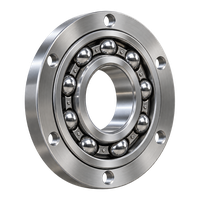
The same logic applies to a crossed roller bearing in a rotary table, where the ring seats on a face. A square shoulder matters as much as the diameter there.
08Setting the Fit for the Next Bearing
The fit grade follows the duty. The ring that rotates relative to the load needs the interference. On a shaft in a gearbox driven by a deep groove ball bearing, that is usually the inner ring. On a wheel hub it may be the outer.
Heat, do not hammer
Warm the ring or the housing evenly, and keep the heat below the level that changes the ring material. Never strike a ring face with a hammer or drift. A single blow puts a dent in the raceway that will show up as noise within a shift.
Never knurl a shaft
Knurling raises metal without restoring the dimension, and the peaks flatten the moment the ring goes on. The seat ends up loose again with a worse surface. A sleeve or a new shaft is the honest repair.
Write the readings on the job sheet with the date. For the failure patterns that follow a bad fit, see our article on why bearings fail.
09Frequently Asked Questions
Can a retaining compound fix a loose fit?
For light fretting and a seat still close to size, a retaining compound can hold a ring that would otherwise creep. It will not restore a shaft that has lost material, or survive a seat that is oval.
Which ring should carry the interference fit?
The ring that rotates relative to the load direction. In most shaft applications that is the inner ring. Where the housing rotates and the load stays put, the outer ring takes the interference instead.
Is a tight fit always safer than a loose one?
No. Too much interference reduces internal clearance, distorts the ring, and can crack a thin outer ring during installation. It also makes removal destructive, which turns a bearing change into a housing repair.
Can I reuse a bearing that has been creeping?
Rarely. The bore is polished and slightly worn, so the ring has lost the fit it needs. A bearing that ran with a loose inner ring also carries heat damage that is hard to see.
Why is there a bright mark on the ring face?
Something is clamping or tilting the ring. Check the shoulder squareness, the spacer, and the end cap. A face that polishes in an arc is sitting on a high spot.
Send the bearing size, the seat readings, and a photo of the marks, and we will say whether the seat needs repair before the next bearing goes in. Contact our engineers.



Related Products