

 English
 French
 German
How to Store Bearing Grease So It Still Works
Lubrication Store Desk
Grease storage decides how much of the grease you paid for is still grease when the gun is filled, and the damage happens long before anyone notices it.
A pail that sat through a summer in a steel shed, or a gun that rode in a hot service van, can look perfect and still deliver oil that has separated from its thickener. The five stages below follow a container from the dock to the bearing.
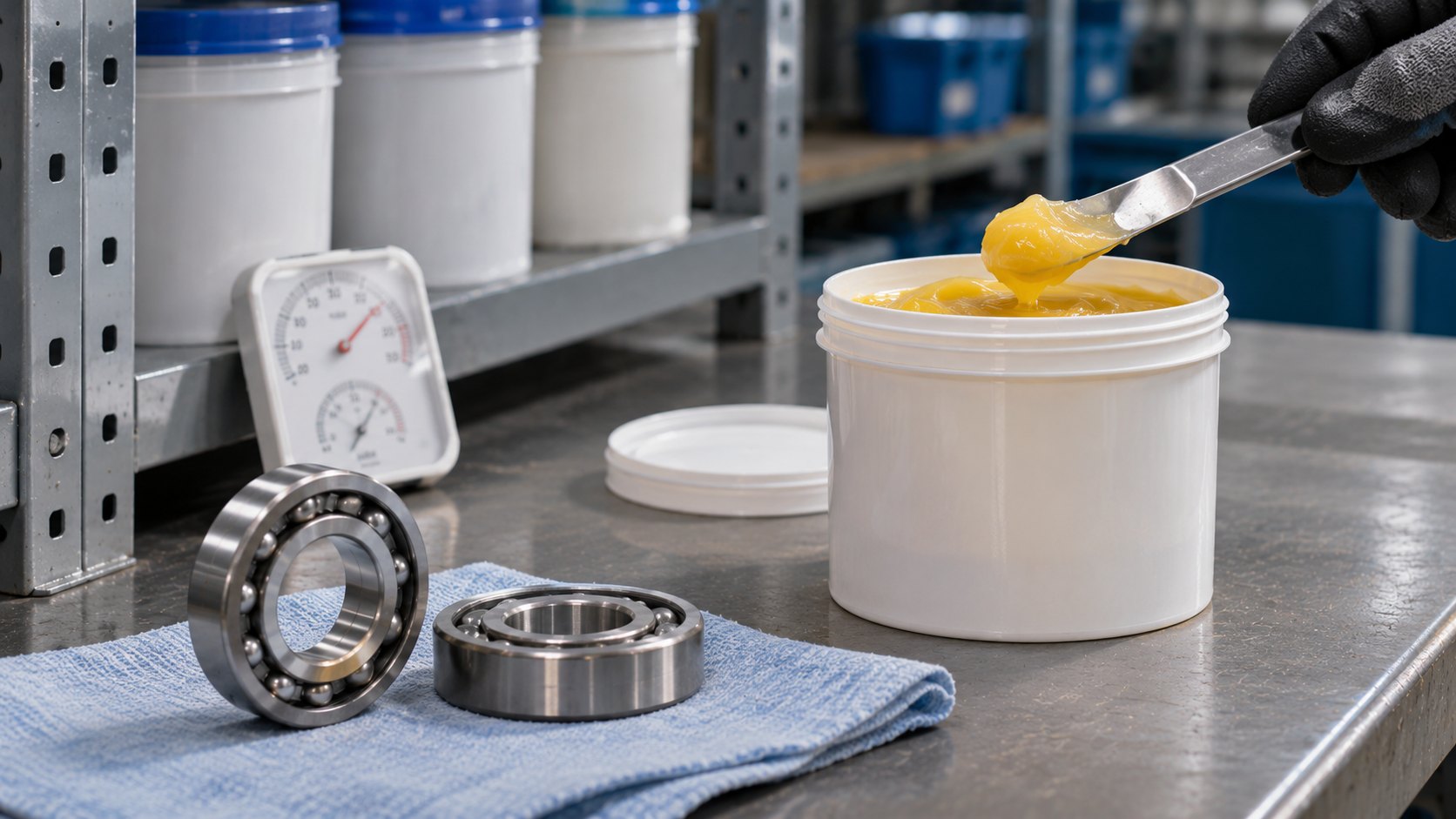
01Why Grease Ages in a Warehouse
Grease is a base oil held inside a thickener structure, with additives for oxidation, wear, and rust. Nothing in that structure is permanent. Given time, temperature swings, and air, the oil works its way out and the soap matrix stiffens.
The bearing itself is the last link in that chain. A deep groove ball bearing with a sealed grease charge has no way to reject degraded lubricant once it is inside the cavity.
Oil separation
Oil bleeds out of the thickener and pools. In a clear container you see a film on the surface or a thin layer at the bottom. The grease left behind is drier than the label claims, and it will not release oil into a contact the way it should.
Thickener hardening
Soap fibers pack closer over time, especially after repeated warming and cooling. The result is a crust at the surface and a grease that no longer flows to the gun fitting. A stiff grease in a sealed bearing can simply sit in one place and never reach the ball path.
Container breathing
A metal pail that warms during the day and cools at night pulls air in through the lid gasket. Each cycle carries moisture with it. Water under the lid is the start of rust on the grease surface and on any steel it later touches.
02Stage One. Arrival at the Dock
Most grease arrives already stressed. A delivery truck bed in direct sun is hotter than the store it is heading for, and a pail that has been warm for a day has already begun to separate.
The signal. A pail that is warm to the hand, a bulged lid, an oil ring around the rim, or a carton that came off a wet pallet.
The action. Let containers stand at room temperature before opening, log the batch and the arrival date, and send back anything with a broken seal or a deformed lid. A bulged pail has been pressurized from the inside.
03Stage Two. Inbound Storage
Grease is a consumable with a clock on it, the way a pre-greased 6004 bearing is. Both are bought on a schedule and both lose value if they sit in the wrong corner of the store.
The signal. Pails on the floor against an outside wall, cartons in front of a window, drums next to a space heater, or a stock where the newest container is at the front of the shelf.
The action. Pallet everything off the floor, keep the store at a steady temperature away from sunlight, and rotate on first in, first out. Write the arrival date on the carton in marker, on the side that faces the aisle.
Steady matters more than cool. A container that cycles between a cold night and a warm afternoon breathes more than one held at a constant temperature, even if that constant is warmer than the night air.
04Stage Three. Opening the Container
Contamination enters at the moment of opening, not before. A pail opened in a dirty workshop and left with the lid resting on top is collecting everything the grinder throws.
The signal. Grit at the rim, a scoop left standing in the grease, a lid with no date on it, or a container that has been open so long nobody remembers when it was.
The action. Open the smallest container that matches the job, wipe the rim before and after, reseal with the lid seated flat, and date the lid. Keep the scoop out of the pail, and never put unused grease back.
Returning grease to the pail is the single habit that ruins more containers than any storage fault. The grease that came out has been in a coupler, on a rag, and in contact with air. It does not go back in.
05Stage Four. Filling the Gun
The gun is a storage container too, and a small one. It holds a charge for weeks in a toolbox, a truck cab, or on a machine frame, and it is opened to the air every time it is uncapped.
The signal. Grease weeping at the coupler, a hardened plug at the nozzle, two colours meeting inside a partly used cartridge, or a gun that has been stored in a vehicle through a hot spell.
The action. Purge a few strokes to waste before the coupler goes on a fitting, cap the coupler when the gun is put away, and keep one gun per grease family. A gun that has held two greases is a mixing experiment.
On the machine side, the same discipline applies at the fitting. A 6205 bearing under a dirty coupler takes the grit that was sitting on the nipple. Wipe the fitting before the coupler goes on, not after.
06Stage Five. Past the Date on the Label
The date on the pail is the maker’s statement about the grease in the condition it was packed. Storage conditions move that date in both directions, so the date is a prompt to look, not a verdict.
What the date covers
It assumes an unopened container held at a steady temperature. It says nothing about a pail opened eighteen months ago in a damp store, and it says nothing about a cartridge that has been in a warm cab.
Judging a container past its date
Look at the surface, smell it, and stir a small amount on a clean plate. Free oil on top, a skin that will not break down, a sharp or sour smell, or water under the lid all mean the container is finished for bearing work.
Grease that fails the look test is not automatically scrap for every use, but it should not go into a sealed bearing. If a batch is in doubt, our team can advise on the replacement charge for the bearings you buy from us, including the grease family each order ships with.
Sealing matters here as much as storage. The difference between a shielded and a sealed bearing, covered in ZZ and 2RS bearings, decides how much of the surrounding dirt ever reaches the grease in the first place.
07The Warehouse Check Sheet
A short walk through the store once a month catches most of this. The table is written to be used as a list, not read once.
| Check | What a pass looks like | What fails |
|---|---|---|
| Container condition | Lid seated, no oil ring at the rim, no bulge | Dented, weeping, or a lid that has popped |
| Position | On a pallet, off the floor, out of sunlight | Against an outside wall or under a window |
| Temperature | Steady through the day, no local heat source | Next to a heater, door, or press |
| Age marks | Arrival date written and visible from the aisle | No date, or the oldest stock at the back |
| Open pails | Sealed, dated, scoop stored outside the grease | Open, undated, scoop standing in the pail |
| Guns | Capped, one grease family per gun, clean coupler | Weeping coupler, mixed colours, stored in a cab |
| Rejected stock | Quarantined and labelled | Back on the shelf because it looked fine |
08Frequently Asked Questions
Does grease go bad in an unopened container?
Yes, more slowly. The seal limits air exchange but does not stop oil separation or oxidation. An unopened pail held for years at a steady temperature is usually better than an opened one, not immune.
Should grease be kept in a cold room?
No. Steady temperature matters more than low temperature. A cold store that swings warm each time the door opens causes condensation inside the pail, which is worse than a stable warm store.
Can I top up a new pail with the last of the old one?
Not if you want a known grease. The mixture has an unknown age and an unknown contamination load. Finish the old container on a low risk point, or dispose of it, and open the new one clean.
How can I tell if grease has separated?
Look for free oil on the surface, a thin liquid layer at the bottom of a clear container, or grease that will not hold its shape on a spatula. All three mean the thickener has released oil it will not take back.
Does storage matter for grease already inside a sealed bearing?
It does, because the bearing is stored too. A carton kept in a hot, damp corner can arrive with grease that has softened against the seal. Ask for the packing date when a bearing has sat in your own store for a long time.
Send us the bearing size, the duty, and how the machine is stored, and we will confirm the grease charge and the seal type that suits it. Contact the engineering desk.



Related Products