
 English
 French
 German
Ceramic vs Steel Ball Bearings
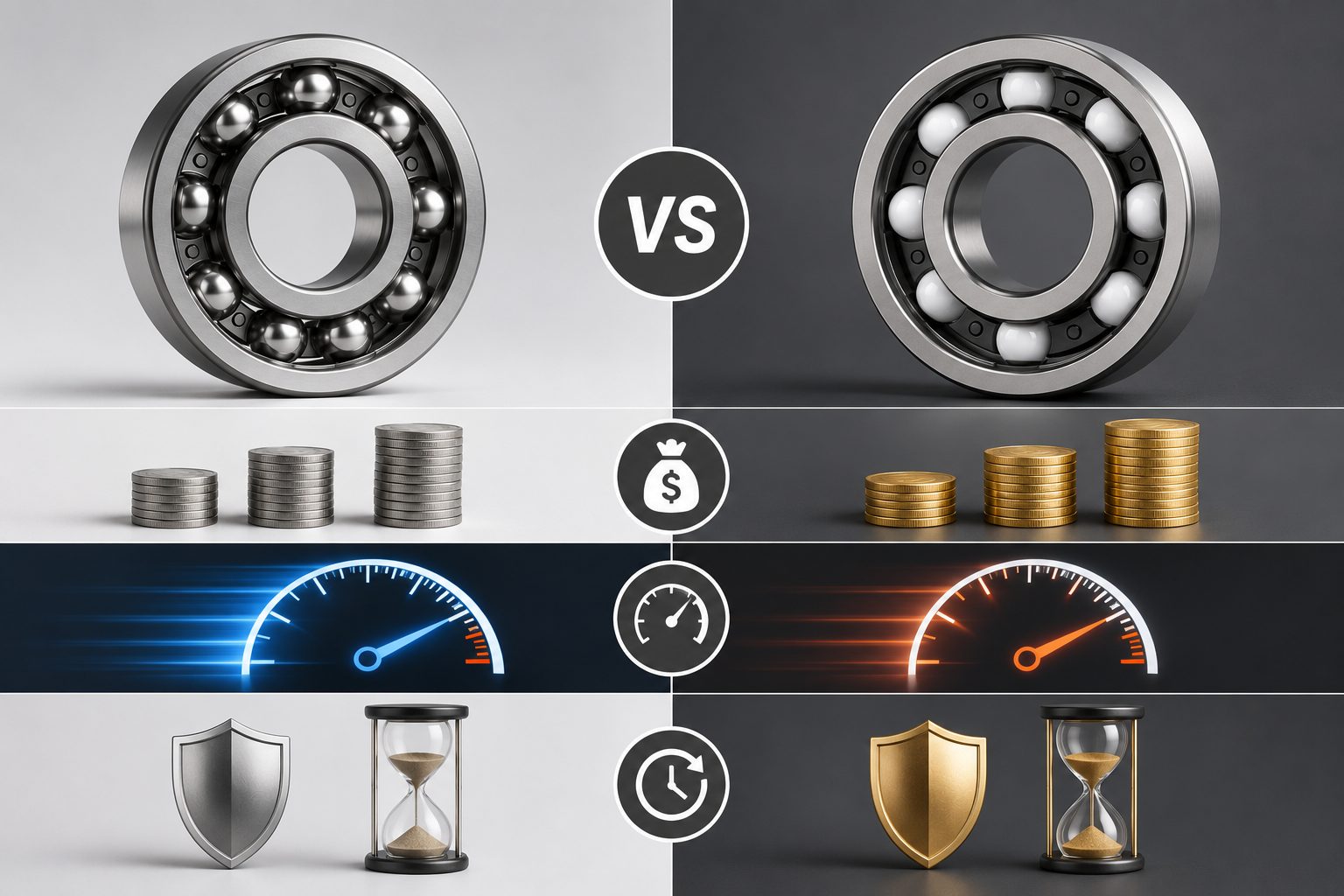
The ceramic vs steel ball bearings comparison starts with a simple fact: a steel ball bearing and a ceramic ball bearing look similar from the outside. Same rings. Same cage. The difference is in the balls themselves. That single material change shifts speed limits, operating temperature, electrical behavior, and cost by an order of magnitude. This comparison covers the five decisions that determine which bearing type works for your application: speed requirements, load conditions, operating temperature, environmental exposure, and budget.
At a Glance
Ceramic hybrid bearings use silicon nitride (Si3N4) balls with steel rings. The ceramic balls are 60% lighter and roughly twice as hard as bearing steel. This gives them 40-50% higher speed limits and lower operating temperatures. The trade-off: ceramic bearings cost 3-10 times more than all-steel equivalents. For most general industrial applications, steel bearings remain the practical choice. Ceramic bearings earn their premium in high-speed, high-precision, electrically sensitive, or extreme-temperature environments.
| Property | Steel (GCr15 / AISI 52100) | Ceramic (Si3N4) |
|---|---|---|
| Density | 7.8 g/cm³ | 3.2 g/cm³ (59% lighter) |
| Hardness | 700 HV (HRC 60-64) | 1,500-1,700 HV |
| Young’s Modulus | 210 GPa | 310 GPa (48% stiffer) |
| Thermal Expansion | 12.5 × 10⁻⁶ /K | 3.2 × 10⁻⁶ /K (74% lower) |
| Max Use Temperature | ~120°C (standard) / 150°C (heat-stabilized) | ~800°C (ball material only; rings and cage limit practical range) |
| Electrical Conductivity | Conductive | Insulating (prevents EDM current damage) |
| Magnetic | Ferromagnetic | Non-magnetic |
| Corrosion Resistance | Rusts without coating or stainless steel grade | Inherently corrosion-resistant |
| Relative Cost (6000 bearing series) | 1× (baseline) | 3-10× (hybrid); 10-50× (full ceramic) |
How Material Properties Drive Performance
Standard deep groove ball bearings use GCr15 chromium steel (equivalent to AISI 52100) for both rings and balls, through-hardened to HRC 60-64. A ceramic hybrid bearing keeps the steel rings but replaces the balls with silicon nitride (Si3N4), a technical ceramic produced by sintering silicon powder in a nitrogen atmosphere.
The density difference is the first thing engineers notice. At 3.2 g/cm³, Si3N4 is 59% lighter than bearing steel at 7.8 g/cm³. Centrifugal force on each ball scales with mass, so lighter balls generate less force against the outer ring. This translates into higher speed capability and less heat generation, the two advantages that drive most ceramic bearing applications.
Hardness tells the second story. GCr15 steel tops out around 700 HV. Silicon nitride measures 1,500 to 1,700 HV, more than double. Higher hardness means better wear resistance, especially under marginal lubrication or when contamination enters the bearing. The trade-off is fracture toughness. Si3N4, like all ceramics, is brittle. It handles compressive loads well, the kind ball bearings normally see, but a sharp impact can crack a ceramic ball. Steel balls deform plastically under overload; ceramic balls can fracture.
Thermal expansion is where Si3N4 diverges most from steel. Its coefficient of thermal expansion is 3.2 × 10⁻⁶/K, roughly one-quarter of steel’s 12.5 × 10⁻⁶/K. This has two consequences. First, at elevated temperatures, the internal clearance of a ceramic hybrid bearing changes less than an all-steel bearing, maintaining more consistent preload. Second, the mismatch in expansion rates between ceramic balls and steel rings means the bearing’s internal fit changes with temperature, a consideration during design, not a flaw in operation.
Speed, Friction, and Operating Temperature
Ceramic hybrid bearings carry speed ratings 40-50% higher than equivalent all-steel bearings. The mechanism is straightforward. At high RPM, the balls experience centrifugal force pressing them against the outer ring raceway. This increases contact stress and generates heat. Lighter Si3N4 balls reduce this centrifugal load proportionally, allowing higher rotational speeds before reaching the same contact stress threshold.
Friction behavior differs between the two materials. Steel-on-steel contacts can experience microwelding at the asperity level, microscopic cold welding between surface peaks under load. Silicon nitride has a lower coefficient of friction against steel than steel against itself, and it does not microweld. The practical result is lower running torque and reduced frictional heating. Ceramic hybrid bearings typically run 5-15°C cooler than all-steel equivalents at the same speed and load.
Lubrication demands also differ. Steel bearings depend on a continuous lubricant film to separate rolling elements from raceways. Ceramic hybrid bearings tolerate thinner films and brief lubrication interruptions better because Si3N4 has a lower adhesion tendency with steel. They still need lubricant, but they provide a longer grace period if lubrication degrades or is temporarily lost. This characteristic makes them valuable in machine tool spindles where high-speed operation pushes lubrication to its limits.
Load Capacity and Fatigue Life
Static load ratings for ceramic hybrid bearings are comparable to all-steel bearings of the same size, within 5-10% in most catalog comparisons. This is because the load capacity is determined primarily by the ring material and geometry, not the ball material. Both types use hardened steel rings, so the contact ellipse at the ball-to-raceway interface behaves similarly.
Dynamic load capacity presents a different picture. The higher elastic modulus of Si3N4 (310 GPa vs 210 GPa for steel) means the contact area between a ceramic ball and a steel raceway is smaller at a given load. A smaller contact patch concentrates stress over a smaller area, which can reduce the calculated L10 fatigue life. However, this theoretical reduction is often offset in practice by the ceramic ball’s superior surface finish and higher hardness, which reduce the initiation sites for fatigue spalling.
For applications with steady loads and clean lubrication, ceramic hybrid bearings can match or exceed the service life of all-steel bearings. The caveat is shock loading. A sudden impact from a machine crash, a dropped assembly, or severe vibration can fracture a ceramic ball. Steel balls handle occasional overload by deforming; ceramic balls do not deform, they crack. Applications with unpredictable shock loads should default to all-steel bearings unless the speed advantage of ceramic is required and the load environment can be controlled.
Environmental Resistance
Corrosion resistance is a clear differentiator. GCr15 bearing steel rusts when exposed to moisture unless protected by oil, grease, or a coating. Stainless steel grades (AISI 440C) improve corrosion resistance but sacrifice hardness and load capacity. Silicon nitride is chemically inert to most industrial fluids, including water, mild acids, and common solvents. Ceramic balls do not corrode, period. For food processing, marine, or chemical plant washdown environments, ceramic balls eliminate a failure mode that stainless steel only delays.
Electrical insulation is the other advantage that has driven adoption in electric motor applications. Variable frequency drives (VFDs) create common-mode voltages that induce shaft currents through bearings. These cause electrical discharge machining (EDM) damage: microscopic pits on the raceway surface leading to premature failure. Si3N4 is an electrical insulator, blocking the path to ground. This single property has made ceramic hybrid bearings the default choice for VFD-driven motors above 100 kW in many industries.
Non-magnetic behavior matters in specialized fields. MRI machines, semiconductor wafer handling, and certain laboratory instruments cannot tolerate ferromagnetic components. Full ceramic bearings, where both rings and balls are ceramic, serve these applications. Vacuum environments also favor ceramic bearings because the low outgassing of Si3N4 simplifies lubricant selection for high-vacuum operation.
Cost Comparison
Cost is where the decision gets practical. A 6204-size all-steel deep groove ball bearing from a quality manufacturer costs a few dollars at volume. The equivalent ceramic hybrid bearing, same steel rings, same cage, Si3N4 balls, costs 3 to 10 times more depending on precision grade and quantity. Full ceramic bearings cost 10 to 50 times more than steel equivalents and are manufactured in much smaller volumes.
The cost premium comes from two sources. First, silicon nitride ball manufacturing is inherently more expensive. Steel balls are produced by cold heading wire, then ground and lapped in large batches. Si3N4 balls start as pressed powder that is sintered, then ground with diamond abrasives, a slower process with higher tool wear. Second, ceramic bearing production volumes are far lower, so economies of scale never fully close the gap.
Whether the premium pays off depends on the application. In a conveyor roller at 200 RPM, ceramic bearings add cost without benefit. In a 20,000 RPM machining spindle where bearing life determines uptime, the premium is easy to justify. The same logic applies to large electric motors where a single EDM bearing failure can cost tens of thousands in downtime. Ceramic bearings are not inherently better, they are better for conditions where steel bearings reach their limits.
Which Bearing Type for Your Application
| Application | Recommended Type | Reason |
|---|---|---|
| General industrial (conveyors, pumps, fans under 3,000 RPM) | Steel | Ceramic adds cost without meaningful benefit at moderate speeds |
| Machine tool spindles (10,000-40,000 RPM) | Ceramic Hybrid | Higher speed rating, lower heat, longer spindle uptime |
| VFD-driven motors over 100 kW | Ceramic Hybrid | Electrical insulation prevents EDM bearing damage |
| Food processing / washdown environments | Ceramic Hybrid or Full Ceramic | Corrosion resistance without stainless steel’s load penalty |
| Heavy shock loads (crushers, vibratory equipment) | Steel | Ceramic balls risk fracture under impact; steel deforms safely |
| MRI / semiconductor / vacuum equipment | Full Ceramic | Non-magnetic, electrically insulating, low outgassing |
| Turbochargers / high-temperature machinery | Ceramic Hybrid | Lower thermal expansion drift; better hardness retention at temperature |
| Budget-constrained OEM production | Steel | The 3-10× cost premium of ceramic is only justified when speed, electrical, or environmental demands require it |
The decision tree is simpler than it first appears. Start with speed. If the application runs above 10,000 RPM sustained, ceramic hybrid bearings are worth evaluating. Check electrical requirements: VFD-driven motors above 100 kW should default to ceramic hybrid to prevent EDM damage. Consider the environment: wet, corrosive, or cleanroom conditions favor ceramic. Check the load profile: steady loads are fine for ceramic; shock loads are not. If none of these factors point to ceramic, steel bearings are the right choice.
For OEM buyers needing custom bearing specifications, including ceramic hybrid configurations in non-standard sizes, Yuanhe’s custom manufacturing service produces bearings to your drawings with material certifications, inspection reports, and batch traceability. Standard lead time is 7-15 days.
Need ceramic hybrid bearings to your specifications?
Send your drawing or part number. We quote within 24 hours with material options, ABEC grade, and lead time.
Frequently Asked Questions
Do ceramic bearings need lubrication? +
Can I replace steel balls with ceramic balls in an existing bearing? +
How much longer do ceramic bearings last than steel bearings? +
Are ceramic bearings worth the extra cost for electric vehicle motors? +
What is the difference between hybrid ceramic and full ceramic bearings? +



Related Products