

 English
 French
 German
Bearing Internal Clearance Explained C2 CN C3 and C4
CLEARANCE GROUPS AT A GLANCE
Bearing internal clearance is the total play between the rolling elements and the raceways before the bearing carries any load. Two bearings with the same bore, the same seals, and the same grease can behave completely differently in the same machine, and clearance is usually the reason.
It sounds like a minor detail. In practice, it sets the running temperature, the noise level, and how much of the load capacity you actually get to use.
This article explains what clearance is, how it is measured, what the C groups mean, and why so many electric motors ship with C3.
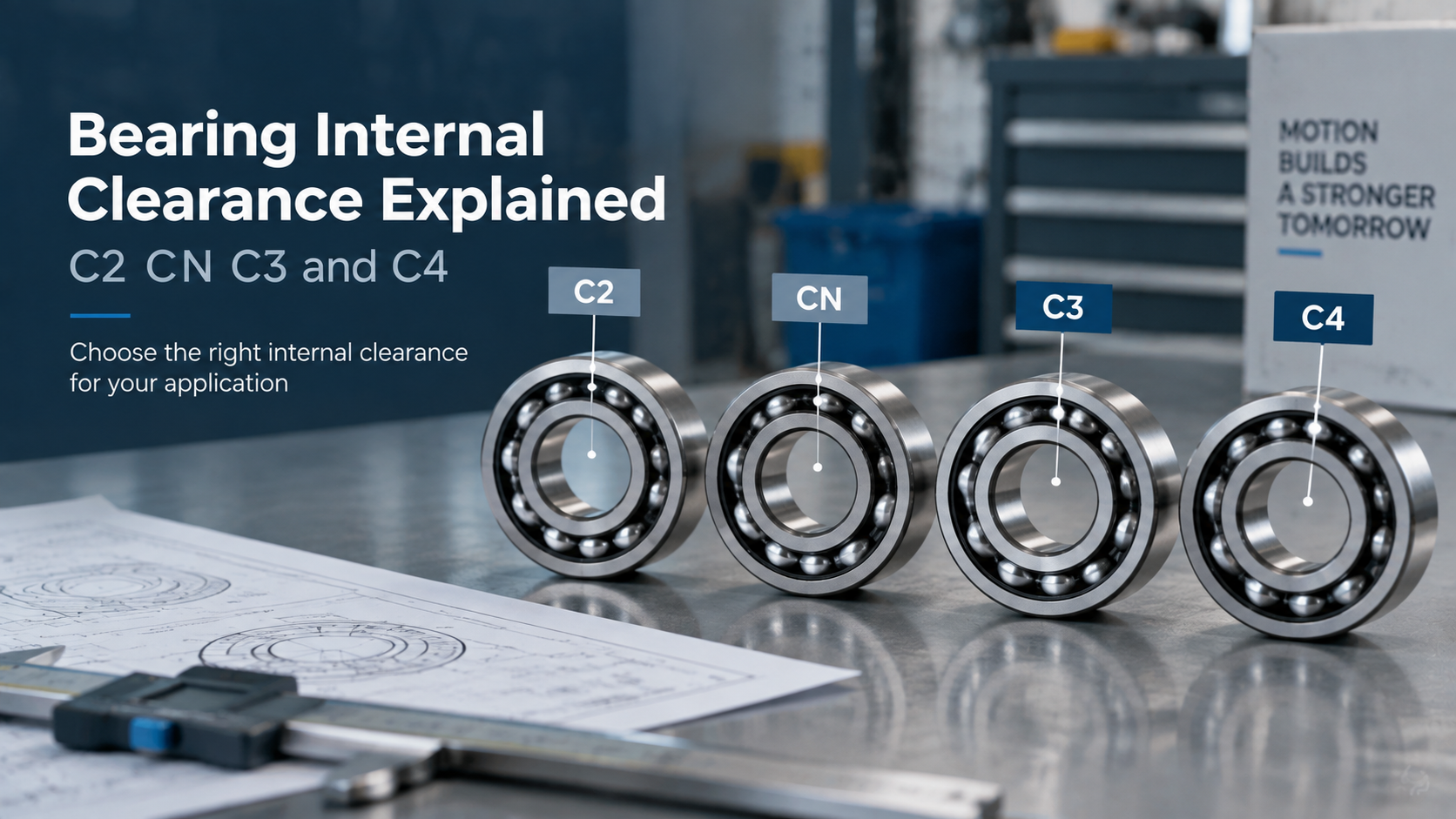
01What Internal Clearance Means on a Deep Groove Ball Bearing
Take a deep groove ball bearing in your hand and move the inner ring sideways. That small amount of movement, before the balls are squeezed, is radial internal clearance.
Three points about it are worth holding onto:
- It is built in at assembly. The manufacturer decides it by matching ring and ball sizes within a tolerance band.
- It shrinks once the bearing is mounted. Interference fits and heat both remove clearance.
- It is not the same as fit. Fit is the metal around the bearing. Clearance is the space inside it.
A bearing with too little clearance runs hot and wears fast. A bearing with too much clearance rattles, misses the load zone it was designed for, and can be noisy at low speed.
02How Clearance Is Measured
Clearance is checked in the factory and can be checked again in a metrology room.
- Radial internal clearance. Fix the inner ring or outer ring, apply a small measured force the other way, and read the movement with a dial indicator. This is the number that appears in clearance tables.
- Axial internal clearance. Push the inner ring along the axis of the bearing. On a deep groove ball bearing this is typically several times the radial value.
- Feeler gauge on large bores. On bigger bearings, technicians may use a feeler gauge between a rolling element and the raceway, though the reading is coarser.
- Temperature matters. A measurement taken on a warm bearing tells you very little. Measure at a stable room temperature.
For a shop-floor check, one bearing from a batch plus a dial indicator is enough to confirm that the group marked on the box matches the group delivered.
03What C2, CN, C3 and C4 Actually Mean
Clearance groups are tolerance bands around the nominal clearance, not single values. The bands are defined in published standards, and the letters widen in the direction of more play.
| Group | Relative clearance | Why an engineer picks it |
|---|---|---|
| C2 | Tighter than CN | Low noise, low speed, minimal temperature rise, no tight fits |
| CN | Standard | General purpose, moderate speed, moderate load |
| C3 | Looser than CN | Electric motors, temperature differentials, tight shaft fits |
| C4 | Looser again | High temperature rise, heavy or long shafts, fast thermal growth |
| C5 | Loosest shown in most catalogs | Extreme heat, special applications, check with the maker first |
CN is what arrives when nobody specifies anything. It is the right call more often than people expect.
04Why Most Electric Motors Run C3
Three effects push motor applications toward a looser group, and they stack.
The temperature differential
A motor shaft warms faster than the housing around it. The shaft grows, the housing lags, and the difference eats radial clearance. In a warm running motor, a bearing that started at CN can be running effectively tighter than a C3 by the time it reaches steady state.
The interference fit
Motor shafts are usually machined for a light interference fit so the inner ring cannot creep. As the fits guide in this series explains, each micrometer of interference on the ring removes clearance inside the bearing. Choose a tight fit and a CN group together, and you have spent your clearance before the motor starts.
The cost of getting it wrong
A motor bearing running with almost no clearance makes noise and heat, and heat shortens grease life. Overgreasing makes this worse, not better, which is why so many premature motor bearing failures come back looking like a lubrication problem.
For a sealed miniature bearing in a small actuator, the same logic pushes the other way. Low speed and low heat mean a tighter group gives you quieter running, and a 696 ZZ miniature bearing is often specified at CN for exactly this reason.
05Clearance for Crossed Roller Bearings
Crossed roller bearings follow a different logic. In the RAU series, the inner and outer rings are integrated and the bearing is preloaded at the factory. There is no clearance group to select, because the assembly is delivered with the play already removed.
What you control instead is stiffness and mounting condition:
- Keep the housing bore round and the shoulder faces flat, since distortion shows up as uneven roller loading
- Match the clamping force to the drawing rather than to feel
- Confirm the preload value with the factory if the joint has an unusual load case
A robot joint that loses repeatability after a rebuild usually has a mounting problem, not a clearance problem.
06Five Mistakes That Cost You a Bearing
- Leaving clearance unspecified on a motor project. The default CN arrives, the shaft fit is k5, and the bearing runs tight.
- Using C3 as a fix for noise. Looser clearance usually makes low-speed noise worse, not better.
- Measuring clearance on a hot bearing. The reading is not wrong, it just answers a different question.
- Ordering C4 because the application runs hot, without doing the arithmetic. C4 is a big step. Sometimes C3 plus a better grease is the correct answer.
- Changing the clearance group when the real problem is alignment. Misalignment loads one row or one side of the raceway and looks a lot like a clearance fault in the vibration data.
07How Clearance Groups Are Marked and Verified
Marking practice varies between makers. Some bearings carry the group on the outer ring face, some only on the box label, and some ship with no marking at all, which means CN. When clearance is a functional requirement rather than a default, put the group into the purchase specification so it appears on the label and in the inspection record.
Standard sizes make this easy. A 6204 at 20 mm bore, 47 mm OD and 14 mm width, or a 6001 at 12 mm bore, 28 mm OD and 8 mm width, are both produced in CN and C3 as normal runs. A motor build can move between the two groups without a custom order or a new tool.
08Clearance or Fit, Which One Should I Adjust
When a bearing runs hot, the clearance group is often the first thing people reach for. Adjusting the fit is sometimes the cheaper move, because it costs nothing except a machining tolerance and a fresh drawing revision.
If the shaft fit is tighter than the load requires, loosen the fit before you loosen the clearance. A tighter internal group is a bigger design change, and it is harder to reverse once parts are sitting in a warehouse.
09FAQ
How do I know which clearance group I have?
It is marked on the box and often on the outer ring. If nothing is marked, assume CN, or ask the supplier to confirm by batch.
Can I change clearance after mounting?
No. Clearance can be reduced by interference and heat, and a preloaded assembly can be adjusted, but a deep groove ball bearing’s group is fixed.
Is C3 always better for high speed?
Not automatically. High speed benefits from lower friction, but the temperature rise of a fast running bearing also eats clearance. The right answer depends on the fit and the cooling path.
Does grease affect clearance?
No, but it affects how much heat the bearing generates and how fast it loses clearance. High-speed greases with the right base oil viscosity matter more than most people expect.
What clearance do I need for a press fit into an aluminum housing?
Aluminum grows faster than steel, so the fit tightens as the machine warms. Loosen the internal group one step, or reduce the shaft interference, and confirm with a test build.
10Ask for a Clearance Recommendation
Clearance is one of the few bearing decisions where a short technical conversation saves a long field failure. Send us the application: bore size, load, speed, running temperature, and the shaft fit you plan to use.
Next Step
Our engineers will tell you which group we would supply, and why. For standard sizes that is often as simple as confirming C3 on a 6204 bearing or a 6001 bearing. When the size is not standard, our custom manufacturing group produces the bore and clearance to the drawing instead. Yuanhe has run more than 12,000 OEM projects for over 500 B2B clients, and clearance selection is part of the engineering review on every one of them.