


 English
 French
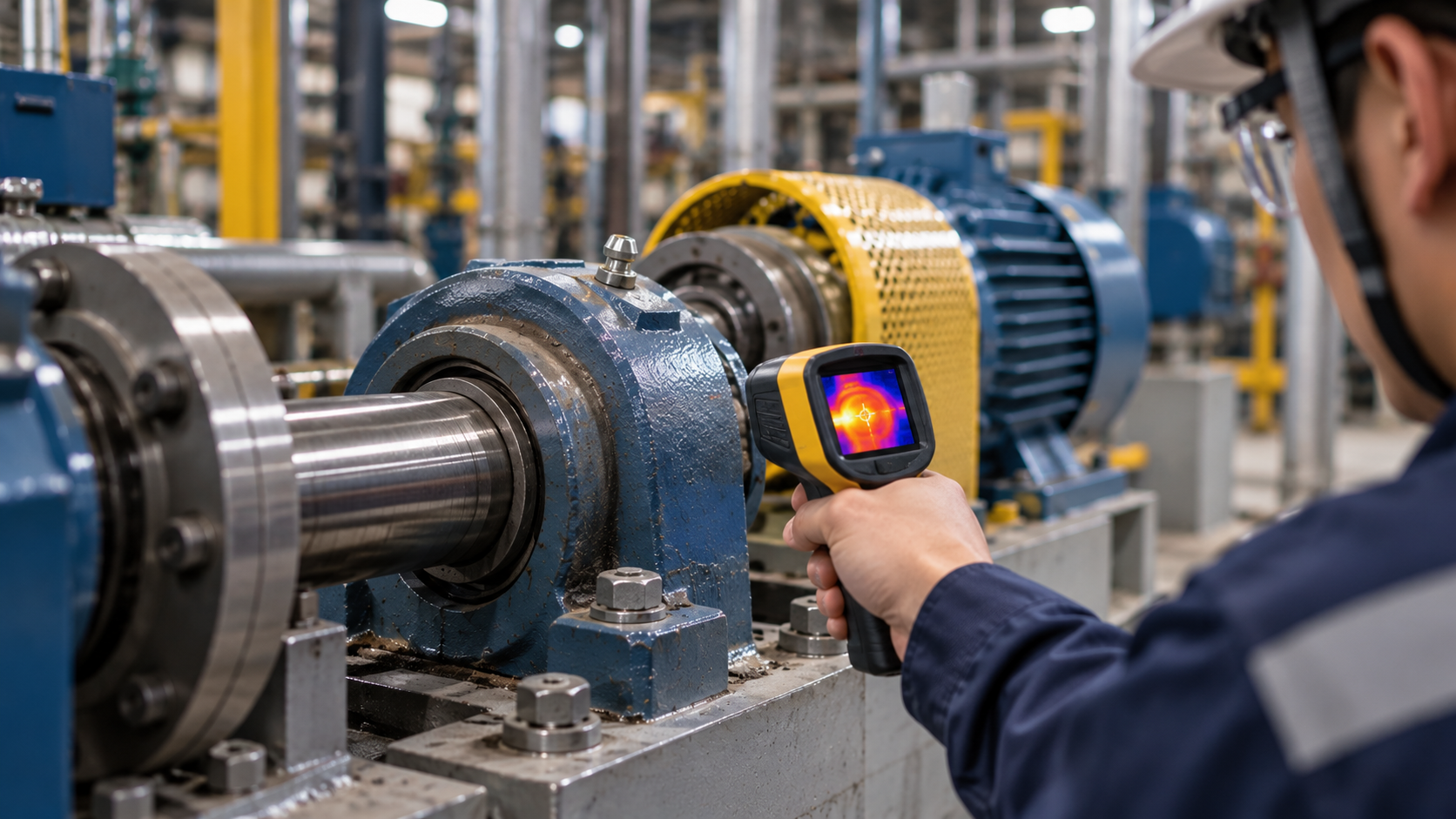
 German
Bearing Temperature. How Hot Is Too Hot and What to Do
HEAT SIGNAL
Bearing temperature is the easiest signal to read and the easiest one to ignore. A bearing cannot talk, but it does report. Vibration is one signal and noise is another. Temperature is the third, and you can feel it with the back of your hand before you ever own a tool.
A bearing that runs warm is doing its job. A bearing that runs hot is telling you something is wrong. The skill is knowing the line between the two, and reading the trend instead of a single number.
This guide explains how to judge bearing temperature, what usually causes heat, and what to do before a warm bearing becomes a stopped machine.
1What a Normal Bearing Temperature Looks Like
There is no single correct number. The temperature a bearing reaches depends on the load, the speed, the ambient air, and the grease inside it. A bearing in a cold room and a bearing next to a furnace can both be healthy at very different temperatures.
What is useful is a comparison. The heat a bearing makes above the surrounding air, called the temperature rise, tells you more than the raw reading. Track that rise, and you have a baseline that travels with the machine.
2Warm or Overheating. Read the Trend, Not One Number
A practical field rule helps here. A bearing you can hold your hand on for a few seconds is usually fine. One that is too hot to touch is worth a look, even if it still runs.
The more useful habit is to know what normal is for each machine. Check bearings when the machine is running well and write the reading down. Later, when a reading drifts above that baseline, you have warning while there is still time to act. A bearing that climbs over weeks is easier to catch than one that fails in an hour.
A sudden jump is a different story. Heat that appears in minutes points to a change you just made, such as a fresh grease charge, a new belt tension, or a misaligned mount.
3The Common Causes of a Hot Bearing
Five causes explain most hot bearings. Each one has a different fix, so the first step is to work out which one you are looking at.
A Loose or Tight Fit
Fit is the most overlooked cause. If the bore is too loose on the shaft, the inner ring slips and rubs, and the friction turns into heat. If the fit is too tight, the ring is squeezed and the internal clearance shrinks, which raises friction even though the bearing never moved. Both problems look like heat at the housing. Setting these right is a measuring job, not a guess.
Too Much or Too Little Grease
Grease does two jobs. It separates the moving surfaces, and it carries heat away from the raceways. Too little grease leaves metal touching metal, and the friction shows up as heat within minutes.
Too much grease causes its own problem. A bearing stuffed full has to churn the extra grease on every turn, and that churning raises the temperature. More grease is not safer. The right fill, not the full fill, is what keeps a bearing cool. For open and shielded parts, the choice between grease and oil also shapes how well heat escapes.
Misalignment
If the shaft and the housing are not square to each other, the bearing is forced into a position it was not built for. The rolling elements then run against the raceway edges instead of the middle, and the extra load becomes heat. Misalignment often starts small and grows as the mount settles, which is why the temperature climbs over time rather than jumping.
Overload and Speed
Every bearing has a load and a speed it was chosen for. Push past either one and friction rises. Too much load, too high a speed, or a change in the process that no one told the maintenance team about will all show up as heat. When a process changes, check the bearing along with the motor.
Electrical Erosion in Motors
Electric motors add a cause that other machines do not have. Current can pass through the shaft and jump across the bearing, pitting the raceways. This damage raises friction and heat, and it does not stop. If a motor bearing runs hot with no obvious load cause, this is worth checking. The signs show up faster on a motor than on any other machine.
4How to Track Bearing Heat in Daily Operation
You do not need a lab to track heat. A simple routine is enough.
1. Record a baseline reading on each machine while it runs well.
2. Use a contact thermometer or an infrared gun at the same point every time.
3. Compare the rise above ambient, not the raw number alone.
4. Watch the trend over days and weeks, not just the value today.
5. Investigate any steady climb, and any sudden jump right away.
For machines that cannot afford to stop, a fixed sensor and a simple alarm can watch temperature around the clock. It is a low cost way to catch a bearing in the weeks before it fails, rather than the minutes.
5What to Check First When a Bearing Runs Hot
When a bearing runs hot, work through the easy checks before you take the machine apart. Most causes turn up in the first few steps.
1. Feel the housing in several places. A hot spot on one side points to misalignment or a tight fit.
2. Check the grease level. Overfilled and underfilled both run hot, and both are quick to fix.
3. Listen at the housing. A grinding or rumbling note points to damage that is already there.
4. Compare with the other bearings on the same machine. If only one runs hot, the fault is local to that position.
5. Look at the load and the speed. If the process changed, the bearing may be running past what it was chosen for.
A short check like this turns a vague worry into a named cause, and a named cause has a fix. If nothing obvious shows up, note the reading and check again the next day. A number that climbs over a week tells you more than a single hot afternoon, and it gives you time to plan the repair instead of reacting to a breakdown.
6Why Heat Shortens Bearing Life
Heat does not only signal a problem. It causes one. High temperature breaks down grease faster, so the oil in it separates and stops protecting the steel. Once the grease stops working, friction rises again, which raises heat further. The result is a loop that runs away on its own.
Heat also changes the fit. Steel grows as it warms, so a warm inner ring tightens on the shaft and a warm outer ring tightens in the housing. That shift can take away internal clearance and press the rolling elements harder into the raceway. That is the internal clearance at work, and it is worth checking before you change a part.
The good news is that heat is an early signal. A bearing that runs a little hot for a few weeks is still a bearing you can save. Catching it early turns a rebuild into a routine change.
At what temperature should I worry about a bearing?
There is no single number. Compare against the machine baseline and the surrounding air. A bearing you can hold your hand on is usually fine, and a steady climb above its normal rise is the real warning.
Why did my bearing get hot right after I greased it?
Likely too much grease. A bearing filled past the correct level has to churn the extra, and that raises temperature. Let it run and the reading often settles. If it does not, check the quantity and the grease type.
Can a bearing run hot and still be fine?
Yes, some do. Some machines simply run warm. What matters is whether the reading matches its own history. A steady number that never changes is normal. A number that keeps climbing is not.
Can hot bearings be stopped without replacing them?
Often yes, if caught early. Fix the cause, whether it is fit, grease, alignment, or load, and the temperature returns to normal. If the raceways are already marked, a replacement is the safer route.
Do high temperature bearings run at a different temperature?
They are built to survive higher heat, not to run cooler. A part with the right steel, cage, and grease holds up better in a hot zone, but heat still shortens life. What changes when the heat is real is the steel, the cage, and the grease, not the shape of the bearing.
Talk to an Application Engineer About a Hot Bearing
If a bearing keeps running hot after the usual checks, describe it to us. Tell us the machine, the speed, the load, and the temperature you are seeing, and where the bearing sits in the assembly. Most of what we ship for these jobs is a standard deep groove ball bearings size, from the 6204 and 6205 up to the 6305. We can point to the likely cause and suggest the right grade, clearance, and grease. If the heat comes from a design limit, a custom bearing with a different internal clearance or a heat rated grease may solve it at the source. Reach us through our contact page and we will work through it with you.