


 English
 French
 German
Bearing Spares. How to Plan Stock Without Overstocking
Spares Planning Playbook
Bearing spares are the cheapest insurance a plant can buy, and the quickest way to tie up cash if you buy the wrong ones. This playbook covers grouping, counting, standardizing and storing them so they work when a line stops.
A machine sits idle while a fitter waits for one bearing. The part costs almost nothing next to the hours of lost output, and everyone knows it.
The answer is not a bigger shelf. It is a short plan that sets which positions you protect, how many you hold, and how you keep them fit to install. Most plants run on a small stock of deep groove ball bearings plus a few rings for the tightest positions, and nothing else.
Why Spare Planning Goes Wrong
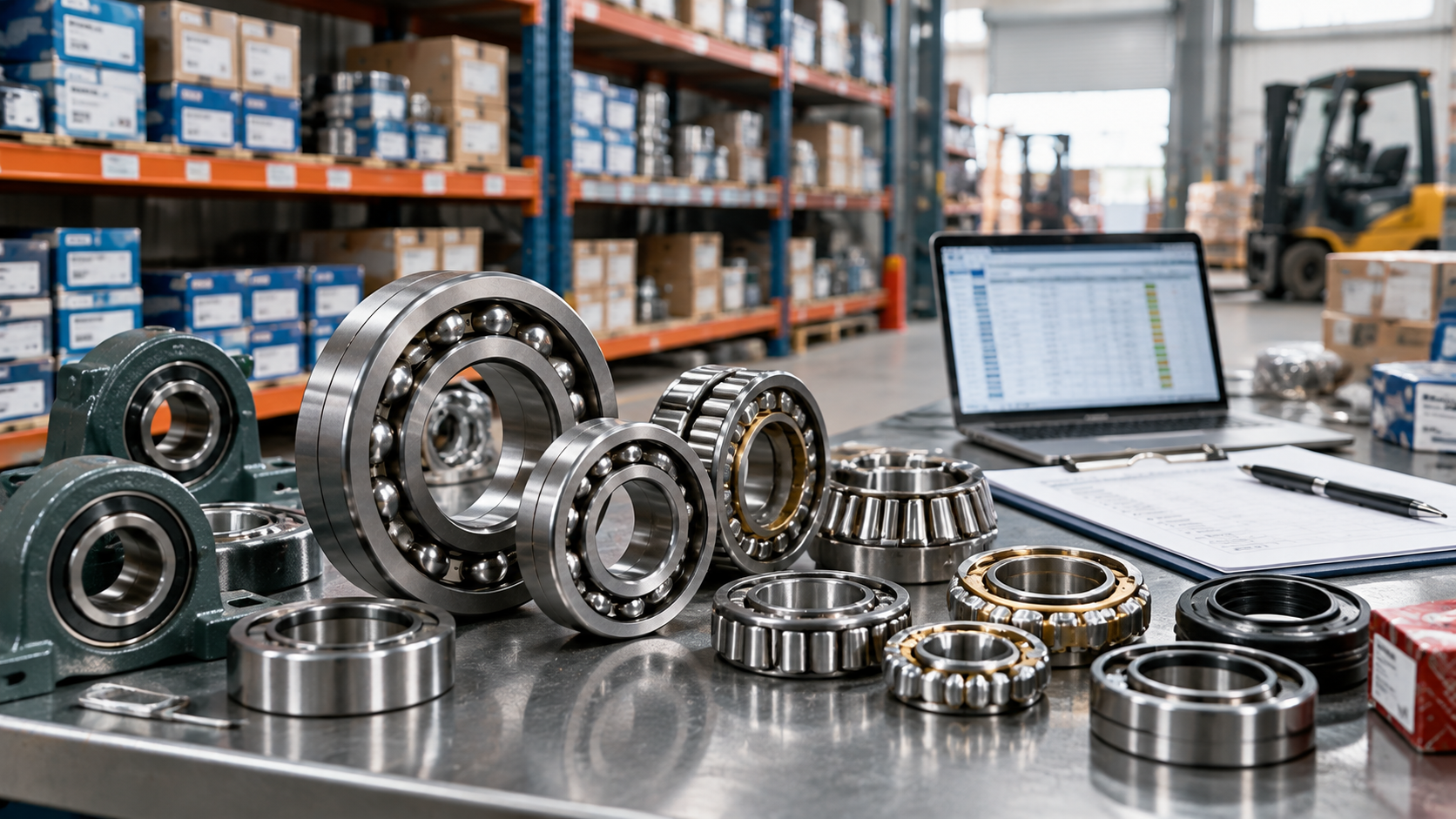
Look at almost any plant storeroom and you see the same pattern. Shelves are full of small cheap bearings that the line never stops for, and empty of the ring that would have saved a shift. Stock builds up where buying is easy and runs out where a stop hurts.
Cheap parts are easy to buy. The ones that hold a plant to schedule are the ones nobody planned for.
Group the Positions Before You Buy Anything
Before you count anything, write down every position on the machine list and put each one in a group. The question is not what the bearing costs. It is what happens to the plant when that position stops turning.
The Priority Matrix
Three groups cover most plants. Use this table as a starting point and adjust it to your own schedule.
| Position group | What happens when it stops | Keep on the shelf | Order as needed |
|---|---|---|---|
| Holds the line | Output stops, every hour is lost output | Yes, one or more per machine | Top up after every use |
| Planned stop | You can wait for the next service window | One spare | No, order with the stop |
| Standby or low duty | Nothing, the unit is not running | No | Yes, when it moves to duty |
Read the left column and be honest. Only a handful usually sit in the top group.
How Many to Hold
Once the groups are set, the quantity follows from four things. Annual usage, the wear window between planned stops, the smallest order the maker sells, and the lead time you really see.
Start With Annual Usage
Count how many of that part number the plant uses in a year, then divide by the number of planned stops. That tells you what one stop consumes. Hold enough for one stop plus a margin.
The wear window matters as much as the count. If a position is replaced at every planned stop, your stock has to match that stop. If it lasts for years, one piece is enough.
Lead time decides how you buy, not how many you keep. If the maker sells only in a full box and the freight takes a season, order earlier and accept a slightly deeper first buy.
Standardize Before You Buy
Fewer part numbers means deeper stock on the numbers that matter. Every new size on the shelf splits the same money across another box.
A common example is a motor position. Standardize on the 6204 bearing at 20 x 47 x 14 mm. It is sized for IEC frame 90 to 100 motors, rated 12.8 kN dynamic and 6.55 kN static, and it runs to 16,000 RPM open or shielded and 10,000 RPM with 2RS seals.
Where the load is heavier or the shaft is larger, a step up pays off. The 6205 bearing at 25 x 52 x 15 mm carries 14.0 kN dynamic and 7.85 kN static. Where the housing is short and the load is high, a 6304 at 20 x 52 x 15 mm is the better pick at 16.0 kN dynamic.
Standardizing does not mean forcing one size everywhere. It means one part number per position, held until the machine changes.
A shallower shelf, mapped position by position. Send the machine list or the spares list you keep today and we will map every position to one part number. Start with a short message and we will tell you which boxes you can stop carrying.
The Two Part Numbers Worth Keeping Both Of
If you only ever stock two designs, these are the two. One is the everyday part, and the other is the one you cannot improvise on a Sunday.
The Workhorse on the Line
The deep groove ball bearing is the everyday part. It carries radial load and a modest axial load in both directions, comes open, shielded or sealed, and covers most motor, fan and pump positions.
Keep a shallow stock of the sizes your plant repeats. Two or three well chosen part numbers cover far more positions than a shelf of odd sizes.
The One That Stops the Line
A crossed roller bearing is the part you keep because nothing else will do the job. Rollers sit at 90 degree alternating angles in a V raceway and make line contact across both rings, so one ring takes radial load, axial load in both directions and tilting moment at the same time.
On a robot axis the ring is often built with an integrated one piece inner and outer ring and a factory set preload with no field adjustment. A spare ring drops in, and nobody has to set it up in the cell.
Crossed roller rings in the RAU series run from a 20 mm bore to 350 mm, in 5 mm, 8 mm and 13 mm wide sections, with accuracy from P5 up to P2. RAU 2005 packs a 20 mm bore into a 31 mm outside diameter, a small box to keep for the stop it prevents.
Storage, Seals and Shelf Life
A spare that has sat open in a damp store is not a spare. Grease ages even when the bearing never turns, and dust on the raceway becomes a wear mark on the first run.
Leave bearings in their wrap until the moment of fitting. Keep the store dry, off the floor and away from vibration and grit.
The shield or seal type decides what survives a humid building. ZZ metal shields keep coarse dirt out. 2RS contact seals keep moisture and fine dust out and are the safer choice for a long stay on the shelf.
Write the date on the box when it arrives and pull the oldest stock first. Our notes on how to protect crossed roller bearings cover the same ground in more detail.
Repair or Replace
When a bearing comes off a machine, you have two choices. Put it back or bin it, and the answer depends on why it came off.
Putting it back is a gamble if the raceway shows a mark, the cage is loose or discolored, the seal is torn, or the part ran hot in service. Any of those signs means the damage will come back.
Reuse can be fine in a standby position that runs clean and slow. Grease it fresh and feel both rings by hand before it goes back in.
If you are not sure, do not put the used part where a stop costs the most.
A One Page Spare Plan Anyone Can Follow
1Group every position. Sort the machine list into line, planned stop and standby before you count anything.
2Set the quantity. One stop of use for line positions, one spare for planned stops, nothing for standby.
3Pick one number per position. Choose the size that covers the most positions and move the rest onto it.
4Write the reorder rule. Pull the oldest stock first and top up to your rule, not to the box.
5Walk the store twice a year. Look for opened wrap, damp boxes and faded labels.
Frequently Asked Questions
How many spare bearings should I keep?
Hold one stop of use for any position that stops the line, one spare for positions that can wait for a planned stop, and nothing for standby units.
Do spare bearings go bad on the shelf?
Yes. Grease ages even when the bearing never turns, and seals dry out over a long stay. Keep them wrapped, dry and out of vibration.
Can I reuse a bearing that came off a machine?
Sometimes. If the raceway is clean, the cage is sound and the seal is intact, a standby position can take it again. Any mark or discoloration means replace it.
Should I stock a whole set for one machine?
Rarely. A full set ties up money across sizes you may never pull. Stock only the sizes that belong to the line group.
What is the quickest way to cut part numbers?
Write down every bearing on the machine list, then map them onto the smallest number of sizes that still covers the loads. A motor position often collapses onto one size, such as a 6204.
Stock Standardization Program
Send the machine list or the spares list you keep today and we will map every position to one part number with an annual pull figure, so the shelf gets shallower and the line stops less often. Yuanhe has 500+ B2B clients and 12,000+ OEM projects behind that work.
Request a quote and tell us which positions give you the most trouble.