


 English
 French
 German
How to Protect Crossed Roller Bearings From Dust and Moisture
How to protect crossed roller bearings from dust and moisture decides how long they stay precise. Crossed roller bearings pack many small rollers into a thin section, which gives them their stiffness and compact size. That same design makes them sensitive to contamination. This guide explains how to seal, lubricate, and mount them so they stay clean and run for years.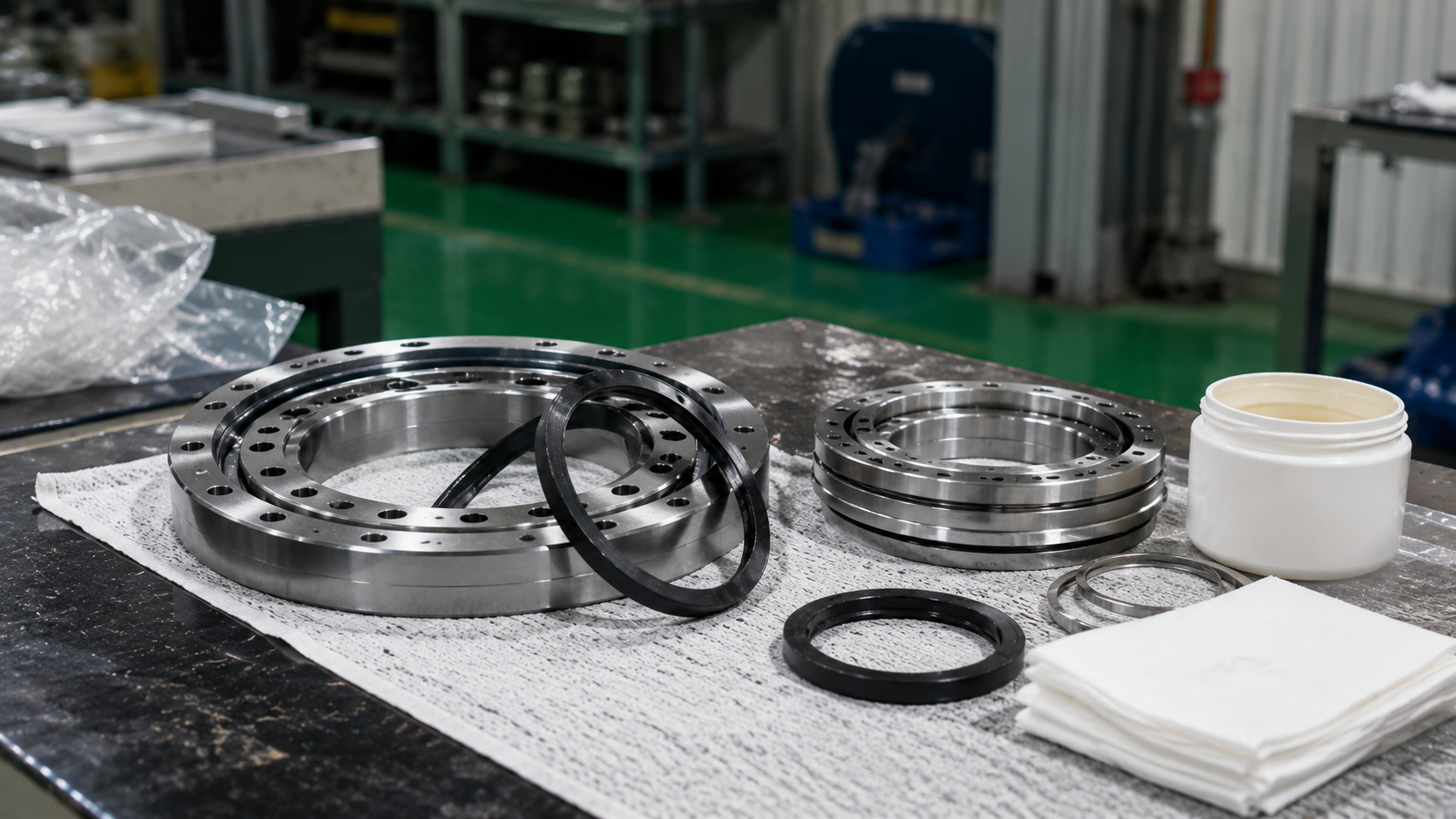
1Why Crossed Roller Bearings Need Protection
The very features that make a crossed roller bearing precise also make it vulnerable.
Small, Tightly Packed Rollers
The rollers are small and sit close together in a single raceway. A grain of dust between a roller and the raceway becomes a hard particle that the rollers roll over again and again, denting the surface. In a precision bearing, those tiny dents show up as runout and roughness.
Thin Section, High Stiffness
The thin cross-section saves space and gives high stiffness, but it leaves little room for the bearing to shrug off contamination. There is no extra material to absorb the wear, so keeping particles out is the whole game.
Precision That Punishes Wear
A crossed roller bearing in a rotary table or positioning stage must hold tight tolerances. Even small contamination causes runout that the machine’s accuracy cannot afford. Protection is not optional for precision duty.
2Sealing Options
The first line of defense is the seal.
Sealed Bearings
A sealed crossed roller bearing has rubber seals that keep dust and moisture out while holding grease in. Sealed bearings are the standard choice for most applications because they need the least attention and stay clean on their own.
Shielded Bearings
A shielded bearing uses metal shields instead of rubber seals. The shields keep out larger particles and hold grease, but they do not seal as tightly against fine dust and moisture. Shields suit cleaner environments where low friction matters.
Open Bearings With External Seals
Some designs use an open bearing and seal the whole assembly with an external cover or labyrinth seal. This adds parts and assembly steps, but it may be needed when the bearing must be serviced or the machine design calls for it.
3A Protection Checklist
Follow these steps to keep a crossed roller bearing clean through its life.
Choose the Right Seal
Match the seal to the environment. A sealed bearing is right for most machines. Choose shielded or open only when the environment is clean and the design specifically needs it.
Lubricate Correctly
Use the correct grease and do not overfill. The right grease film protects the rollers and helps block moisture. Over-greasing builds heat and can push seals out of place.
Mount on a Clean Surface
Install the bearing on a clean, burr-free shaft and housing. Any grit present at mounting goes straight into the bearing. Clean the mating surfaces and keep the bearing wrapped until the moment it is installed.
Check Before Running
After mounting, turn the bearing by hand and feel for roughness. A clean, correctly mounted bearing turns smoothly with no catch. Any roughness is a sign to stop and inspect before the machine runs.
4Common Contamination Sources
Knowing where contamination comes from makes it easier to stop.
Airborne dust is the most common source. In a workshop or factory, fine particles hang in the air and settle on every surface. An unsealed bearing picks them up the moment it runs.
Moisture is the second source. Condensation, coolant spray, and washdown water all reach the bearing and cause rust or wash out the grease. A sealed bearing resists moisture far better than an open one.
Handling and mounting round out the list. Grit on the shaft or housing, or on a technician’s hands, goes straight into the bearing during installation. Clean mounting practices prevent this source entirely.
5Signs of Contamination
A contaminated bearing gives itself away before it fails.
Roughness is the first sign. When you turn the bearing by hand, it feels gritty instead of smooth. That grit is a particle grinding between a roller and the raceway.
Noise is the second. A contaminated bearing runs louder, with a rumble or a grinding sound that a clean bearing does not make. Increased runout or vibration in the machine is the third sign, and it means the bearing has already been damaged enough to matter.
6Choosing Seals for Specific Environments
The seal should match the specific conditions the bearing faces.
A clean, dry lab or assembly area can use a shielded bearing, since low friction matters more than protection. A dusty workshop or a machine near coolant spray needs a sealed bearing to keep particles and moisture out. A washdown area needs a sealed bearing with a seal rated for water and cleaning chemicals.
For the supporting shafts and drives that run alongside a crossed roller bearing, sealed deep groove bearings such as the 6203bearing, 6204bearing, 6205bearing, and 6206bearing keep the rest of the assembly clean under the same conditions.
7Extending the Life of a Sealed Bearing
A sealed bearing is low-maintenance, not zero-maintenance, and a few habits stretch its life.
Keep the outside of the bearing clean, since built-up grime can work past the seal over time. Avoid high-pressure spray directly on the seal, since the pressure can push water past it. Check the machine for vibration and roughness on a schedule, and replace the bearing at the first sign of wear.
These habits cost little and keep a sealed crossed roller bearing precise for far longer than it would last if left to run untouched.
8Common Questions
Why is contamination so bad for crossed roller bearings?
Should I use sealed or shielded crossed roller bearings?
How do I keep a crossed roller bearing clean during mounting?
Does Yuanhe make sealed crossed roller bearings?
Can I wash a crossed roller bearing?
How often should I check a crossed roller bearing?