
 English
 French
 German
Deep Groove Ball Bearing Chart
Selection Table
A deep groove ball bearing chart looks like a wall of numbers, and most buyers only read two of the columns. That habit is how a part gets ordered with the right bore and the wrong width, or the right size and a load margin that was never there.
This guide walks the columns from left to right, shows what each figure answers, and points out the three places readers slip. Every number used here comes from a published page in the Yuanhe range, so you can check the arithmetic yourself.
01What a Chart Is For
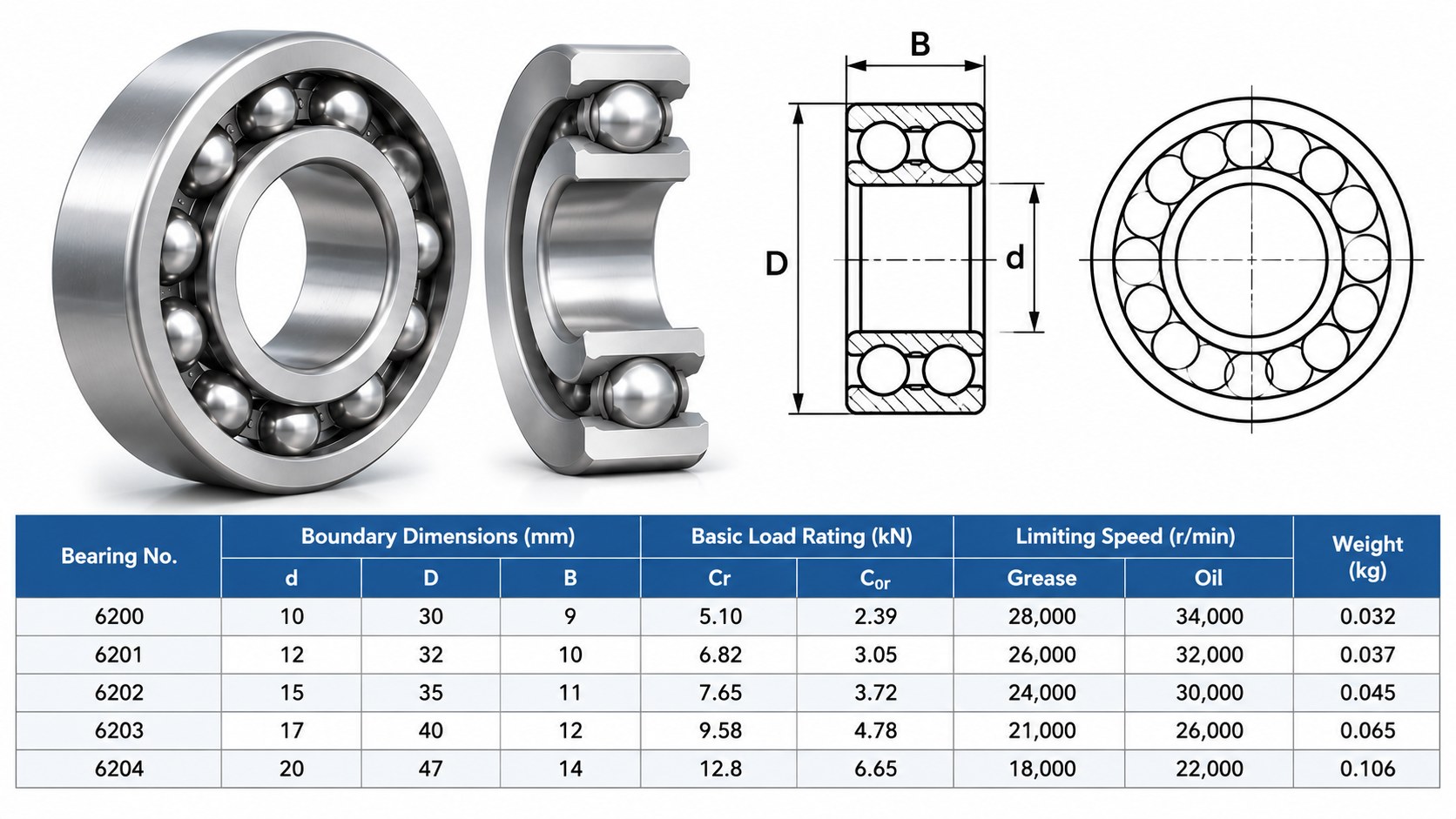
A chart is a filter, not a specification. It lets you start with a bore and a load, cut the list down to a handful of candidates, and then go to individual pages for the details a table cannot carry. Treat it as the first pass in a selection, never the last.
The full range sits behind the deep groove ball bearings catalog page, where each size has its own sheet with tolerances, clearance groups, sealing options and lubrication. The chart gets you to that sheet faster.
One habit worth building early. Read the column headers before you read any row. Half the misreadings in this trade come from assuming a column holds what it does not.
02The Columns From Left to Right
Almost every catalog in this product family uses the same order. Learn the sequence once and you can read a chart from any supplier without a legend.
| Column | What it holds | Unit | How you use it |
|---|---|---|---|
| Designation | Part number, such as 6204 | None | The identifier for every other lookup |
| d | Bore diameter | mm | Start here, it comes off the shaft |
| D | Outside diameter | mm | Check against the housing bore |
| B | Width | mm | Check against the pocket and the shoulder |
| Cr | Dynamic load rating | kN | Sizes the bearing against a rotating load |
| Cor | Static load rating | kN | Checks the bearing at rest or under shock |
| Speed | Limiting speed | RPM | Split by grease, oil and sealing type |
| Mass | Weight | g or kg | Housing load, freight, spares handling |
The Identification Columns
The first four columns are geometry, and three of them are yours to define before the chart is opened. The shaft sets the bore, the housing sets the outside diameter, and the pocket or the shoulder sets the width. If any of the three is still open, the chart will happily give you an answer to a question you have not asked.
Width is the column buyers skip most often, because a chart sorted by bore puts three or four widths next to each other and they all look plausible. The next section shows how much that one figure moves.
The Performance Columns
Cr, Cor and speed are ratings and limits, not guarantees for your machine. Each is measured under a defined condition, and the condition rarely matches a real housing with a real lubricant and a real duty cycle. Read them as a ranking tool first and a design input second.
Mass is the quiet column. It decides whether a housing cover needs a hand lift or a crane, and it changes the freight line on every quote above a few hundred pieces.
03Start With the Bore, Not the Load
The bore is the only figure that comes from a part you can measure. Shaft diameter, or the old bearing on the bench, gives you d without argument. Load estimates, by contrast, are usually a range, and a range entered at the wrong end sends you two columns to the right of where you should be.
So sort by bore first, then by width series, then by load. Working in that order keeps the candidate list short and keeps the arithmetic honest.
04Match the Width Series to the Envelope
At a fixed bore, the width series is what changes the outside diameter and the width together. The 20mm bore row shows the progression clearly, and all four parts are on the site with published figures.
| Part | Bore | Outside diameter | Width | Cr | Cor | Speed open |
|---|---|---|---|---|---|---|
| 6004 | 20 mm | 42 mm | 12 mm | 9.36 kN | 5.10 kN | 18,000 RPM |
| 6204 | 20 mm | 47 mm | 14 mm | 12.8 kN | 6.55 kN | 16,000 RPM |
| 6304 | 20 mm | 52 mm | 15 mm | 16.0 kN | 7.88 kN | 11,000 RPM |
| 6205 | 25 mm | 52 mm | 15 mm | 14.0 kN | 7.85 kN | 13,000 RPM |
What the Same Bore Looks Like Across Series
Read the first three rows as one story. The bore never moves, the load climbs from 9.36 kN to 16.0 kN, and the speed ceiling falls from 18,000 RPM to 11,000 RPM. Wider series carry more, and they pay for it in heat.
The fourth row is the trap. The 6205 bearing and the 6304 share an outside diameter of 52mm and a width of 15mm, and they do not share a bore. Anyone who reads a chart by scanning two columns will eventually order one for the other.
Individual pages carry the detail behind each row, for example the 6204 bearing sheet with its clearance and sealing options, or the 6305 bearing page once the bore steps up to 25mm. The chart row is the summary, the page is the argument.
05Reading Cr Without Misreading It
Cr is the dynamic load rating. It is the load at which a group of identical bearings reaches a rated life under a defined test condition, not the load you may hang on the shaft. A bearing with Cr of 12.8 kN does not fail at 12.9 kN, and it will not last forever at 6 kN either.
The practical use is a ratio. Divide Cr by the actual equivalent load and you get a number that ranks candidates. A larger ratio means more margin, a smaller ratio means a shorter life, and both statements stay true without a single hour figure attached.
What Cr Does Not Tell You
It does not tell you the static capacity, which is what matters when the machine sits still under load or takes a shock at start up. That is Cor, and the two columns rarely move in step. Compare the 6004 and the 6304 above, where Cr rises 71 percent and Cor rises 54 percent.
It also does not tell you what happens when the load is axial. A deep groove part takes thrust in both directions, but the axial capacity is smaller than the radial figure and it depends on the internal geometry, not on the column in the chart.
The three numbers behind most quotes
Bore, load and speed decide nine out of ten selections. Send those three with the housing space you have, and we will return the rows that fit plus the options each size offers. Nothing else is needed for a first pass.
06The Speed Column Has Two Modes
A single speed figure on a chart is a simplification of at least four variables: lubrication method, sealing type, load, and cooling. The catalog limit is the ceiling for the most favorable combination, and every deviation moves you down from it.
Grease and oil do not share a limit. Sealed and open do not share a limit either. On the 6204 bearing page the open part is listed at 16,000 RPM and the sealed version at 10,000 RPM, which is a 37 percent drop for the same bearing with contact seals.
So when a chart gives one number, ask which configuration it belongs to. If the answer is not on the page, ask the supplier. A speed figure without a lubrication and sealing condition is a number without a meaning.
07Three Places Readers Slip
• Reading Cr as the permitted load. It is a rating at a defined life, not a limit. Using it as a working load leaves the margin undefined and the life unknown.
• Taking the speed column as one number. It changes with grease or oil, with seals or shields, and with load. Pick the figure that matches the configuration you are ordering.
• Skipping the mass column. Weight drives handling, housing cover design and freight. On a thousand piece order it also drives the quote.
• Assuming one row equals one part. Suffixes, clearance groups and precision classes all sit outside the chart. The row describes a size, not a finished order.
08Turning Chart Rows Into an Inquiry
A chart row becomes a usable inquiry when you add three things to it: the clearance group, the sealing type and the precision class. Without those, the supplier quotes a default and the default may not match the machine.
| Chart column | What you add | Example line |
|---|---|---|
| Designation | Full suffix | 6204 2RS |
| Size | Bore x OD x width | 20 x 47 x 14 mm |
| Cr and Cor | Actual load estimate | Radial 4 kN, axial 1 kN |
| Speed | Running speed and lubricant | 2,400 RPM, grease |
| Extra fields | Clearance and precision | C3, ABEC-3 |
Five lines and the quote comes back with a part number you can compare against the drawing. Send only the designation and you get a price for a part that may differ in four ways from the one you need.
09Questions Buyers Ask About the Chart
What does Cr mean on a bearing chart?
Cr is the dynamic load rating, expressed in kN. It is the load a group of bearings can carry for a rated life under a defined test condition. It ranks candidates well, and it is not a permitted working load.
Why do two rows with the same outside diameter have different bores?
Because the series digit changes the bore to fill a different position in the range. The 6205 and the 6304 both measure 52mm outside and 15mm wide, and one has a 25mm bore while the other has 20mm. Always read the d column.
Which speed figure should I use?
The one that matches your configuration. Open with oil sits highest, grease sits lower, and contact seals pull the limit down again. If a chart shows one number, ask what it assumes.
Is a higher Cr always better?
No. A wider series with a higher Cr also runs hotter and often costs more. If the load is light and the speed is high, a smaller part such as the 6004 bearing is the better choice.
Can Yuanhe send a chart for the sizes we use?
Yes. Tell us the bore range and the applications, and we will send the relevant rows with the options that exist for each size, including clearance and sealing.
10Reading a Chart in Five Minutes
Used well, a deep groove ball bearing chart is a filter. Bore from the shaft, width from the housing, load from the duty cycle, speed from the drive. Four inputs, one chart, and a short list of candidates that fit all four. That is the whole method, and it works on any supplier chart in this product family because the columns are standardized.
The part that needs a supplier is everything after the short list: clearance, sealing, precision, lubrication and the tolerance stack that decides whether the fit is right on your shaft. Read the chart for the shortlist, then talk to someone for the rest.
Send the bore range and the duty
Tell us the bore, the housing space and the load, and we will come back with the rows that fit plus the options that exist for each one. If you already have a chart row in mind, send the designation with the suffix.
For a quote on a specific size, add the clearance group, the sealing type and the running speed. That is enough to price the right part the first time.