
 English
 French
 German
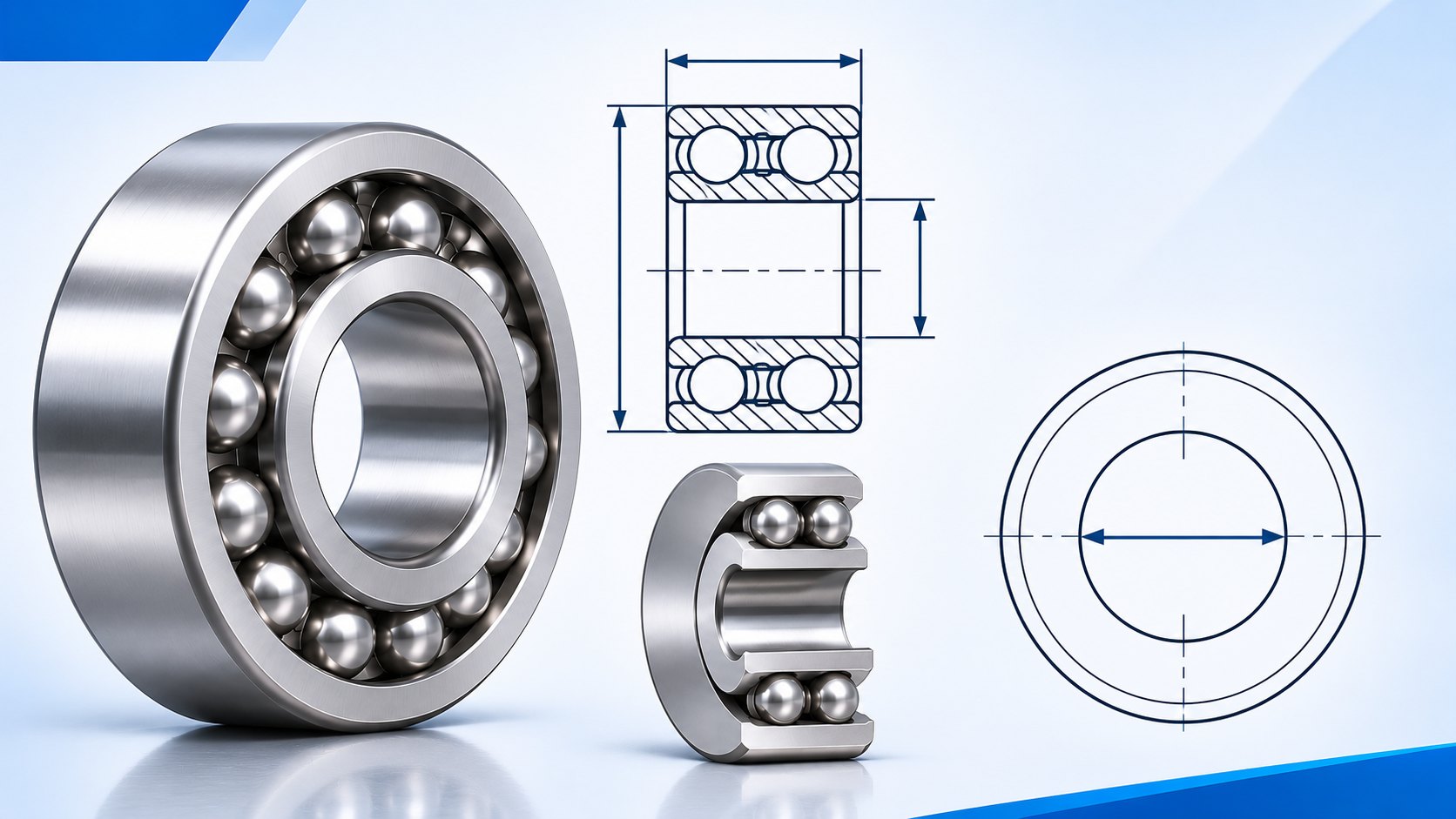
Double Row Deep Groove Ball Bearing 5208 Bore Diameter Spec
Bearing Code
The double row deep groove ball bearing 5208 bore diameter spec is one line long. The code gives you the 40mm bore for free, and nothing else.
The five characters give you the row count, the dimension series and the bore. They say nothing about width, seals, clearance or load. This guide takes the code apart, then covers what belongs on a purchase order.
01What the Five Characters Actually Say
A bearing designation is built from blocks, not from one number with a single meaning. Read 5208 left to right and each block answers a different question. The middle block only narrows the family, which is where most quoting errors begin.
The same three block logic runs through the whole single row range, so a part like the 6204 bearing reads the same way. Once you can split one designation, you can split all of them.
| Block | Value in 5208 | What it answers | What it leaves open |
|---|---|---|---|
| Leading digit | 5 | Row count and type family | Cage design, sealing, clearance |
| Series digit | 2 | Light dimension series | Exact outside diameter and width |
| Bore code | 08 | 8 x 5 = 40mm bore | Tolerance class, chamfer, fit |
| Suffix | none | Nothing declared | Seals, shields, clearance, precision |
The Leading 5 Sets the Row Count
A 6 at the front marks a single row deep groove part. A 5 marks two rows of balls running in the same pair of rings. That one digit changes the width, the load path and the price, so it is the first thing to check when someone quotes a number from memory over the phone.
The 52 and 53 groups both carry two rows. The second digit separates a light series from a medium one, and the difference shows up in the outside diameter rather than in the bore.
The 08 Bore Rule
The last two digits multiply by five. 08 becomes 40mm, 06 becomes 30mm, 04 becomes 20mm, 13 becomes 65mm. The rule holds across the 60, 62, 63, 68 and 69 groups, which is why an engineer can read a bore straight off a label without opening a book. Every part in our deep groove ball bearing range follows it.
Two exceptions are worth keeping in your head. Codes 00, 01, 02 and 03 do not multiply, they map to 10mm, 12mm, 15mm and 17mm. And bores under 10mm are written as the bore itself, so a 608 is 8mm and not 40mm.
02The Bore Is the Only Number the Code Gives You
This is where quoting goes wrong. The 40mm bore is trustworthy because it comes from arithmetic. The outside diameter and the width do not, because a series digit only sorts a bearing into a family.
So a line that says 5208 is not a specification. It is a lookup code that opens a catalog page, and the page gives you the envelope. Without the page, the drawing is the only valid source.
A ten second test
Cover the left side of a bearing label with your hand. If the only figure you can still read is the bore, you are holding a lookup code and not a specification. The outside diameter and the width have to come from somewhere else.
03Single Row and Double Row Side by Side
The useful comparison is the double row design against the single row design at the same bore. That is the choice a designer faces when a housing pocket is already cut.
| Trait | Single row 62 group | Double row 52 group |
|---|---|---|
| Rows of balls | One | Two, side by side |
| Radial load | Carried by one row | Shared across two rows |
| Axial load | Both directions, modest | Both directions, less per row |
| Width | Narrower | Wider, the second row needs room |
| Speed ceiling | Higher | Lower, more rolling contact |
| Cost | Lower | Higher, more parts to make and inspect |
| Typical use | Motors, pumps, gearboxes | High radial load in a short span |
Where the Second Row Earns Its Space
Two rows put more rolling elements under the same shaft, so radial capacity rises without growing the bore. On a short shaft span, where a wider single row part will not fit and a second bearing position is not available, that is often the entire argument for the double row design.
The layout also absorbs a small amount of shaft deflection better than a narrow part, because two rows share the movement instead of one taking all of it.
Where It Costs You
Speed is the first trade. More balls in contact means more heat at the same rotational speed, so a 52 part rarely matches the speed ceiling of the narrow single row bearing it replaces. If the job is a small motor or a high speed spindle, a single row part such as the 6004 bearing at 20mm bore usually fits better.
Width is the second trade. A housing cut for a narrow bearing will not accept a double row part without a change to the shoulder or the end cover, and that change is a machining job rather than a swap.
04What a 5208 Fits On
A 40mm bore double row part turns up where the radial load is steady, the axial load stays modest, and the housing has room. Four patterns cover most of the work we quote.
• Conveyor and roller assemblies where the load is steady and the shaft span is short.
• Pump and fan shafts where one wider bearing can replace two narrow ones and simplify the housing.
• Agricultural and off highway hubs where shock loads arrive from one direction and the housing is generous.
• Gearbox and drive ends where radial load is high but axial load stays small, one step up from a 6305 bearing sized drive end.
Check that the envelope allows the extra width, and that running speed stays inside the catalog limit for your lubricant.
05Suffixes Change the Part More Than the Code Does
Two bearings can both be called 5208 and still not interchange, because the suffix carries the options. When the suffix is missing, the supplier has to guess, and guessing is how wrong parts ship.
| Suffix or field | What it sets | Why it matters on site |
|---|---|---|
| ZZ | Two metal shields | Low drag, dust only, no washdown |
| 2RS | Two contact seals | Keeps grease in and water out, adds drag |
| C2, CN, C3, C4 | Internal clearance group | Decides running temperature and fit |
| ABEC-1 to ABEC-5 | Tolerance class | Runout, noise and shaft fit quality |
| N or NR | Snap ring groove | Axial location without a shoulder |
| Grease or oil | Lubricant and fill | Speed ceiling and service interval |
A 40mm bore part bound for a wet conveyor and the same bore bound for a dry gearbox are not the same order.
06Six Things to Confirm Before You Order
Run this list against the drawing before the inquiry leaves your desk.
1. Envelope, all three figures. Bore, outside diameter and width, taken from a drawing or a catalog page, never from the code alone.
2. Row count. Confirm the leading digit is 5. A 6208 is a different part with a different width and a different price.
3. Clearance group. C2, CN, C3 or C4 changes the internal fit. State it, do not leave it to the supplier to pick.
4. Sealing. Open, one shield, two shields or two contact seals. Each option changes drag, ingress protection and the speed ceiling.
5. Precision class. ABEC-1, ABEC-3 or ABEC-5. A conveyor does not need the class a spindle needs, and paying for it buys nothing.
6. Lubrication. Grease grade and fill percentage, or oil. This fixes the running temperature and the relubrication interval.
07Why 5208 on Its Own Is Not an Order
Suppliers see bare four digit codes every day, so they fill the gaps with whatever sits on the shelf. That is how a customer ends up with an open bearing where a sealed one was specified, or CN clearance on a shaft that runs hot and needed C3.
A complete line reads like this. 5208, 40mm bore, double row, C3 clearance, two contact seals, ABEC-3, grease filled. Seven fields, one line, no room for interpretation on either side of the transaction.
The three fields that get dropped most
Sealing and clearance vanish because they look like details rather than dimensions. Width vanishes because the code seems to imply it. Those three cause most of the returns we see on double row orders.
08Writing the Line on a Purchase Order
A purchase order is read by someone who has never seen your machine. Write for that reader.
1. Start with the full designation including any suffix, exactly as it appears on the drawing or on the old bearing.
2. Add the three dimensions in the order bore x outside diameter x width, with mm after each figure.
3. State clearance and precision as a class, not as a description such as tight or free.
4. State sealing and lubrication so the supplier cannot substitute an open part and call it equivalent.
5. Add the batch or annual quantity because price breaks with volume, and a supplier who sees a quantity of five will quote a different part than one who sees five thousand.
If the drawing and the old bearing disagree, send both. A photo of the old part beside a caliper reading settles more arguments than a paragraph of description. Our guide to reading a bearing code covers the other digit families if you are working from a label rather than a drawing.
09Questions Buyers Ask About 5208
Is 5208 the same as 6208?
No. The leading digit differs, so the row count differs and the width differs. Both sit on a 40mm shaft, and that is roughly where the similarity ends. Using one for the other means checking the housing pocket again.
Does 5208 always mean a 40mm bore?
Yes, as long as the designation follows the standard bore code, where 08 multiplied by five gives 40mm. A suffix does not change the bore. A prefix or a non standard variant can, which is why the drawing still wins.
Can I replace a 6208 with a 5208?
Only if the housing has room for the extra width and the running speed stays inside the double row limit. Confirm both before you commit, because the load gain is real but the speed loss is real too.
Which clearance group should I order?
CN covers most general duty work. C3 suits shafts that run warm or carry a tight fit on both rings. The choice belongs on the drawing, not on the shop floor after the first warm run.
Can Yuanhe make a double row part to a drawing?
Yes. Send the drawing or the old part number together with the envelope and the options you need, and we will quote against it. If the drawing is incomplete, we will ask for the missing fields instead of filling them in.
10From a Code to a Quote
A double row deep groove ball bearing 5208 quote is short once the fields are settled. The bore comes from the code, the envelope from the drawing, and the options from the application.
Send the part number and the envelope
A 5208 quote needs the bore, the outside diameter and the width, plus the clearance and sealing you want. Photograph the label or attach the drawing and we will confirm the envelope before quoting.
If the original part came from a machine builder and the label is worn, send the shaft diameter and the housing bore instead. We can work back from there.



Related Products