

 English
 French
 German
How Custom Bearing Manufacturing Works From Drawing to Delivery
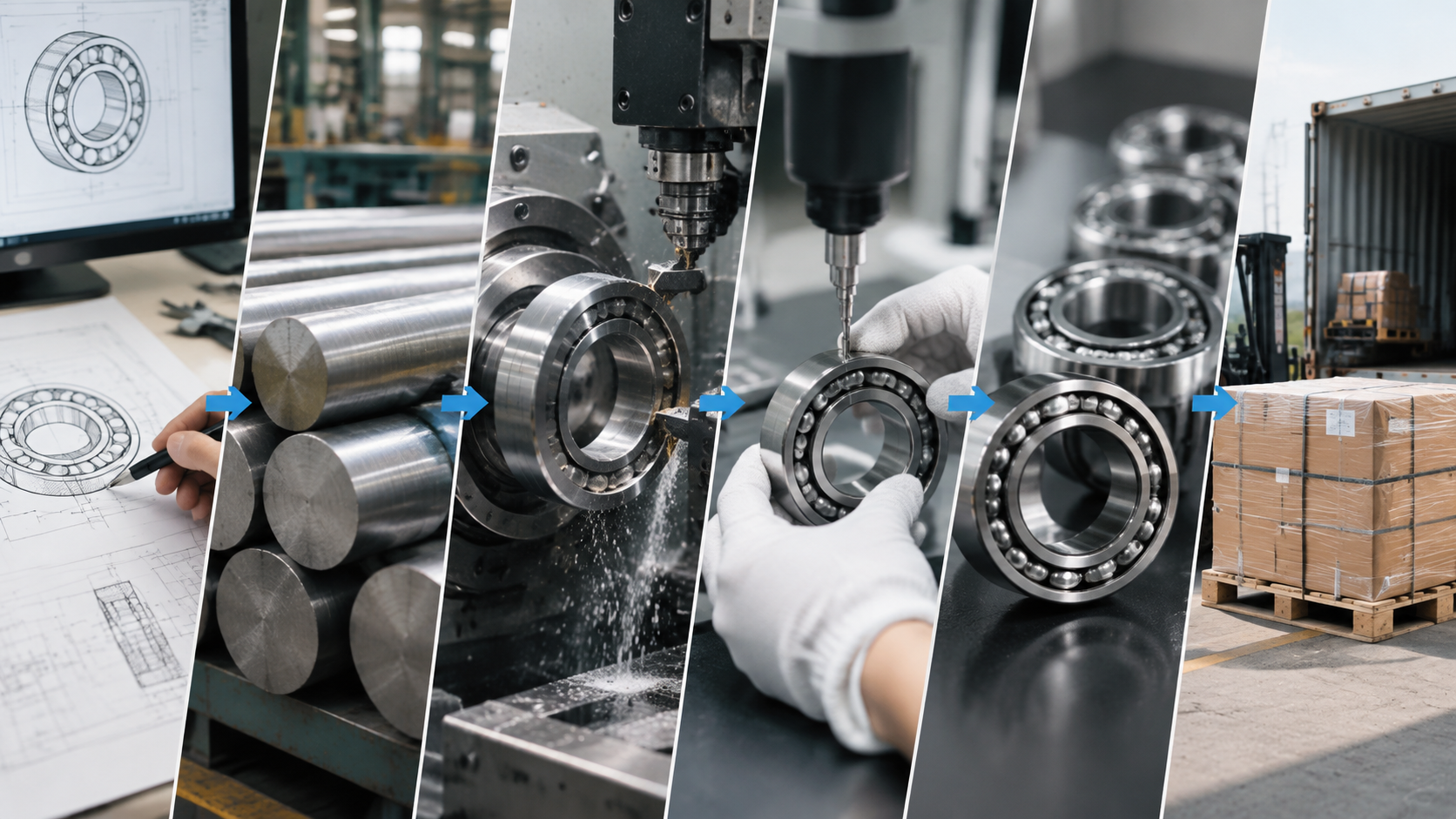
EIGHT STAGES FROM DRAWING TO DELIVERY
Custom bearing manufacturing exists because a catalog cannot answer every problem. The bore is right but the width is wrong. The OD fits, but the seal will not survive the washdown. The joint is too thin for the load it has to carry.
That is the point where a custom bearing project begins, and the process is more predictable than most buyers expect. Eight stages, each with a specific question to answer and a specific deliverable.
01Stage One, Reading the Drawing Against the Application
The first job is not machining. It is understanding what the bearing has to survive.
A drawing gives dimensions. The application gives everything else: load direction, running speed, temperature, contamination, and how long the part needs to last. Both are needed, because a drawing alone cannot tell us whether the priority is stiffness, quiet running, or the ability to survive a dusty aisle.
What we need from you
- Bore, outer diameter, and width, with tolerances if the interface is held tight
- Load direction and approximate magnitude, radial, axial, or both
- Running speed and whether it is continuous or stop and start
- Operating temperature and any cleaning or washdown exposure
- The interface around the bearing, which is shaft fit and housing fit
- Target annual volume and the first delivery date
Six answers are usually enough to recommend a design. When one is missing, we ask, because guessing at a temperature costs more time than a two line reply.
02Stage Two, Material and Heat Treatment
Bearing steel is the default for a reason. GCr15, the equivalent of AISI 52100, gives the hardness and fatigue resistance that a rolling contact needs.
Where the choice changes:
- Moisture or washdown. Stainless steel grades resist corrosion without coating, which matters when the bearing cannot be sealed from water.
- Corrosive chemistry. A coated or stainless option may be the only route, and the grade has to be matched to the chemical rather than to the word stainless.
- Higher temperature. The heat treatment has to be specified for the running temperature, not just for hardness at room temperature.
- High precision. Dimensional stability after machining is a heat treatment question before it is a grinding question.
Material certification travels with the order. If your quality system needs to trace the heat, ask at quotation stage, not after delivery.
03Stage Three, Grinding to Tolerance
Raceway geometry is where a bearing earns its precision. Ring faces, raceway curvature, and groove position are ground and finished to the tolerance class on the drawing. The common classes, from tighter to looser, run from ABEC-7 and ABEC-5 down through the standard classes, with each step costing more in machine time and inspection.
Two practical points for a custom project:
- Specify precision where it changes behavior. A robot joint cares about runout and stiffness. A conveyor roller cares about running torque and cost.
- Say so when a dimension does not affect function, and we hold it at a commercial tolerance. Over specifying a dimension that does not affect function adds cost without adding life.
04Stage Four, Cage, Seals and Lubrication
The rolling elements are only part of the assembly. The cage holds the balls or rollers apart, the seal keeps contamination out, and the grease decides how long everything lasts.
| Choice | Option | Fits best with |
|---|---|---|
| Cage | Stamped steel | General use, good strength and cost balance |
| Cage | Polyamide | Quiet running with moderate temperature |
| Cage | Machined brass | Higher loads, demanding or hot applications |
| Seal | ZZ metal shield | Clean, fast rotating positions |
| Seal | 2RS contact seal | Dust, chips, and washdown |
| Seal | Open | Relubricated positions with a clean environment |
| Grease | Standard lithium base | General purpose, moderate temperature |
| Grease | Wide temperature range | Motor and actuator applications |
If you already know the grease that works in your machine, tell us and we match it. If not, we select against the temperature and speed range you gave us in stage one.
05Stage Five, Inspection and the Report
Every custom bearing leaves with inspection data. What varies is how much.
- Core measurement of bore, OD, width, and radial runout
- Radial internal clearance verification for ball bearings, preload verification for crossed roller bearings
- Visual and functional checks on seals and cage retention
- Material certification where specified
A sample inspection report goes to you with the first article. If your incoming quality process needs a specific format, send the template early and we will build the report around it.
06Stage Six, First Article and Approval
The first article is the real test. It is one piece, or a small lot, built on production tooling so you can check the fit and function before volume begins.
What a first article should prove:
- The bore and OD match the interface you measured, not just the drawing nominal
- Running torque or preload is in the expected range
- The seal behaves as expected in the intended cleaning environment
- Assembly into your housing reaches the seat without distortion
Approval at this stage is where most project risk disappears. Once it is signed off, the production tolerance is locked, and everything after that is repeatability.
07Stage Seven, Production and Traceability
Production runs to the approved drawing, with in process inspection at the points that affect the fit and the raceway. Batch traceability links a delivered lot back to the material heat and the inspection record, which is what a recall investigation and an ISO 9001:2015 audit both need.
08Stage Eight, Packing and Delivery
Custom bearings are packed to protect the ends of the rings and the seal lips, since a dented sealing surface ruins a good bearing. Units that will sit in storage also get rust protection matched to the storage duration and climate.
Delivery scheduling follows the production plan you agreed at order confirmation. Rush requests are handled by moving the project up the plan, and that conversation is best had before the material order is placed.
09What Actually Drives Lead Time
Buyers ask about lead time first. The honest answer is that lead time is made of four parts, and the first one is on the buyer’s side.
| Lead time component | Typical influence |
|---|---|
| Drawing review and design freeze | Fast if the application data arrives complete |
| Material and heat treatment | Depends on grade availability, stainless takes longer |
| Tooling or sample build | Only needed when the size is outside the standard range |
| Production and inspection | Scales with quantity and with the inspection level chosen |
The single biggest variable is the design freeze. A project that changes a dimension after tooling has been cut loses more time than any production step can make back.
10A Note on Tooling
Tooling is the one cost that surprises buyers, and it is easy to check before the project starts.
When the requested size sits inside a standard dimension range, no new tooling is required and the project runs as a special build. A 6205 bearing at 25 mm bore, 52 mm OD and 15 mm width, or a 6302 bearing at 15 mm bore, 42 mm OD and 13 mm width, both fall into that group.
When the bore, OD or width falls outside those ranges, tooling is quoted as a separate line, and it belongs to the project once it is paid for. Ask for that line explicitly at quotation so the unit price comparison is honest.
11FAQ
What is the minimum order quantity for a custom bearing?
It depends on the size and the tooling required. Send the drawing with your target annual volume and we will quote both the tooling and the unit price so you can compare.
Can you copy an existing bearing that has no part number?
Yes. Send the physical sample or a full set of measurements, including the fit dimensions and the seal type. Measuring a worn bearing needs care, so we normally measure several areas and ask about the intended fit.
How do you handle the shaft and housing interface?
We can machine the bore and OD to a specific fit tolerance rather than to a catalog value, which is one of the main reasons a project becomes custom in the first place.
Do we get the inspection report with every shipment?
A sample report ships with the first article, and lot records are retained. If you need a report with every lot, specify it at quotation.
What if the first article does not fit?
We review the measurement data with you. Most first article issues trace to a drawing ambiguity or a housing measurement, and both are corrected before production.
12Submit Your Drawing
The fastest way to start is a drawing plus the six application answers in stage one. Our engineers will reply with a recommended design, the tolerance class we would hold, the seal and grease selection, and an indicative lead time.
Next Step
Yuanhe manufactures deep groove ball bearings and crossed roller bearings on one shop floor, with over 12,000 OEM projects delivered for more than 500 B2B clients. Standard sizes such as a 6205 bearing or a 6302 bearing ship from stock patterns, and everything else is built to your drawing. Send the file through our contact page and we will confirm within one business day.