
 English
 French
 German
How to Choose Shaft and Housing Fits for Bearings
IN THIS GUIDE
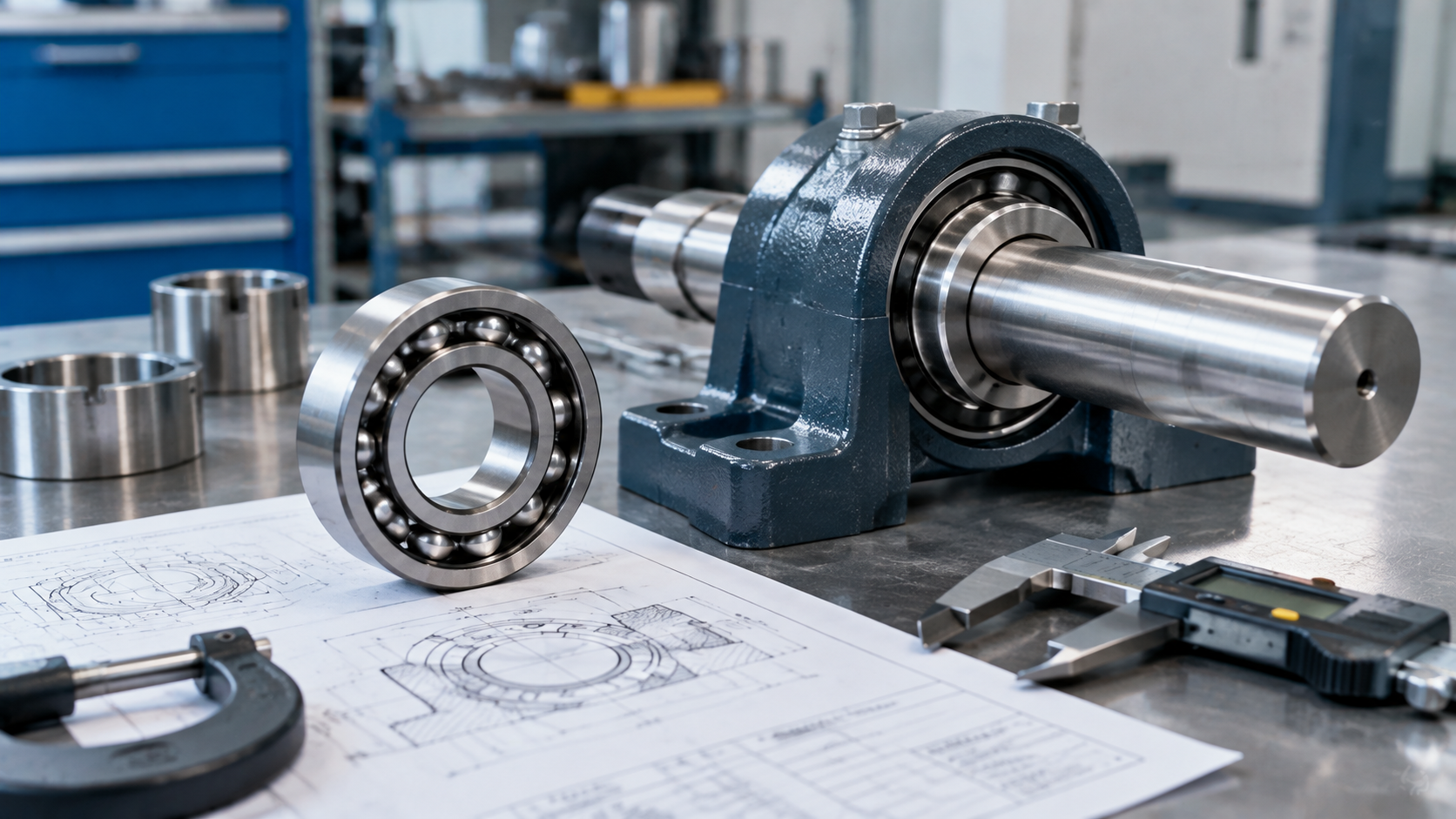
Shaft and housing fits decide whether a bearing runs for years or fails in months. A bearing that measures perfectly on the bench can still fail early once it is pressed into a machine, because the fit controls how the load travels through the rolling elements. Too loose and the ring creeps on the shaft, wearing a groove that no amount of grease will fix. Too tight and the ring is squeezed before the motor ever turns.
This guide covers the two questions that set every fit, the starting fits we see most often on deep groove ball bearings, and how interference quietly eats internal clearance.
01Why the Fit Decides Bearing Life
Two failure modes come straight from the drawing, not from the bearing itself.
Creep. When a ring sits too loose on a loaded, rotating seat, it slips a fraction of a degree at a time. Over thousands of hours the seat polishes, then darkens, then wears into a visible groove. The bearing is blamed, but the housing tolerance was the cause.
Excess preload. When a ring is squeezed harder than the application needs, the rolling elements are pressed into the raceway before any external load arrives. Friction climbs, running temperature climbs with it, and grease life drops.
Both problems are avoidable at the drawing stage. Neither is fixable after the fact by changing grease or adding a cooling fan.
02The Two Questions That Set Every Fit
Before you open a tolerance chart, answer two questions about the application.
Which ring rotates relative to the load
This is the single strongest signal. If the load direction is fixed in space and the inner ring turns under it, the inner ring needs interference and the outer ring can be a light fit. Reverse the arrangement, and the housing takes the interference instead.
- Rotating inner ring, stationary load direction, shaft takes the interference
- Stationary inner ring with a rotating outer ring, housing takes the interference
- Both rings stationary or the load rotates with the ring, a lighter fit is usually enough
How heavy is the load, and how thin is the wall
Heavy loads, shock loads, and thin-walled housings all push you toward a tighter fit. Thin housings flex under load, and a light fit that works in a solid cast iron block can walk in an aluminum plate.
As a rough hierarchy, light loads tolerate the loosest fit, normal loads sit in the middle, and heavy or shock-loaded seats need the tightest arrangement in the list.
03Typical Starting Fits for Deep Groove Ball Bearings
The table below is the range we use as a starting point for deep groove ball bearings with a solid steel or cast iron housing. Treat it as a conversation starter with your own catalog, not as a substitute for it.
| Condition | Shaft | Housing | Notes |
|---|---|---|---|
| Rotating inner ring, light load | h6 to js6 | H7 | Slip fit, easy assembly |
| Rotating inner ring, normal load | j5 to k5 | H7 | The common motor arrangement |
| Rotating inner ring, heavy or shock load | m5 to m6 | H7 or M7 | More interference holds the ring |
| Rotating outer ring under load | g6 to h6 | N7 to P7 | Housing carries the interference |
| Thin-wall housing | k5 to m5 | H7 | Housing flex needs the extra grip |
Two patterns matter more than any single row. First, H7 is the workhorse housing bore, because it holds a repeatable size without special tooling. Second, shaft fits move up the interference scale as load rises, and the letters move from h toward m.
04What Interference Costs You in Internal Clearance
A fit is not free. Every micrometer of interference on a ring raceway removes close to the same amount of radial internal clearance inside the bearing. A k5 shaft fit on a small bore can pull out several micrometers of clearance, and an m5 fit takes more.
That matters when the application already runs hot. A hot shaft grows, a cooler housing stays put, and the difference tightens the bearing further. When a tight fit and a warm running condition appear together, specifying a C3 clearance group is the usual answer. Article two of this series covers the clearance groups in detail.
Practical rule we give machine builders: if the shaft fit is k5 or tighter, plan for C3.
05Fits for Crossed Roller Bearings in Robot Joints
Crossed roller bearings behave differently from a ball bearing in one respect that changes the drawing. Both rings carry the rollers, and the assembly is normally preloaded at the factory. You are not choosing clearance; you are preserving a preload that was set for you.
That changes the fit calculation:
- Keep housing roundness and flatness inside the drawing limits, because a distorted seat loads the rollers unevenly
- Avoid heavy interference on the ring that is clamped by the joint housing, since it distorts the raceway
- Use the clamping method intended for the bearing, with a shoulder that supports the full ring face
On a robot arm, fit errors rarely show up as a failure. They show up as lost repeatability that nobody can explain.
06Checking the Fit on the Shop Floor
A drawing is only half the job. The other half is confirming what the machinist actually produced.
- Measure the housing bore at several depths and both axes, then record the smallest and largest reading
- Measure the shaft in the same way, at the seat and close to the shoulder
- Compare the pair against the fit you specified, not against a single nominal number
- For a light fit, a controlled push by hand or arbor press is the expected result
- For an interference fit, heat the bearing or the housing within the limits the bearing maker allows, and never drive load through the rolling elements
A bearing mounted by hammering on the outer ring of a rotating-inner-ring application is an early failure waiting for a schedule slot.
07A Worked Example on a Standard Size
The most common size in the range makes the arithmetic concrete. Take a 6204 bearing at 20 mm bore, 47 mm OD and 14 mm width.
- The 20 mm bore points to a shaft seat ground for a light interference fit under normal load
- The 47 mm OD suits an H7 housing bore in a solid steel or cast iron housing
- A k5 shaft fit on a small bore removes enough clearance that C3 is the sensible group
- Record both measurements before assembly and keep them with the machine file
The same logic scales up. A 25 mm seat on a 6205 bearing or a 15 mm seat on a 6302 bearing follows the same chain, from load and rotation condition to fit, then to clearance group.
08FAQ
Should I always use the tightest fit I can achieve?
No. Every bit of extra interference removes clearance and adds friction. Use the loosest fit that still prevents creep under your load.
Can I fix a loose housing with retaining compound?
It can rescue a repair in the field. It is not a design solution for a production machine, because it cannot restore a worn, out of round bore.
Does the fit change for a sealed bearing?
Not the ring fits. But ZZ and 2RS seals add friction, so a sealed bearing running at a tight fit and a warm temperature benefits from the next clearance group up.
What about a plastic or aluminum housing?
Aluminum expands more than steel, so the fit tightens as the machine warms. Thin-wall aluminum often needs the same shaft fit as a heavy load condition, for a different reason.
How much interference is too much?
When the remaining internal clearance is close to zero at running temperature. That is the point where the fit has used up the bearing.
09Get Your Fit Reviewed Before You Cut Metal
Most fit problems are solved on paper in ten minutes or found in a machine months later. Send us the shaft and housing dimensions, the load direction, and the rotation condition, and our engineers will check the pair against the bearing you plan to use.
If the standard range does not cover your seat, the answer is often a custom manufactured bearing with a bore or OD tolerance held to your interface rather than a catalog value. Yuanhe has delivered more than 12,000 OEM projects for over 500 B2B clients, and a fit review is how most of them start.
Next Step
Send your drawing through our contact page and we will reply with a recommended shaft and housing fit, the matching clearance group, and the 6204 bearing or equivalent standard size we would supply for the first sample.



Related Products