

 English
 French
 German
Crossed Roller Bearings for Laboratory and Precision Instruments
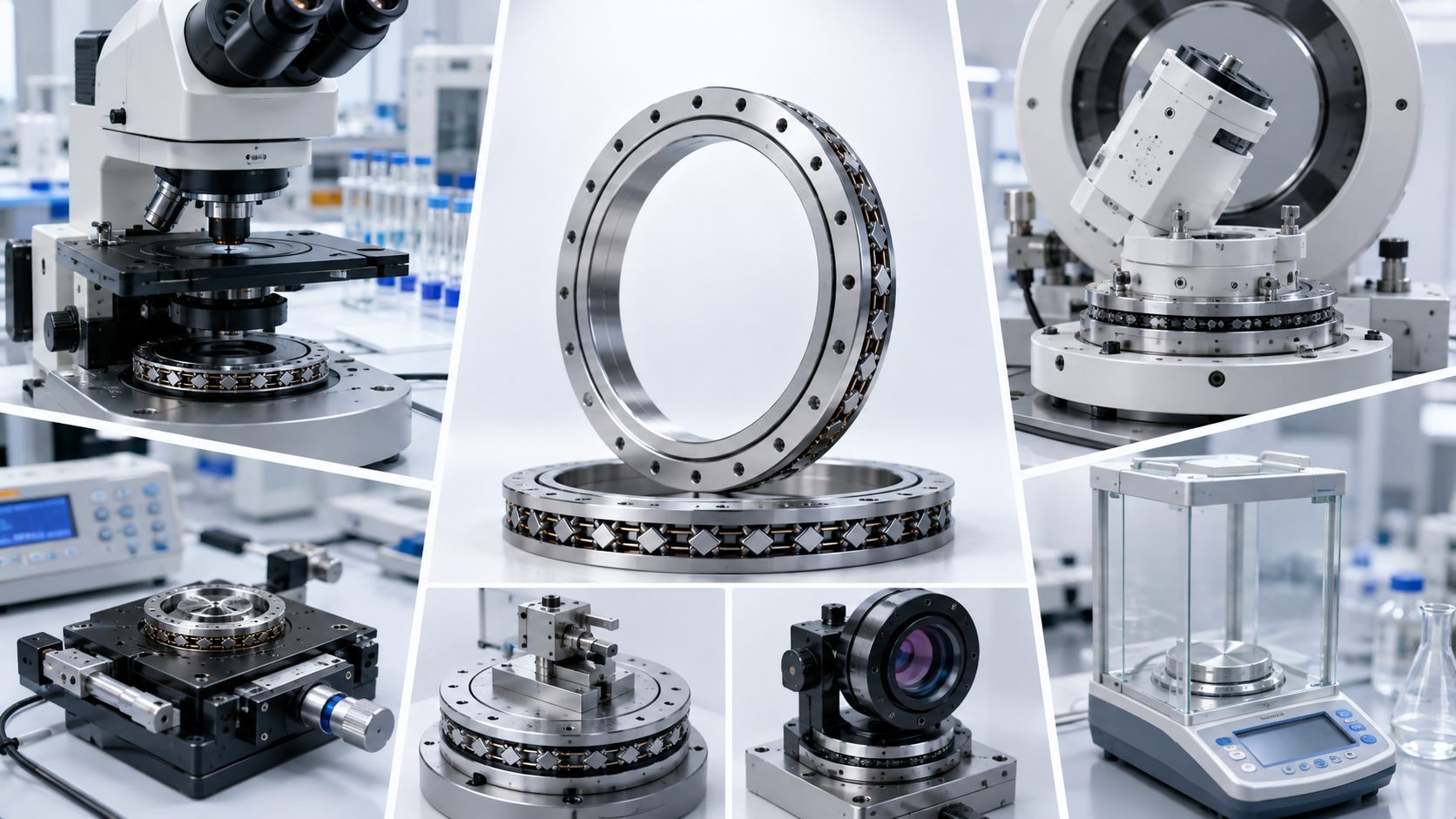
Crossed roller bearings for laboratory and precision instruments provide the stiffness and accuracy that spectrometers and optical stages demand. Laboratory and precision instruments depend on smooth, accurate rotation, and any runout shows up as measurement error. This guide explains where they fit and how to choose one.
1Why Precision Instruments Use Crossed Roller Bearings
A few properties make crossed roller bearings the natural choice for laboratory rotation.
Stiffness
A crossed roller bearing carries radial load, axial load, and tilting moment at once, thanks to its crossed rollers. That stiffness means the stage does not flex or sag under the weight of a sample or lens. For an instrument that must hold its position, stiffness is the first requirement.
Accuracy
The tight tolerances and low runout of a precision crossed roller bearing translate directly into accurate positioning. When a stage rotates a sample through a set angle, the bearing keeps that rotation true rather than wandering.
Compact Size
Laboratory instruments pack a lot into a small footprint. The thin cross-section of a crossed roller bearing saves space compared to a pair of conventional bearings, leaving room for optics, sensors, and sample holders.
2Where They Appear in the Lab
Crossed roller bearings show up in several familiar instrument types.
Spectrometers and Analyzers
Sample stages and rotating optics in spectrometers rely on crossed roller bearings for smooth, repeatable positioning. The bearing holds the optics steady while the stage rotates through measurement angles.
Optical Stages and Positioning Systems
Precision linear and rotary stages used for alignment and measurement often run on crossed roller bearings. The bearing’s stiffness keeps the stage flat and true under load, which is what makes fine positioning possible.
Goniometers and Rotary Stages
A goniometer measures angles, so its rotary stage must turn with minimal runout. Crossed roller bearings provide that accuracy in the compact space a goniometer allows.
3Choosing a Bearing for an Instrument
The right bearing for a laboratory instrument balances accuracy, size, and cost.
Start with the accuracy the instrument must hold. If the measurement demands tight tolerances, choose a higher precision grade such as P5 or P4. If the instrument is less demanding, a standard grade may be enough.
Consider the load and the space. The bearing must carry the sample, optics, or fixture without flexing, and it must fit the available footprint. A factory-preloaded bearing removes clearance and adds stiffness right out of the box, which suits instruments that need consistent, repeatable motion.
4Preload and Repeatability
Repeatability is the ability to return to the same position again and again, and it depends on preload.
A bearing with internal clearance has a little free play. Every time the stage reverses or changes load, that play lets the position shift slightly. Preload removes the clearance, so the rollers stay in constant contact with the raceways and the position stays put.
A factory-preloaded crossed roller bearing gives consistent, repeatable rotation out of the box. For an instrument that must return to the same angle measurement after measurement, that repeatability is the whole point.
5Specifying a Bearing for an Instrument
When you order a bearing for a precision instrument, a few details get you the right part.
State the accuracy grade you need, based on the instrument’s tolerance. State the load the bearing will carry, including the weight of any optics, samples, or fixtures. State the space available and the mounting method, since these set the bearing’s size and ring design.
With those details, a supplier can recommend the right crossed roller bearing, or confirm that a standard grade will do. Yuanhe manufactures crossed roller bearings with integrated rings and factory preload across the precision grades for exactly this kind of duty.
6Comparing Bearing Types for Instrument Use
Crossed roller bearings are not the only option for instrument rotation, but they are often the best.
A pair of conventional ball bearings can support rotation, but they take more space and do not resist tilting moment as well. A crossed roller bearing does the same job in a single, thin package with higher stiffness. That is why it wins in compact, precise instruments.
For the supporting shafts and drives around the instrument, standard deep groove bearings like the 6203bearing, 6204bearing, 6205bearing, and 6206bearing are the practical choice. The crossed roller bearing handles the precision axis, and the deep groove bearings handle everything else.
7Getting Repeatable Motion From the Start
An instrument that must return to the same reading again and again depends on consistent mounting.
Mount the crossed roller bearing on clean, flat surfaces and torque the bolts evenly. Any flex in the mounting shows up as lost repeatability, no matter how good the bearing is. Check the runout after mounting, and confirm the housing and shaft are machined to match the bearing’s grade.
With a factory-preloaded bearing and a clean, even mount, the instrument holds its position and its readings stay consistent from the first measurement.
8Common Questions
Why do spectrometers use crossed roller bearings?
What accuracy grade does a laboratory instrument need?
What is the benefit of a factory-preloaded bearing?
Does Yuanhe supply crossed roller bearings for instruments?
Can a crossed roller bearing replace two ball bearings?
What should I tell a supplier when ordering an instrument bearing?



Related Products