

 English
 French
 German
Best Ball Bearing Type for Robotics Joints. A Selection Guide
Robot Joint Bearing Selection
The best ball bearing type for robotics joints is not one part number. It is the bearing that matches the load path of the axis you are designing, and a six axis arm needs a different answer at the base than at the wrist.
This guide compares the ball bearing types used inside robot joints, lines them up against the loads a joint applies, and walks the arm from base to wrist to show which type wins where.
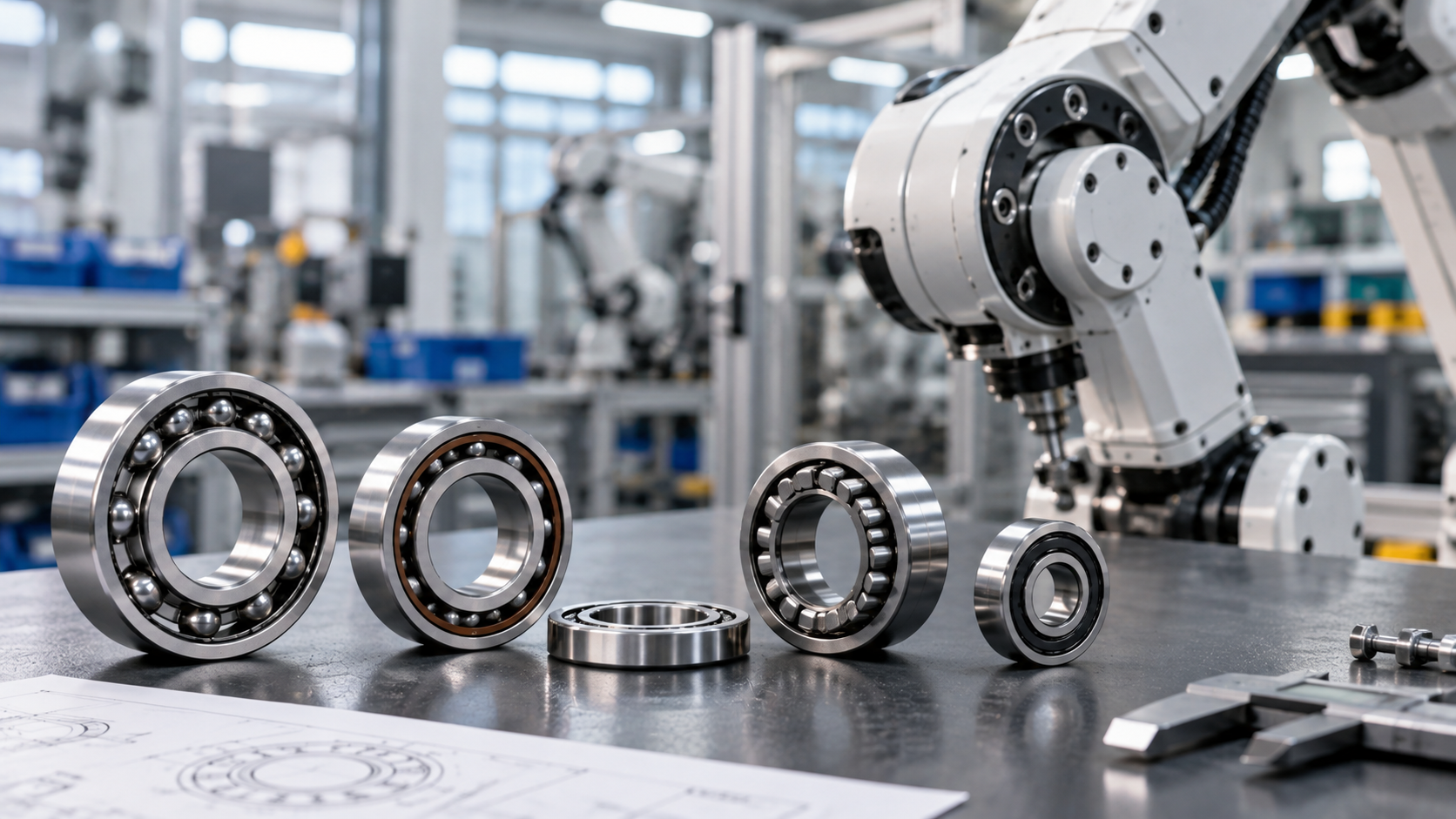
What a Robot Joint Asks of a Bearing
A joint bearing does four jobs at once. It carries the weight outboard of the axis, resists the bending moment that weight creates, holds the axis true while the arm reverses, and stays repeatable after millions of cycles. Radial capacity is the easy part. Moment stiffness is the hard part, and it is why many high load joints skip ball bearings.
Load One
Radial and axial load together. A vertical axis pushes down the shaft, a horizontal arm bends the joint sideways, and most joints see both.
Load Two
Tilting moment. A payload held far from the axis turns a modest force into a large overturning moment, and this decides most joint bearings.
Load Three
Stiffness and repeatability. What the end user feels is deflection at the tool center point, which shows up as vibration, path error and slow settling.
The Ball Bearing Types You Will See in Robot Joints
Four ball bearing designs cover almost every joint on the market. A fifth, the crossed roller bearing, is included because it is what most high moment axes use.
| Type | Load It Carries | Where It Shows Up | Where It Runs Out |
|---|---|---|---|
| Deep groove ball bearing | Radial load plus moderate axial load both ways | Servo motor shafts, gearbox input and output, small joints | Little moment capacity; deflection climbs under offset load |
| Angular contact ball bearing | Combined load in one direction; a facing pair covers both | Actuator shafts with thrust, spindle style joints | Needs a matched pair and set preload; one way each |
| Thin section ball bearing | Light to moderate load in a shallow section | Compact wrists, hollow shaft joints, gimbal frames | Thin rings deflect more and punish an out of round housing |
| Four point contact ball bearing | Radial, axial both ways and moment in one ring | Small rotary joints, tool changers, some wrist axes | More friction than deep groove; preload harder to control |
| Crossed roller bearing | Radial, axial both ways and tilting moment in one unit | Shoulder, elbow and wrist axes that carry a real moment | Taller section; needs a flat rigid seat |
Standard angular contact designs sit at 15, 25 or 40 degrees of contact angle, and a wider angle takes more axial load. Deep groove ball bearings run shallow and take both directions without a partner, which is why they dominate motor and gearbox positions.
Best Ball Bearing Type by Joint Position
Base and Shoulder Axes
The shoulder carries the whole arm plus the payload, so the moment is the largest on the machine. A crossed roller bearing absorbs that moment and both axial directions inside one ring, which removes the clearance stack that pairing bearings creates. Short reach desktop arms can still use a pair of ball bearings.
Elbow and Forearm Axes
Moment drops here, and the design usually splits. A crossed roller bearing takes the main axis when the arm is long or the payload is heavy. Two opposed angular contact ball bearings work when the joint is light and the housing already fits them. The trade off is covered in this comparison of crossed roller bearings and angular contact bearings.
Wrist Axes
Section height is tiny here, moment is still significant, and repeatability has to be high because every error multiplies through the tool offset. Thin section crossed roller bearings fit this case. A 5 mm wide RAU 2005 gives a 20 mm bore in a 31 mm outside diameter, and a 5 mm wide RAU 10005 reaches a 100 mm bore in 111 mm outside diameter.
Servo Motor and Gearbox Shafts
These positions see radial and thrust load only, and they run fast. Deep groove ball bearings are the right fit. Common sizes on robot servo shafts include the 6004 bearing at 20 mm by 42 mm by 12 mm, the 6204 bearing at 20 mm by 47 mm by 14 mm, and the 6205 at 25 mm by 52 mm by 15 mm.
The Four Numbers That Decide the Choice
Load Against the Rating
Read the static safety factor as the static rating C0 divided by the applied static load. Most industrial designs want that number at 2 or above. Below it, deflection and brinelling drive the design.
Stiffness and Tool Center Point Deflection
Roller bearings make line contact against the raceway instead of point contact, and a crossed roller unit carries three to five times the moment stiffness of an equivalent ball bearing. Yuanhe quotes tool center point deflection under 0.01 mm at full payload.
Speed, Noise and Friction
Ball bearings win on speed, with low friction, low heat and a cage that tolerates fast reversing. Noise is tested per ISO 15242, with Z2 and V2 as standard grades and Z3 and V3 for the quietest builds. Roller bearings carry more friction and suit slow, stiff axes.
Section Height
Crossed roller bearings run in 5 mm, 8 mm and 13 mm wide series, with bores from 20 mm to 350 mm and precision grades P5, P4 and P2. If the drawing allows a taller ring, one roller bearing solves the moment problem alone.
When a Ball Bearing Is the Wrong Answer
Three signs say stop and look at a roller design.
Stop Signals
1The arm droops or rings after a stop. The payload offset has outgrown the moment capacity of the pair.
2The joint must hold position against a moment. No brake assist, no counterbalance, and the axis still has to stay put.
3Two bearings are stacked and shimmed. If the stack drifts after re-setting, the moment is shared by luck rather than by design.
A bigger ball bearing does not fix any of those, because they point at moment stiffness. A crossed roller bearing carries radial load, axial load both ways and the tilting moment in one unit, with factory set preload.
Spec Details That Matter on the Ball Bearing Side
Clearance. C2 tightens the fit for a rigid low noise axis. CN is the standard build. C3 is the usual pick on servo bearings because the inner ring runs warmer than the housing.
Cage. A moulded polyamide cage (TN) runs quiet and suits light, fast reversing joints. A steel cage takes more heat and heavier duty cycles.
Shield or seal. ZZ metal shields suit clean gearbox interiors. 2RS contact seals keep grease in and dust out, at the cost of a little friction and heat.
Grease and fill amount. Give the supplier the load, speed and temperature range before the fill is chosen, because the wrong grease ages out fast.
Mistakes That Show Up in the Field
1Sized on radial load alone. The bearing is picked from a radial table, the joint deflects, and the housing gets blamed.
2Mixed clearance. A C3 bearing in a CN housing fit, or a tight fit on both rings, leaves nowhere for thermal growth.
3A soft or rough seat. A crossed roller ring reflects every flatness error of its seat straight into runout.
How to Check a Joint Bearing Before It Goes In
1. Read the shipment data. Bore tolerance, radial runout and assembly height are measured at four quadrant positions. Yuanhe supplies this sheet with every crossed roller bearing.
2. Measure the seat first. Check mounting flatness and housing roundness before the bearing goes in, not after the joint fails to hold position.
3. Rotate it by hand. A preloaded unit should turn smoothly through a full revolution with no tight spot, which points at the seat rather than the bearing.
Frequently Asked Questions
Is a deep groove ball bearing good enough for a robot joint?
For motor and gearbox positions, yes. For an axis carrying a real moment at the end of a lever, no. Moment capacity is small.
What is the best ball bearing type for robotics joints under high axial load?
Angular contact in a matched pair, when the load is mainly axial and there is no large moment. If the joint also carries a tilting moment, a crossed roller bearing covers both.
Can one crossed roller bearing replace two ball bearings?
Usually yes. One unit takes radial load, axial load both ways and the moment, so the clearance stack and the shimming disappear.
Which type suits hollow shaft joints and cable routing?
Thin section crossed roller bearings, because the bore stays large while the ring stays short. RAU series bearings run from a 20 mm bore to 350 mm.
Do robot joints need P4 or P2 accuracy?
Only where the axis has to hold position tightly, such as a wrist on a measuring or dispensing arm. P5 covers most general automation joints.
Send Your Joint Drawing
Send the axis drawing with bore, section height, moment and speed. Yuanhe manufactures deep groove ball bearings and RAU series crossed roller bearings to drawing, under ISO 9001:2015 process control, with 500+ B2B clients and 12,000+ OEM projects.
Request a quote and the engineering team will come back with a bearing type and a section height for each axis.