


 English
 French
 German
Crossed Roller Bearings vs Angular Contact Bearings
Designers building a precision rotary stage face an early bearing choice: crossed roller bearings vs angular contact. Both types can support combined radial and axial loads. Both can achieve micron-level runout when manufactured to high precision grades. But their architectures differ in ways that affect stiffness per unit height, cost, assembly complexity, speed capability, and moment capacity. The right choice depends on which factors dominate your specific design constraints.
This comparison focuses on the practical factors that drive the decision, without naming specific bearing part numbers. The goal is to help you pick the bearing type that matches what your stage actually needs rather than the one that looks best in a catalog cross-section. The analysis applies to rotary stages used in machine tools, automation equipment, inspection systems, and similar precision applications.
VSHead-to-Head at a Glance
| Characteristic | Crossed Roller | Angular Contact |
|---|---|---|
| Contact Type | Line contact (rollers) | Point contact (balls) |
| Height | Single ring, about half the height | Two bearings, separated |
| Moment Stiffness | High in a single ring | Gained via bearing separation |
| Speed | Best below 300 RPM | Better above 300 RPM (cooler) |
| Assembly | Factory preloaded, bolt-on | Field preload (spacers / nut) |
| Component Cost | Higher | Lower |
01Bearing Architecture at a Glance
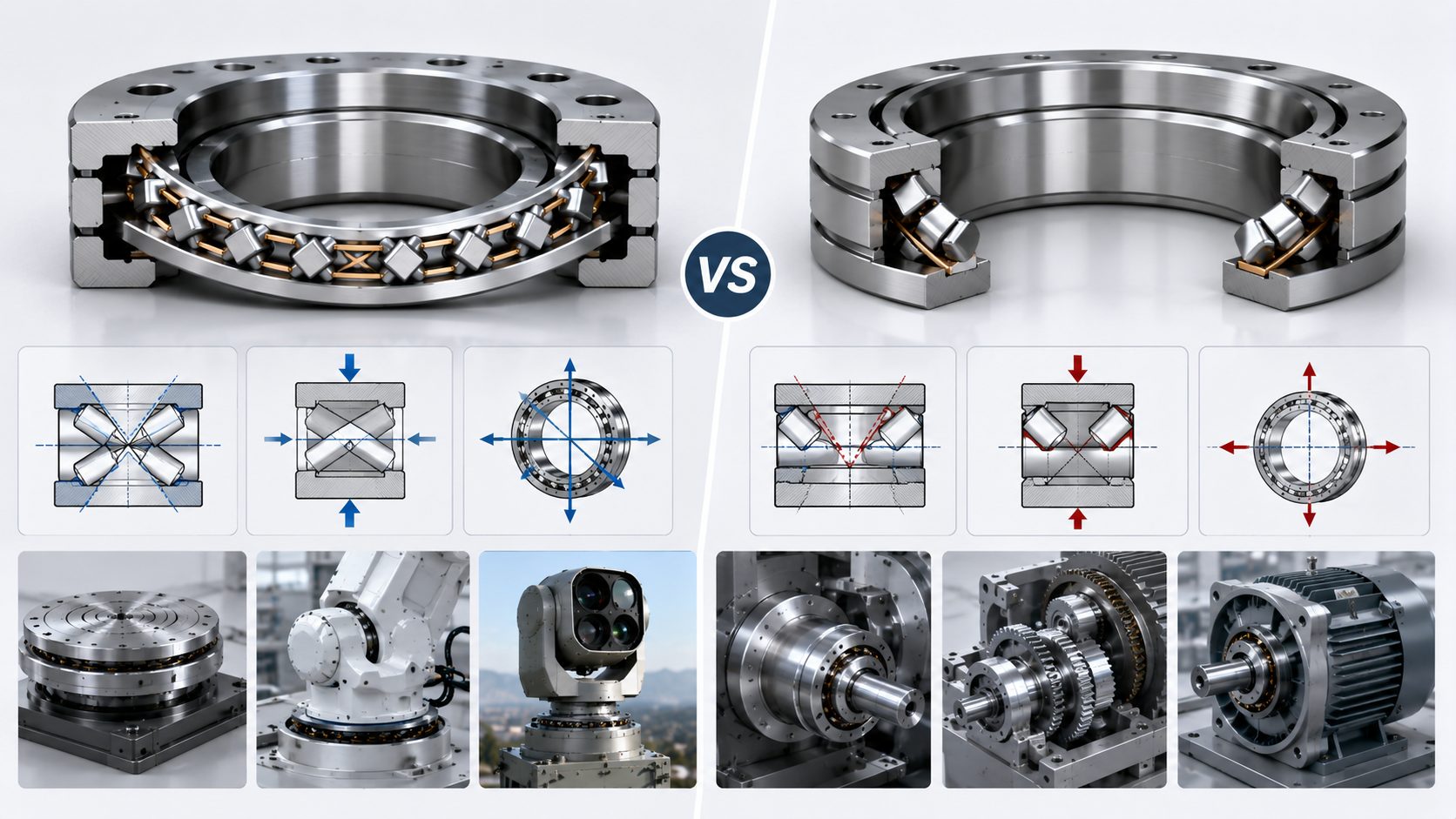
A crossed roller bearing packs two rows of cylindrical rollers into a single ring. The rollers alternate at 90 degrees, with one roller oriented to handle radial load while its neighbor handles axial load in one direction and the next neighbor handles axial load in the opposite direction. This V-raceway geometry provides high stiffness in all load directions from one bearing ring set that is about half as tall as a comparable two-bearing stack. The crossed roller arrangement is self-contained: it does not need a second bearing paired against it to handle reversed loads.
An angular contact bearing pair uses two separate rings spaced apart on the shaft. Each bearing handles axial load in one direction, with the pair preloaded against each other to share radial loads. The separation distance between the two bearings creates a moment arm that resists tilting. More separation equals higher moment capacity for a given bearing size. This is the core advantage of angular contact pairs: you can increase moment stiffness by increasing the bearing span without increasing the bearing diameter.
The key architectural difference: crossed roller bearings put all four load directions (radial, axial in both directions, and moment) into one compact ring, minimizing height. Angular contact pairs trade height for moment capacity through bearing separation distance. If your design is height-constrained, crossed roller wins decisively. If you have axial space to work with, angular contact pairs can match or exceed crossed roller moment stiffness at lower component cost, though the assembly cost may be higher due to the need for precision spacer rings or preload adjustment.
02Stiffness and Accuracy Comparison
Crossed roller bearings develop high radial and moment stiffness from their line-contact rollers. The roller-to-raceway contact patch is a line rather than the ellipse of a ball bearing. For the same envelope dimensions, crossed roller bearings are typically significantly stiffer than angular contact ball bearings of similar size. This matters when the stage supports a cantilevered load, such as a robot arm extended horizontally or a workpiece offset from the bearing center line. The line contact distributes the load over a longer contact area, reducing the contact stress and the resulting elastic deflection.
Accuracy specifications such as radial and axial runout are comparable between the two types when both are built to the same precision grade. A high-precision angular contact pair ground to P4 or ABEC-7 tolerances can match the runout figures of a crossed roller bearing ground to the same grade. The difference shows up under load rather than in free-state measurements. The crossed roller bearing maintains its runout specification better under moment loading because the rollers do not deflect into elliptical contact patches the way balls do under increasing load. The ball contact ellipse grows with load, increasing the effective compliance of the bearing, while the roller line contact stays essentially the same geometry.
Angular contact bearings have a clear advantage in speed. Ball bearings generate less heat than roller bearings at the same RPM because the rolling friction at the ball-to-raceway contact is lower than the friction at the roller-to-raceway contact, all else being equal. A crossed roller bearing at 500 RPM runs measurably warmer than an angular contact pair of similar size. If your rotary stage spins above 300 RPM continuously, angular contact bearings become the better thermal choice regardless of the stiffness comparison. Below 300 RPM, the thermal difference is small enough that other factors such as stiffness and assembly simplicity can drive the decision.
03Assembly and Cost Factors
A crossed roller bearing arrives as a single pre-assembled unit. You bolt it to the housing and shaft, torque the fasteners, and the bearing is ready. The preload is set at the factory and verified before shipment. Angular contact pairs require setting preload during assembly, either by grinding spacer rings to a precise thickness or by using a preload nut and measuring drag torque as the nut is tightened. This adds assembly time, requires technician skill, and introduces the risk of incorrect preload if the spacer ring thickness is off by even a few micrometers.
On the component cost side, a crossed roller bearing is typically more expensive than an angular contact pair of similar precision because of the more complex V-raceway grinding and the matched roller set. However, the crossed roller bearing saves cost elsewhere: shorter housing, fewer assembly steps, no need for precision spacer rings, and no need for preload adjustment on the assembly line. The total system cost often favors the crossed roller bearing when assembly labor is factored in, especially at low to medium production volumes where the one-time cost of grinding custom spacer rings cannot be amortized across many units.
04Decision Framework
CHOOSE CROSSED ROLLER
Height-constrained, moment-heavy, or assembly-sensitive
Pick a crossed roller bearing when the rotary axis is height-constrained, when the load creates a significant overturning moment that would require widely spaced angular contact bearings to match, or when you want to simplify assembly by using a single pre-assembled bearing unit. These conditions cover most robot joint applications, rotary indexers, small to medium CNC rotary tables, and inspection equipment rotary stages.
CHOOSE ANGULAR CONTACT
High-speed, space-rich, or high-volume
Pick an angular contact pair when the axis spins above 300 RPM continuously, when axial space is available and moment capacity can be achieved through bearing separation rather than bearing diameter, or when the production volume is high enough to justify the assembly tooling investment for preload setting. These conditions describe high-speed spindles, continuous-duty indexing tables in automotive transfer lines, and rotary stations where the bearing span can be designed into the machine structure from the beginning.
OVERLAP ZONE
Medium speed, moderate moment
For applications in the overlap zone at medium speeds with moderate moments, request stiffness curves, torque data, and thermal performance estimates from the bearing supplier for both bearing types. A few watts of additional heat in the bearing may or may not matter depending on your thermal management design, and the cost difference at system level may be small enough that other factors like lead time or supplier support become the deciding factors.
Related: Crossed Roller Bearings | Deep Groove Ball Bearings | Custom Assemblies
Get a Quote
Yuanhe supplies both crossed roller bearings and angular contact bearing pairs for rotary stage applications. Contact us with your load, speed, and space budget for a bearing type recommendation.