
 English
 French
 German
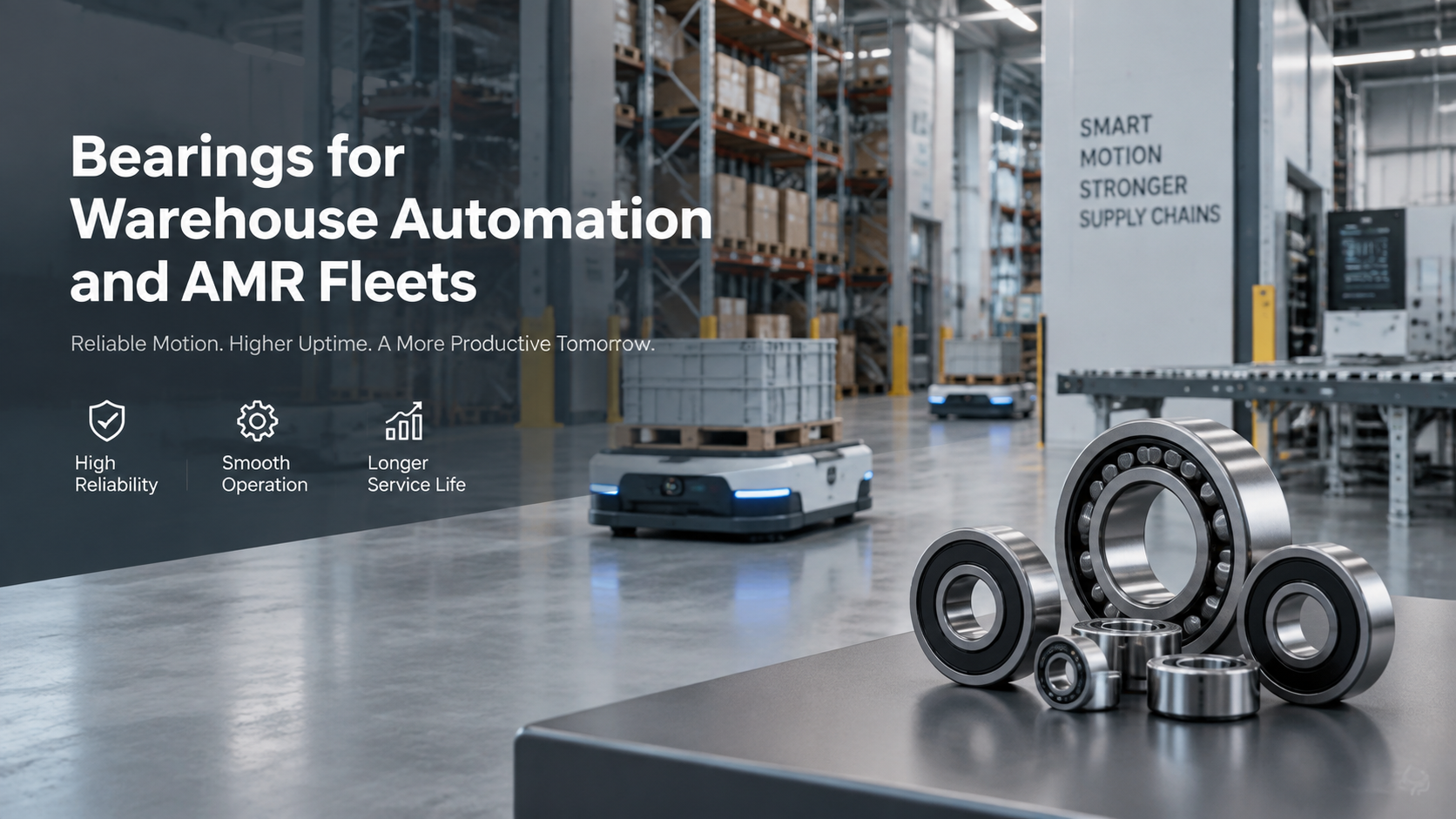
Bearings for Warehouse Automation and AMR Fleets
DUTY CYCLE FIRST
Bearings for warehouse automation live harder lives than most factory hardware. A warehouse robot runs for two shifts a day, stops and starts thousands of times, rolls over dock plates, and never gets a clean room. A bearing chosen from a load rating alone tends to die in the field, and every failed unit is a truck that stops moving in the middle of a pick wave.
This walkthrough organizes the problem the way a warehouse automation team actually builds it, by module. Each module has its own duty cycle, and each one asks something different from the bearing inside it.
01What Makes Warehouse Duty Different
Four conditions separate a warehouse floor from a normal factory floor.
- Stop and start density. An AMR drive motor reverses direction constantly. Every reversal is a small shock load through the bearing.
- Long running hours. A unit that runs most of the day accumulates hours that a machine tool never sees.
- Contamination you cannot seal out completely. Carton dust, shrink wrap fragments, and floor grit reach everything.
- Low maintenance windows. Nobody takes a fleet of 200 robots out of service to regrease a wheel hub.
Design for the fourth point and the first three usually take care of themselves.
02Where Bearings Sit in an AMR
A single autonomous mobile robot can carry bearings in four or five separate places, and they are rarely the same bearing.
Drive and caster wheel hubs
Drive wheel hubs on an AMR combine a radial load from the robot’s weight with a thrust component when the unit turns in place. Sealed deep groove ball bearings handle both directions of load in one compact package, which is why they dominate this position. The seal matters as much as the size, because a wheel hub is the lowest point on the machine and the closest to the floor.
Lift and mast assemblies
Lift mechanisms put a mostly axial load on the guide rollers and the top of the mast. Crossed roller bearings are a common choice here because a single row handles radial load, axial load, and tilting moment together, which keeps the mast section thin.
Conveyor and sortation modules
Sortation modules run at a fixed speed for hours, with a load that arrives in pulses as cartons cross a transition. Small shielded bearings with consistent running torque keep the belt tracking straight across a long line of rollers. A single rough bearing in a 60 roller line shows up as belt wander.
Robotic picking arms
The arm is the highest precision position on the machine. Arm joints need low play and high stiffness, and a joint that develops play shows up as failed picks rather than as a bearing failure ticket. Crossed roller bearings in an integrated ring design are the usual answer, because the preload is set at the factory and stays inside the joint.
03Duty Cycle Checklist Before You Specify
Collect these six numbers before you talk to any supplier. A bearing recommendation without them is a guess.
| Question | Why it changes the answer |
|---|---|
| Load per wheel or per joint | Sets the size and the number of rows |
| Reversals per hour | Drives shock rating and cage strength |
| Continuous running temperature | Decides the clearance group and the grease |
| Floor condition and cleaning method | Decides seal type, and whether washdown is involved |
| Service interval in hours | Decides sealed for life versus relubrication |
| Fleet size and build schedule | Decides whether tooling or a custom bore is worth it |
The temperature question catches teams out most often. A hub that runs warm expands the shaft faster than the housing, which is the classic reason a motor side bearing needs a looser internal clearance group than the drawing suggests.
04Which Bearing Fits Which Module
| Module | Usual type | Sealing | What to watch |
|---|---|---|---|
| Drive wheel hub | Deep groove ball bearing | 2RS contact seal | Contamination at floor level |
| Caster wheel | Deep groove ball bearing | 2RS or ZZ | Rolling resistance under light load |
| Lift mast roller | Crossed roller bearing | Shielded or sealed | Moment stiffness, mounting flatness |
| Conveyor roller | Small shielded bearing | ZZ | Consistent running torque |
| Picking arm joint | Crossed roller bearing, integrated ring | Sealed | Repeatability after service |
The pattern to notice is that rolling load positions take deep groove ball bearings and positioning positions take crossed roller bearings. Whenever a robot module needs both load capacity and low play in a thin envelope, the crossed roller design earns its cost.
05Sealing and Contamination in Carton Dust
Carton dust is abrasive and fine. It does not need to enter the raceway to cause damage. A trace in the seal lip is enough to wear the lip, and once the lip wears, the raceway follows.
Three practical points:
- A contact seal costs a little running torque and buys a lot of life in a dusty aisle
- Shielded bearings suit clean, fast rotating positions where friction matters more
- If the fleet is washed or wiped down with solvent, a sealed bearing is the only option that survives
Consistency matters as much as the seal type. A fleet that mixes shielded hubs from one build with sealed hubs from another will show uneven service data, which makes planning harder.
06Serviceability and Fleet Downtime
A fleet owner measures bearings in downtime, not in pieces.
- Sealed for life suits modules that are hard to reach and cheap to replace
- Relubrication suits high value joints that stay in the machine for years
- Standard bore sizes keep spare parts simple, and a fleet running a mix of custom bores needs a label on every shelf
Standard metric sizes cover most of what a warehouse robot needs. A 608 bearing handles small rollers and guide wheels, and a 6001 bearing covers the next step up in a compact housing. Sticking to standard sizes where the load allows is the cheapest spare parts policy available.
07Sizing the Small Positions
Most positions on a warehouse robot use small bearings, which is good news for spares and for cost.
- A 608 bearing at 8 mm bore, 22 mm OD and 7 mm width covers guide wheels and small rollers
- A 6001 bearing at 12 mm bore, 28 mm OD and 8 mm width covers the next step up in a compact housing
- A 6204 bearing at 20 mm bore, 47 mm OD and 14 mm width handles caster and drive positions on a heavier unit
Staying inside standard sizes wherever the load allows keeps the spare parts list short, which matters more than a small weight saving on a machine that stops the whole aisle when it fails.
08What Changes for a Fleet of 200 Units
Two things change when you move from a prototype to a fleet.
Consistency starts to beat peak performance. A slightly heavier bearing that behaves the same way in every unit produces comparable service data. A lighter one that varies batch to batch produces noise in the data and in the aisle.
Spares planning also starts at the drawing, not at the service desk. Every position should map to one part number, one seal type and one grease, so a technician standing at the machine never has to guess. Fleets that mix suppliers module by module end up with service records nobody can compare.
09FAQ
Do I need a special bearing for a robot that runs 20 hours a day?
Not a special bearing, but a considered one. Sealing, grease, and the internal clearance group matter more than a premium finish at these duty cycles.
How do I choose between a deep groove ball bearing and a crossed roller bearing in a joint?
If the joint must hold position, use the crossed roller type. If the position is held by the structure and the bearing only carries load, the ball bearing is smaller, lighter, and cheaper.
Should AMR wheel bearings be relubricated?
Only if the hub is designed for it. Opening a sealed hub on a fleet floor usually shortens life rather than extending it.
What is the biggest cause of premature hub failure?
Water and dust reaching the seal lip. The bearing size is rarely the problem.
Can we get the same bearing across multiple builds?
Yes, and you should. Keeping one part number per module across a fleet reduces the spare parts inventory and makes service data comparable.
10Plan Your Fleet Build With Us
Warehouse automation projects move fast, and the bearing list usually arrives last. Send us the module list with the duty cycle numbers above through our contact page, and we will come back with a bearing type, seal, clearance group, and grease recommendation for each position.
Next Step
Yuanhe supplies custom manufacturing for OEM programs, with more than 500 B2B clients and over 12,000 OEM projects delivered on one shop floor. For fleet builders, we ship first samples before the production tooling is committed, so a design review happens on real parts rather than on a drawing.



Related Products