


 English
 French
 German
Common Crossed Roller Bearing Failure Modes and Prevention
This guide covers the four most common crossed roller bearing failure modes in industrial equipment and how to spot them before they cause unplanned downtime.
A crossed roller bearing in a production machine rarely fails without warning. Weeks or sometimes months before the bearing locks up, seizes, or loses enough accuracy to scrap parts, it sends signals: rising torque, changing noise, climbing temperature, growing runout. Reading those signals early is the difference between a planned bearing swap during a scheduled maintenance window and an unplanned line stop that costs hours of lost production and possibly damaged adjacent components.
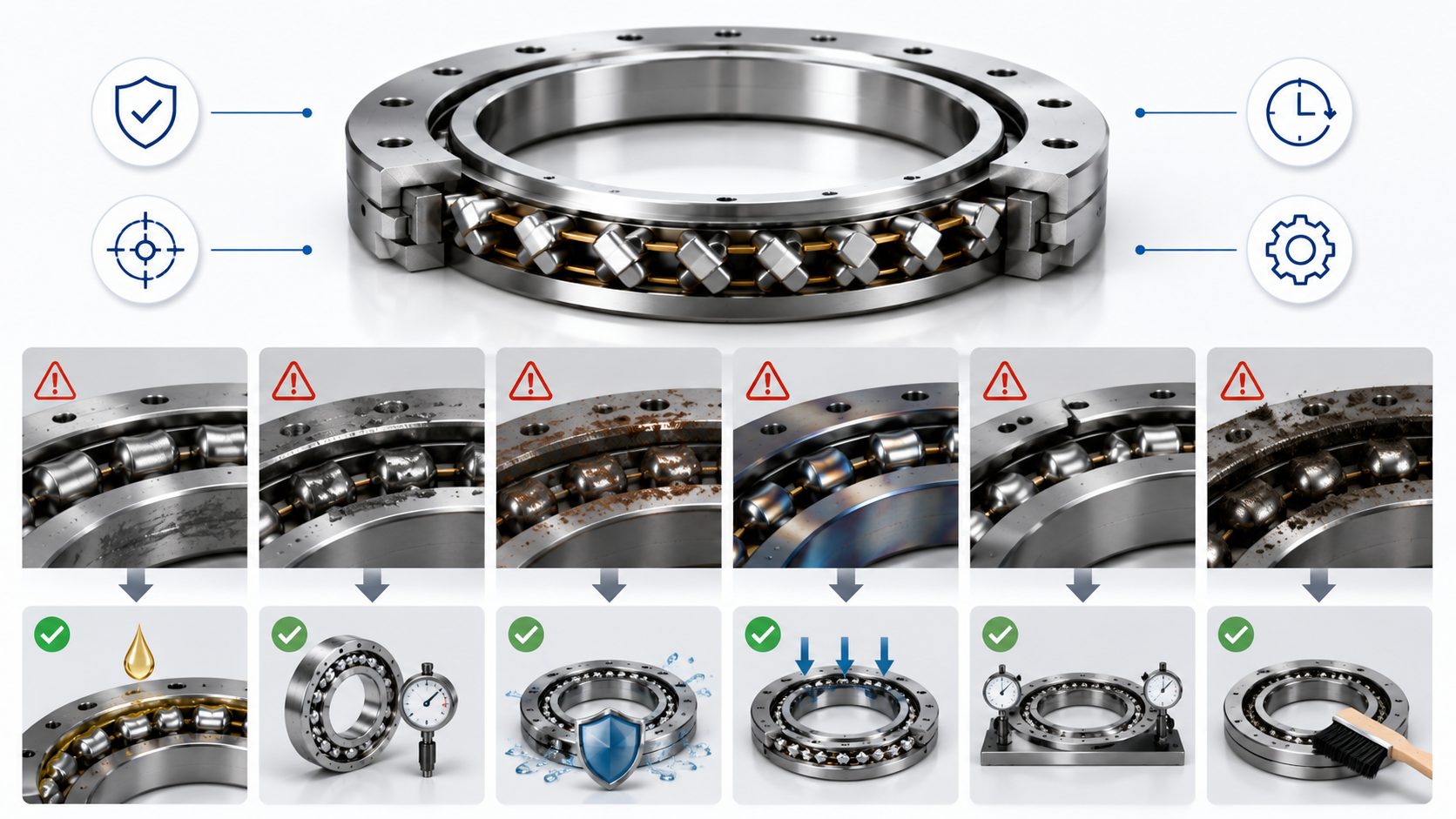
This article covers the four most common crossed roller bearing failure modes in industrial crossed roller bearings: contamination damage from particles entering the raceway, lubrication starvation from inadequate or degraded grease, misalignment-induced edge loading from poor mounting surface preparation, and fretting corrosion from small-amplitude oscillation without full rotation. Each section describes what the failure looks like, what causes it, how to spot it before it becomes catastrophic, and how to prevent it from occurring in the first place.
Contamination Damage
Foreign particles inside the bearing raceway act as a grinding compound. Every time a roller passes over a particle trapped in the grease, the particle dents both the roller surface and the raceway. A single pass may create a dent only a few micrometers deep. After thousands of passes, those microscopic dents accumulate into a textured surface that the lubricant film can no longer bridge. Metal contacts metal. Friction rises. The raceway surface begins to spall, shedding more particles that accelerate the damage in a self-reinforcing cycle.
The telltale sign of contamination damage is a gritty or sandy feel when rotating the bearing by hand. A healthy crossed roller bearing rotates with smooth, uniform drag. A contaminated bearing feels rough, often with a periodic tight spot where a larger particle has embedded itself in the raceway surface. Under magnification, the raceway shows a pattern of small dents or pits, often with a comet-tail shape where material was pushed up at the trailing edge of each dent. This surface texture is sometimes called bruising or false brinelling, though false brinelling specifically refers to fretting damage rather than particle denting.
Prevention starts with seals. Verify the seal material is correct for the operating temperature and the chemical environment. A seal that hardens at low temperature or softens in the presence of cutting fluid will not maintain its lip contact pressure against the rotating ring. Check seals for damage at every maintenance interval. Run a clean finger around the seal perimeter. If you feel a rough edge, a tear, or a gap between the seal lip and the ring, replace the seal before the bearing accumulates contamination damage. Keep the area around the bearing clean. Dust and chips that settle on the machine housing near the bearing will eventually work their way past degraded seals.
Lubrication Starvation
When the grease film between roller and raceway breaks down, the consequences unfold in a predictable timeline. The first hour: bearing torque rises by noticeably as metal-to-metal contact begins at the asperity level. The second to third hour: raceway surface temperature climbs noticeably above normal because friction converts kinetic energy to heat faster than the housing can dissipate it. Hour four to five: the raceway surface shows visible discoloration from heat, typically a blue or straw-colored oxide film on steel races. By this point, the raceway hardness has been reduced by overtempering and the bearing is damaged beyond recovery. Continuing to run it produces spalling, cracking, and eventual seizure.
Starvation occurs for two main reasons. Either the relubrication interval was too long for the actual operating conditions, or the grease oxidized prematurely because the bearing operating temperature exceeded the grease’s rated temperature range. A grease rated for elevated temperatures used in a bearing that runs at high temperatures will survive a fraction of its rated life because the oxidation rate roughly doubles for every several degrees above the baseline. In applications where the bearing runs continuously at elevated temperature, synthetic greases with higher thermal stability are worth the additional cost.
Prevention requires matching the relubrication interval to actual conditions rather than relying on generic catalog recommendations. If the bearing runs hotter than expected, or if periodic inspection reveals darkened or dried-out grease at the scheduled interval, shorten the interval. If the grease looks fresh at the scheduled interval, you can extend it cautiously. A tube of quality grease costs a few dollars. The replacement bearing and the downtime to install it cost hundreds or thousands. The math is simple enough that no formal cost-benefit analysis is needed.
Misalignment and Edge Loading
A crossed roller bearing expects both of its mounting surfaces to be flat within the specified tolerance and parallel to each other. When the housing face is out of flat by more than the bearing specification allows, the outer ring distorts under bolt preload. The raceway V-groove is no longer a perfect circle. The rollers no longer make full-line contact across their length. Instead, the contact is concentrated at one end of the roller, multiplying the local contact stress far beyond the design value.
Edge loading concentrates the entire roller load onto a fraction of the designed contact area. A roller that was designed to distribute significant force across a contact length might see that same significant force concentrated into a narrow band at the roller end when the ring is distorted. The local contact stress can exceed the material fatigue limit even when the total bearing load is well within the catalog rating. The damage starts as spalling or flaking at the raceway edge, visible as small pits or flakes near the shoulder. From there it propagates inward as the damaged surface roughens and generates more debris.
Prevent misalignment damage by measuring the mounting face flatness before bearing installation, not after the machine starts producing out-of-tolerance parts. A surface plate and dial indicator check takes ten minutes. For bolt-down crossed roller bearings, the staged torque sequence described in the installation guide is the most effective way to prevent ring distortion during assembly. Tightening bolts to full torque in a single pass without intermediate stages is the single most common cause of ring distortion seen in field returns. The two or three extra minutes required for the staged procedure pay for themselves in bearing life.
Fretting Corrosion from Oscillation
Fretting corrosion is a specific failure mode that affects crossed roller bearings in oscillating applications. When the bearing sweeps back and forth through a small angle, typically under ten degrees, the rollers never complete a full rotation. They travel the same short arc of the raceway repeatedly without redistributing the grease or moving the contact zone to a fresh section of the raceway surface. The repeated micro-sliding at the roller-to-raceway interface, caused by the elastic deformation and recovery of the contacting surfaces, wears away the protective surface oxide layer. The exposed bare metal reacts with moisture and oxygen in the grease or the atmosphere, forming iron oxide particles. Those oxide particles are harder than the base metal and accelerate the wear.
The visual signature of fretting is reddish-brown wear debris concentrated at the edges of the roller contact path. The raceway shows a distinct wear track matching the oscillation amplitude. If you rotate the bearing through a full 360 degrees by hand, it feels notchy or lumpy because the worn zone has different friction and different surface geometry than the unworn portion of the raceway. The notchiness may be subtle at first but becomes more pronounced as the wear track deepens.
Preventing fretting in oscillating applications requires one of two strategies, sometimes both. Either periodically run the bearing through a full rotation to redistribute the grease and move the rollers to fresh raceway positions, or specify a grease formulated with anti-fretting additives such as molybdenum disulfide, graphite, or certain solid lubricant packages that form a protective tribofilm on the raceway surface. For severe cases where the oscillation angle is under five degrees and the frequency is high, such as a fast-steering mirror pivot or a vibration test fixture, consider a bearing designed specifically for oscillating service with specialized cage geometry that promotes roller rotation and grease redistribution even at small angular amplitudes.
Related: Crossed Roller Bearings | Deep Groove Ball Bearings | Failure Analysis Support
Yuanhe engineering team can help diagnose bearing failure modes from photos and operating data. Contact us for failure analysis support and replacement bearing recommendations matched to your duty cycle.