

 English
 French
 German
EMQ Noise Grades and What Z1V1 Means
Spec Desk
An EMQ bearing noise grade is a promise about sound, and buyers often read it as a promise about accuracy. The two are measured differently, bought separately, and one does not imply the other.
EMQ stands for electric motor quality. It describes a bearing built and sorted for low noise in small motors, and the labels that follow it, such as Z1V1, come from the supplier’s own grading rather than from a single international standard.
01What an EMQ Bearing Noise Grade Covers
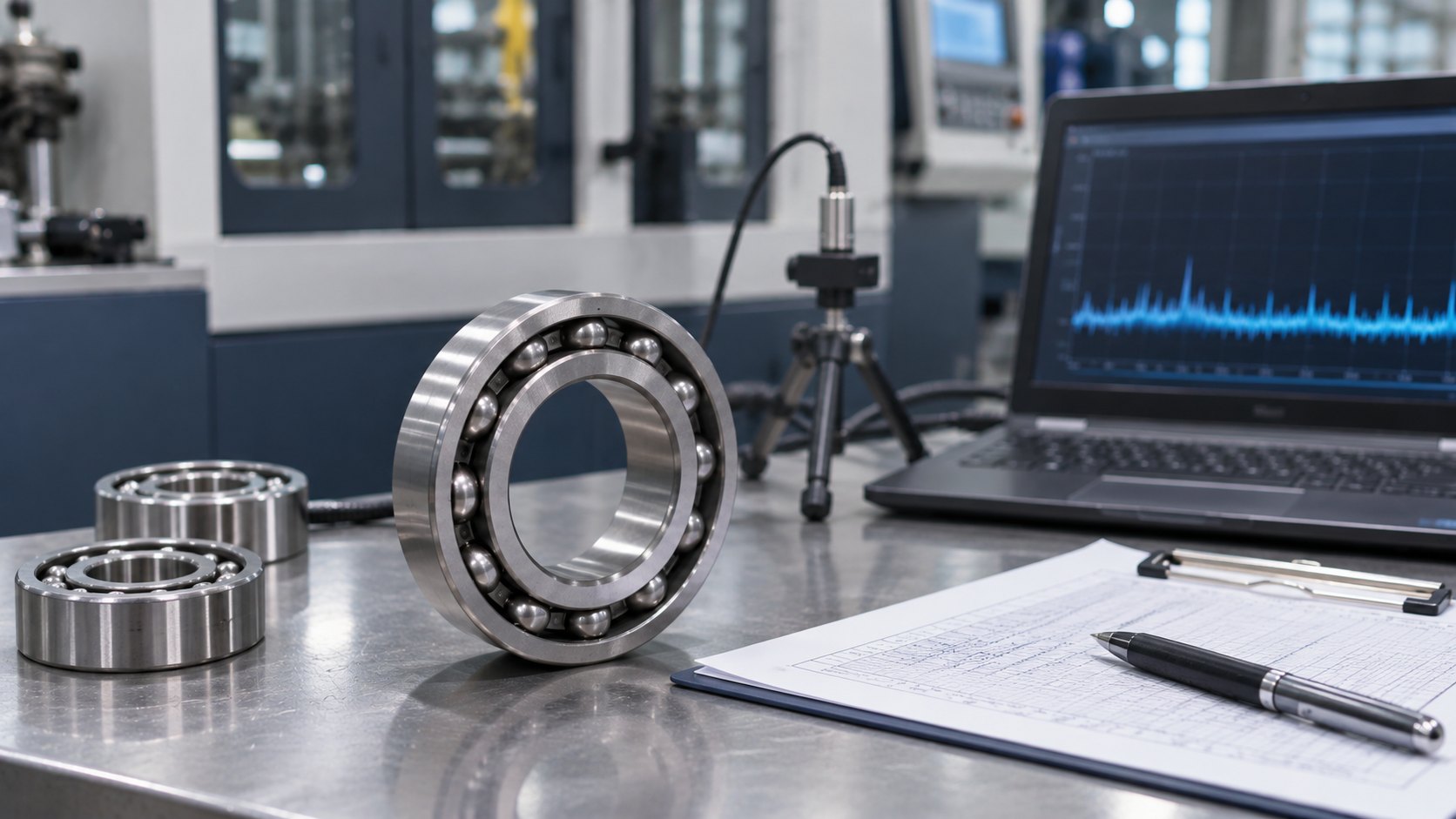
A standard bearing is inspected for dimensions, clearance, and running quality. An EMQ part goes through the same steps and then through a noise or vibration check on every piece or on a sample from each batch.
That extra step is what the label buys. A bearing that passes a dimensional check can still hum at a particular speed because of a rough raceway, a slightly out of round ball, or a cage that rattles. The noise check catches those parts before they reach a motor line.
The grade says nothing about how long the bearing will last or how much load it carries. It is a sorting result, applied to parts that already meet the dimensional spec.
02Reading the Z Prefix
In the trade labeling used by many Asian makers, Z followed by a number is a noise grade. A higher number means a tighter limit and a quieter part. Z1 is the entry level, and the scale runs up through Z2 and Z3 to grades that are sorted even more closely.
What changes between Z1 and Z3
The parts are not built differently. They are sorted differently. A plant runs a batch, tests every piece, and puts the quiet ones in the higher grade. That is why the price step between Z1 and Z3 is larger than the visual difference between the parts.
The practical result is yield. A maker can supply Z3 all day in a popular size, and may struggle to fill an order for a small bore at the same grade, because fewer parts from each run pass the tighter limit.
03Reading the V Suffix
V followed by a number is a vibration grade. The bearing is run on a spindle and the vibration of the outer ring is measured, either as velocity or as acceleration, depending on the method the plant uses.
Vibration and noise are related but not the same measurement. Noise is what a microphone hears, including airborne sound from the housing. Vibration is what the ring does. A part can pass a vibration limit and still sound wrong once it is in a motor end cap.
Most catalog designations pair the two, which is where a label such as Z1V1 comes from. The two numbers are meant to move together, and a supplier who offers Z3V1 is describing a part with a quiet noise grade and a looser vibration grade. Ask what that means for your motor before accepting it.
04Why the Test Conditions Decide the Result
A noise figure without test conditions is not a specification. The same bearing will produce different readings at different speeds, under different loads, in different fixtures.
Speed, load, and microphone distance
The test spindle runs at a set speed, applies a light axial load to keep the balls in contact, and places the sensor at a fixed distance. Change any of those and the number changes. A grade limit that was set at one speed says little about behavior at twice that speed.
The test environment matters as much. A room with background noise near the limit produces unreliable readings, which is why a proper noise bench sits in an acoustic enclosure. Ask where the test was run, not only what the result was.
05Noise Grade Is Not an Accuracy Grade
Accuracy is described by tolerance classes, such as the ABEC scale or the ISO P classes. Those numbers describe how close the bore, the outer diameter, and the runout are to nominal. They say nothing about sound.
| Label family | What it describes | Where you meet it |
|---|---|---|
| Z1 to Z3 | Noise grade, sorted by sound | Motor bearing catalogs |
| V1 to V3 | Vibration grade, measured on the ring | Motor bearing catalogs |
| ABEC or P class | Dimensional and runout tolerance | Precision and spindle work |
| C2 to C3 | Internal clearance range | Fits and thermal growth |
A bearing can be a standard tolerance part with the tightest noise grade, and that combination is exactly what most small motors want. Paying for a precision class when the motor needs a quiet standard part moves cost without moving the result.
06Where the Grade Stops Helping
The bearing is one source of noise in a motor. Housing bore quality, shaft fit, end cap alignment, grease quantity, and the motor’s own magnetic noise all contribute, and the bearing grade cannot fix any of them.
When housing and grease dominate
A loose housing lets the outer ring creep and the motor hums regardless of what the carton said. Too much grease produces a churning noise in the first minutes of running that sounds like a bad bearing and disappears once the excess is pushed out.
This is why a noise complaint should be investigated on the motor, not only on the bearing. If the same batch runs quiet in one motor design and loud in another, the bearing is not the variable that changed. The same 6205 bearing can be quiet in one motor and audible in another, because what changed was the housing and the grease round.
Write the requirement, not just the label
Tell us the motor size, the running speed, the acceptable noise level at the test bench, and whether you need a report per batch. We will quote the grade that meets it and say what the test method covers. Send the motor noise requirement and we will answer with a written spec.
07Writing the Requirement on Your Inquiry
An inquiry that says EMQ will get you a range of answers. An inquiry that names the grade, the test method, and the acceptance rule will get comparable quotes.
What to ask for in the report
Ask for the grade, the test speed and load, the sensor position, the sample size, and the result against the limit. A report that lists only a pass or fail mark is hard to audit later, because it does not say what was measured.
State the grease fill and the seal type as well. Both change the sound of a part. A 6204 bearing with a light fill and a shielded side sounds different from the same ring with a sealed side and a full fill, and neither is wrong if the motor was designed around it.
For volume programs, add the marking and packing requirements. Grade labels on the carton, batch traceability, and a retained sample from each lot cost little at the order stage and save a week of argument later.
08Following Up on a Noise Complaint
When a motor line reports noise, the first step is to separate the bearing from everything around it. Run the suspect part on a known good spindle, then run a known good part in the suspect motor. The pair of results usually points at one side or the other.
Keep the parts. A bearing that was noisy in a motor may run clean on a bench, and that result is evidence about the motor rather than the bearing. Photos of the housing bore and the shaft seat are worth more than a description over the phone.
If the bearing is at fault, the batch record should tell you whether the whole lot shares the problem. A single noisy part in an otherwise quiet batch points to handling damage after packing, which is a different conversation from a grading failure.
09Frequently Asked Questions
Is Z3 better than Z1?
In the usual trade labeling, yes, because the limit is tighter. Confirm the convention with the maker, since not every supplier uses the same scale in the same direction.
Does EMQ mean the bearing is precision ground?
No. EMQ describes noise and vibration sorting. The dimensional tolerance class is a separate line on the same datasheet.
Why is a Z3 part hard to find in small bores?
Because yield falls as the limit tightens, and small sizes run in smaller batches. A 6804 bearing at the top grade may need to be planned rather than pulled from stock.
Can I specify a noise level in decibels?
You can, but only with the test conditions attached. A decibel figure without speed, load, and distance cannot be checked by the supplier or enforced by you.
Do sealed bearings have a different noise grade?
They are graded on the same bench, but the seal adds its own sound. Tell the supplier which closure you need so the limit is set against the right part.
Noise Grade Quote
Send the motor frame, the speed, and the grade you need in writing. We will return a spec sheet with the test method, the grease fill, and the packing mark.
The full deep groove ball bearing range is available in graded noise classes, including the 6305 bearing sizes used in fan and pump motors. For diagnosis after the fact, read our noise diagnosis guide.



Related Products

