
 English
 French
 German
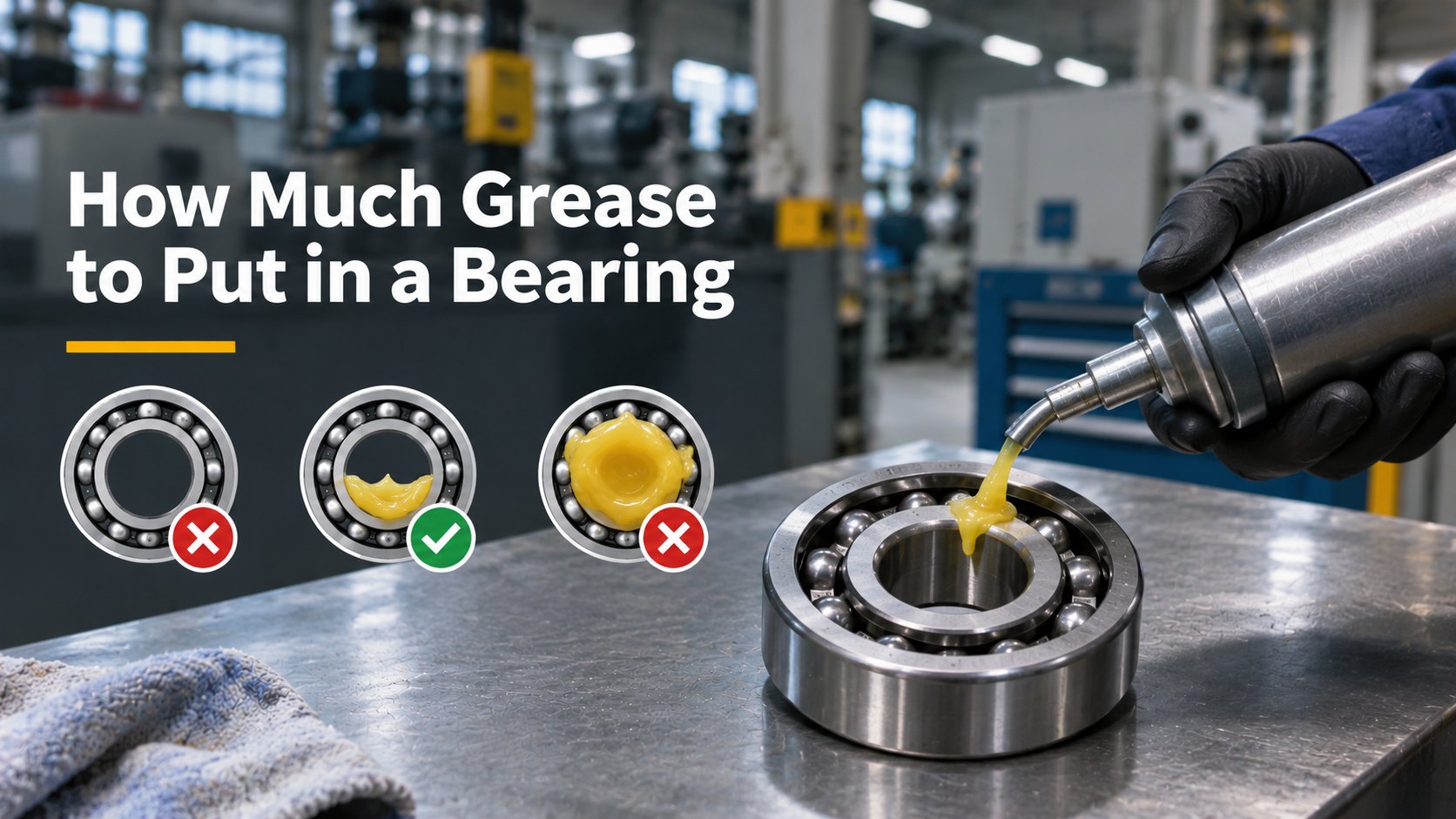
How Much Grease to Put in a Bearing
Lubrication
How much grease to put in a bearing is the question that produces the widest range of confident answers. Ask three people on the same floor and you will get three habits, each defended as standard practice.
The honest answer starts with geometry rather than a quantity. Two empty spaces exist inside a bearing assembly, and they are not the same size.
01Two Chambers, Not One
The first space sits inside the bearing, between the rings, the balls, and the cage. The second is the free space in the housing around it, and on most machines it is much larger than the first.
Grease inside the bearing cavity does the lubricating. Grease in the housing acts as a reservoir that feeds the rolling contact slowly as the machine runs. Treating the two as one volume is where overfilling starts.
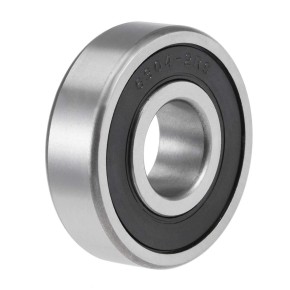
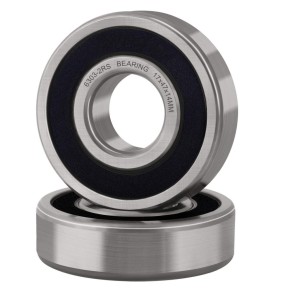
This is true across the family. Deep groove ball bearings in pumps and conveyors share the same layout, and so do the larger rings in a gearbox. The proportions change with size. On a compact part like the 6205 bearing the internal cavity holds very little, so nearly all of what you pump in goes into the housing. The principle does not.
02Myth One. Fill It Until It Squeezes Out
The habit comes from watching someone pack a truck wheel hub, where the cavity is small, the speed is low, and the seal is a lip that tolerates a little pressure.
A machine housing is a different situation. Grease with nowhere to go gets pushed against the seal from the inside until the lip lifts, and from that moment the position is losing lubricant on the side that matters.
What actually happens
A housing filled to the top has no room for the grease to move. The bearing churns it, temperature climbs, and the seal becomes the pressure relief valve. The leak that follows gets blamed on the seal.
There is a second version of the same habit. Someone fills the housing completely, then runs the machine and lets the excess work its way out past the seal as a form of self-levelling. What actually leaves is the lightest part of the grease, and what stays behind is the thickener.
03Myth Two. More Grease Means Longer Life
Extra grease does not extend life once the rolling contact is fully separated. Past that point it adds drag and nothing else.
Churning is the mechanism. When the balls have to push a solid mass of grease aside on every revolution, that work becomes heat. Heat ages grease faster than a small shortage ever would, so the generous fill can shorten the interval it was meant to extend.
Small bearings feel this first. A 6203 bearing on a high-speed shaft has little room and little thermal mass, and a heavy fill shows up as a warm housing within an hour of the service.
04Myth Three. The Seal Will Hold Whatever You Put In
Seals keep contamination out. That is the job they were designed for. A contact seal holds a lip against a running surface with light spring pressure and a thin film of oil under it.
Push grease past that lip and two things follow. The lip loses contact pressure and begins to weep, and the same path lets dust in on the next stroke of the machine. Neither shows up until the bearing is already wearing.
The seal also has a speed limit. A lip running against a surface at speed generates its own heat, and that heat is designed for with a thin film of oil under the lip, not a wall of grease behind it.
05Myth Four. Quiet Means Correctly Filled
A freshly overfilled bearing often runs quietly for the first hours, because there is lubricant everywhere and nothing is starved.
Temperature is the better signal. A housing that runs warmer after a service than it did before is telling you the fill is heavy, the grease is the wrong consistency, or both. Check it by hand at the same point on the casting, at the same load, an hour apart.
Check Temperature, Not Sound
Put a hand on the same spot on the housing before and after the service, at the same load. A difference you can feel is worth acting on. A difference you need an instrument to find is usually not.
06Myth Five. Topping Up Is the Same as Relubricating
Adding fresh grease to a housing full of old grease mixes two materials of two different ages. The new grease does not push the old grease out. It finds the easiest path and stays there.
If the old grease has separated, hardened, or collected dust, the result is a paste that neither lubricates well nor flows back to the contact. At that point the position needs a clean and a measured refill, not another shot from the gun.
When a Clean Is the Only Option
If the old grease has gone hard in the housing, no amount of fresh material will restore the film. The position needs the housing opened, the old grease removed, and a measured refill. It is an hour of work that saves a bearing.
07What Overfilling Does Inside the Housing
Churning and Heat
Every ball has to displace grease as it rolls. A light film is swept aside easily. A full cavity means the cage drags a solid plug around the raceway, and the energy that costs leaves as heat in the housing and in the grease itself.
Pressure at the Seal
Grease expands as it warms. In a sealed housing with no free volume, that expansion has to go somewhere, and the weakest point is the seal lip. Once it lifts, the position leaks and the same gap admits water and grit.
Where the Old Grease Goes
In a housing with free volume, old grease is pushed to the sides and stays out of the rolling path. In a packed housing it has nowhere to go, so it is dragged back through the contact on every revolution and worked until it separates.
The choice of lubricant matters here as well, though less than the amount. Our note on grease versus oil covers when a different lubricant type is the right answer instead of a different fill.
08A Fill Routine That Works
A routine beats a rule of thumb, because it adapts to the housing in front of you instead of the one in a manual.
• Clean the fitting and the housing around it before anything opens, so grit cannot travel in.
• Add in small amounts and let the shaft turn between them, so the grease spreads instead of stacking against one wall.
• Watch the housing temperature rather than the clock, and stop when it stops falling between shots.
• Run the machine for a shift, then recheck temperature and the seal line before you sign the job off.
• Write down what went in, on which date, and what the housing read afterwards.
On larger positions the same steps apply with more patience. A 6304 bearing in a hot housing needs the temperature check more than the small ones, because a heavy fill there is harder to notice and slower to settle.
09Four Checks Before You Add Grease
Run these four before the grease gun comes out
1. Is the existing grease still grease? Touch a sample. Hard, separated, or gritty means clean and refill, not top up.
2. Is the seal intact and dry on the outside? A weeping lip means the housing is already under pressure or the seal is worn.
3. Is this the same lubricant as last time? Mixing thickeners is a common cause of softening and leakage.
4. Does the position have a free volume to expand into? If the cavity is packed, remove before you add.
10Questions About Grease Volume
Is there one correct fill level for every bearing?
No. The right fill depends on speed, housing volume, seal type, and how the machine runs. What carries across applications is the principle: fill the bearing, leave room in the housing.
Can too little grease be worse than too much?
Both fail, in different ways. A starved bearing wears metal on metal within minutes and makes noise. An overfilled one runs hot for weeks and takes the seal with it. Starvation is faster, overfilling is quieter.
Should I fill a sealed bearing before fitting it?
A factory-sealed part is already filled for its rated life and should go in as it arrives. Opening it to add grease breaks the seal you paid for.
How do I know the fill is right after a service?
Run it and watch the housing temperature against the reading you took before the service. A rise that settles back within a shift is normal. A rise that stays is a fill problem.
Two ways to settle it
Send the bearing size, the housing volume, the speed, and the seal type. We will tell you what fill the position can take and which lubricant consistency suits it.
Use the contact form for a fill recommendation, or ask for a 6204 bearing data sheet if you only need the standard build figures.



Related Products