
 English
 French
 German
False Brinelling and Why Idle Bearings Fail
Failure Desk
False brinelling is the failure that makes a maintenance team argue with itself. The bearing shows dents, so the first guess is overload, yet the machine never carried that load.
The marks are real. They are just not what they look like. A shaft that stands still while the frame around it vibrates will produce damage that copies an impact dent almost exactly, and the repair that follows fixes the wrong thing.
01A Failure That Did Not Match the Load
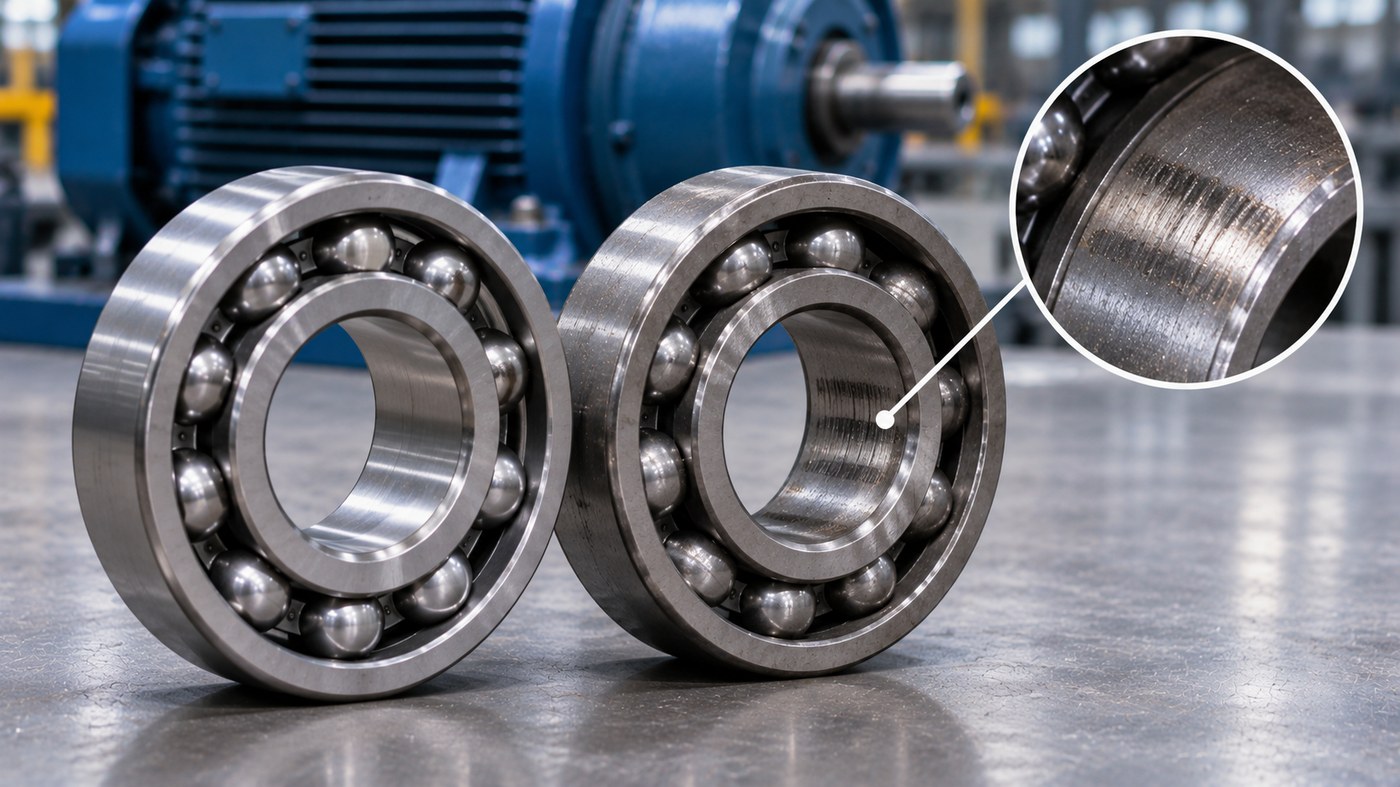
A food plant called us about a standby pump. The duty pump ran most of the week and the standby unit ran a few hours a month, usually during a changeover test. When the standby bearing came out at the annual service, both raceways showed a row of evenly spaced dents.
The first report said overload. That made no sense. The pump had never run against a closed valve, the alignment was checked twice, and the driven load was gentler than the duty unit that had run for years without trouble.
What the report missed was everything that happened while the pump was off. It sat on a skid beside a vibrating screen, bolted to the same steel. For most of the year the shaft did not turn, and the frame shook it anyway.
02What Brinelling Means and What It Does Not
Brinelling is the name for a permanent dent left in a raceway by a hard contact. The word comes from a hardness test that presses a ball into steel, and the mark it leaves is the shape the bearing copies.
Where the name gets stretched
In bearing work the term now covers two different events with a similar appearance. One is a genuine overload dent. The other is wear that develops while the rolling elements stay almost still against the raceway. Both are called brinelling in the field, and only one is a load problem.
03Reading True Brinelling at the Raceway
True brinelling comes from a load the bearing was not built for. A hammer blow during mounting, a dropped unit, a press that bottoms out, or a shock through the frame all press the balls into the race.
The mark is a smooth depression with a raised lip where metal was pushed aside. The surface inside the dent is bright, because the steel was freshly deformed and has not had time to corrode. There is no brown debris in the bottom, and the spacing follows the ball set only if the load passed through a single row.
Look for the cause away from the bearing. A bright dent with a raised edge and no oxide usually points to handling, mounting force, or a shock event rather than to running conditions.
04Reading False Brinelling at the Raceway
False brinelling develops while the bearing is stationary or moving through a very small angle. Vibration from nearby equipment passes through the rolling elements and works them against the raceway by a few microns, thousands of times an hour.
The result is a shallow depression filled with reddish brown wear debris. The dents sit at even intervals that match the rolling element spacing, because each ball wears its own spot. Under magnification the bottom looks rough rather than smooth, and the metal around it is discolored rather than raised.
Fretting corrosion comes next
Once the oxide layer breaks, the exposed steel corrodes in the presence of air and moisture, and the debris acts as an abrasive. That is why a false brinell mark often looks worse than its depth suggests, and why the noise starts before any measurable loss of clearance.
05Why Idle Machines Are the Worst Case
A running bearing spreads the load over a film of oil and keeps replacing the contact patch as it rotates. A bearing at rest keeps the same ball in the same spot, with the film squeezed thin and no chance to recover.
Standby pumps, idler rollers, spare motors on a rack, a 6204 bearing in a fan that only runs in summer, and machines waiting for a season all sit in this condition. So do bearings inside equipment that travels by truck or ship, where road vibration reaches the bearing for days without any rotation.
Small oscillating motion is just as bad. A crossed roller bearing holding a robot joint in position may move through a few degrees all day, which is enough to work grease out of the contact and never enough to carry it back.
Vibration reaches the bearing through whatever the housing touches. Piping tied to a pump, a baseplate shared with a screen, a motor bolted to the same frame as a compressor, and a fan mounted on a duct that shakes all do it. The bearing has no way to tell the difference between that motion and a load it was designed to carry.
06The Damage That Follows the Marks
A false brinell mark is not the end of the bearing, but it is the start of a chain. The dent disturbs the film, the surface roughens, and each pass adds a small impact that shows up as a rising noise floor.
Spalling follows in the advanced case, usually starting at the edge of the worn patch. By then the failure looks like fatigue and gets recorded as fatigue, which hides the fact that the damage began during a shutdown rather than during production.
This is why the same bearing size can fail on a standby unit while lasting years on the duty unit next to it. The difference is not quality. It is time spent standing still in a vibrating frame.
A vibration reading taken while the machine is off will show the problem clearly. Compare the housing against a quiet reference point on the same frame, and repeat the reading on the duty unit. The idle machine with the higher reading is the one that will fail first.
07What Stops It on the Next Shutdown
The fix is mechanical before it is chemical. Remove the vibration path, or move the shaft periodically so the contact patch changes.
Rotation on a schedule
Turn standby shafts by hand or run the unit briefly on a fixed interval. A quarter turn is enough to move each ball off its worn spot. Log the date on the machine, because a schedule that lives in someone’s memory stops the week that person is on leave.
Grease choice and fill level
A grease with anti wear additive and good stay put behavior slows the wear once motion begins. Filling the housing partly, rather than completely, leaves room for the grease to move back into the contact. A dry bearing is the worst case, and an overfilled one is close behind because the grease cannot circulate.
For a common frame size such as the 6205 bearing on an idle fan or the 6304 bearing on a standby motor, the same logic holds. The unit that fails first is usually the one that runs least.
08Storage and Transit
The same damage happens before a bearing is ever installed. Cartons stacked beside a press, a pallet in a truck bed for a week, or a spare part shelf next to a compressor all expose the raceway to vibration with no rotation.
Keep spares on a padded shelf away from running machinery, and do not store them loose in a toolbox that travels. For long storage, leave the factory preservative in place and rotate stock so the oldest units are used first.
Two photos are usually enough
Send a close up of the marks plus the machine it came from, and note whether the unit was running or standing when the noise started. A bright dent with a raised edge and a brown dent with rough debris lead to different answers. Send the photos to our failure desk.
09Frequently Asked Questions
How do I tell false brinelling from a true brinell mark without a microscope?
Look at the color and the edge. A true mark is bright with a raised lip. A false mark is discolored, often brown, with a rough floor and no raised metal around it.
Can a bearing with false brinelling be reused?
Sometimes, if the marks are shallow and the surface has not spalled. It will run louder and its life is shortened. In a standby unit that has to start on demand, replace it and fix the vibration path.
Does the damage happen in storage too?
Yes. Any carton or spare sitting in a vibrating building or on a truck is exposed. Padding and distance from running machines matter more than the shelf label.
Why does the standby unit fail before the duty unit?
Because a stationary bearing keeps the same ball against the same spot. The duty unit keeps moving the contact patch, so no single point accumulates wear.
Will a different grease alone solve it?
No. Grease slows the wear but cannot stop a frame that shakes a stationary shaft. Change the vibration path or rotate the shaft on a schedule first.
Failure Review
Send the marks, the machine history, and whether the unit was idle. We will tell you which mechanism fits and what to change at the next shutdown.
For background on the other mechanisms that end a bearing’s life, read our failure analysis guide, or ask for the deep groove ball bearing range that suits standby duty.



Related Products