
 English
 French
 German
Deep Groove Ball Bearing vs Ball Bearing. What the Difference Is
Plain Language
The deep groove ball bearing vs ball bearing difference is not a contest between two products. One name is the family and the other is the member of the family that most machines actually use. Mixing them up is the quiet reason a purchase order arrives with the wrong part.
This page is about the words. It explains the naming, shows what the confusion costs on a real order, and gives you a one line description that gets the right bearing quoted the first time. The technical comparison between families lives in other guides, so this one stays on language.
01One Name Is the Family, the Other Is a Member
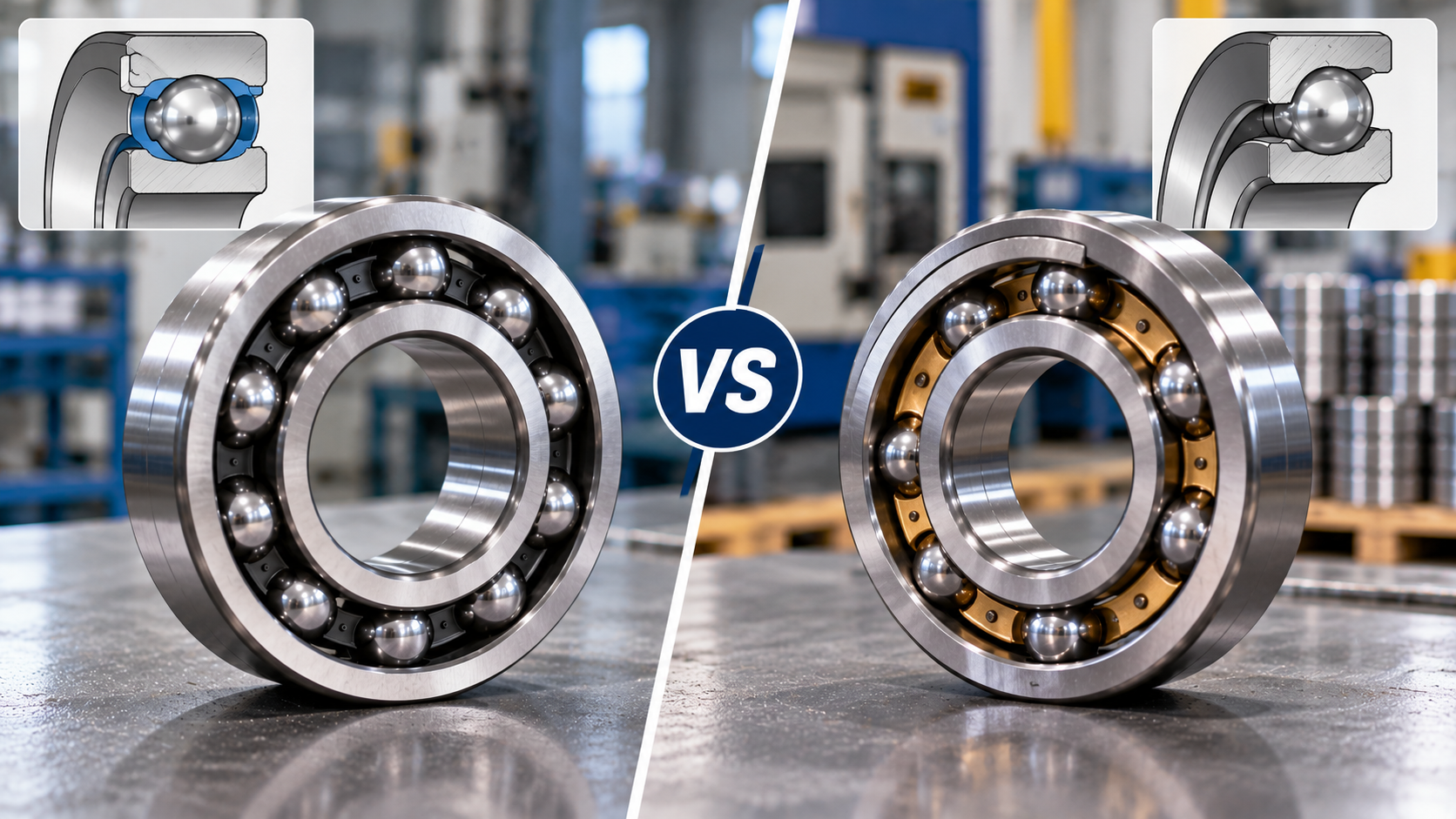
A ball bearing is any bearing that rolls on balls rather than on cylinders, needles, or cones. That covers a wide set of products with different groove shapes, different load directions, and different mounting rules. It is a category, in the same way that pump is a category.
A deep groove ball bearing is one specific product inside that category. It has a continuous groove on both rings, it takes radial load and a share of axial load in both directions, and it is the version that sits in electric motors, fans, conveyors, and gearboxes by the million.
So the honest answer to the comparison is that there is nothing to compare. Asking for the difference between a deep groove ball bearing and a ball bearing is like asking for the difference between a sedan and a car. One answer describes a shape, the other describes a group.
02Where the Two Names Came From
The family name came first because the shape came first. Early ball bearings were simple: two rings, a row of balls, and a cage to keep them apart. As machines asked for more axial capacity, more stiffness, and more tolerance of shaft deflection, makers changed the groove and the ring geometry and gave each version its own name.
The deep groove version kept the simple two ring layout and added shoulders that wrap around the ball. That shoulder is what lets it take axial load in both directions, and it is why the name survived while other versions were renamed around their function, such as angular contact for the contact angle or self aligning for the spherical seat.
Our own catalog uses the family name for the group and the product name for the part, which is why the deep groove ball bearing range sits under a ball bearing heading. The 600 to 6900 series designations inside it are all deep groove parts.
03What Goes Wrong When the Names Get Mixed
A buyer writes ball bearing on the inquiry because that is the word on the drawing, the maintenance ticket, or the old purchase order. The supplier quotes the cheapest ball bearing that fits the bore. Both parties believe they agreed on a part.
The error only appears at installation or, worse, after a few months of running. The bore and outside diameter match, the width may not, the axial capacity may not, and the seal arrangement is often different. Nobody lied. The description was just one level too general.
The Quote That Comes Back Wrong
Three things go wrong on the quote, and all three are cheap to prevent. The bearing arrives open when the machine needs a sealed version. The clearance group is standard when the duty needed something looser for a hot shaft. The axial capacity is a fraction of what the old part carried, because the family member quoted was a lighter design.
Each of those is a description problem, not a manufacturing problem. A 6204 bearing is a 20 x 47 x 14 mm deep groove part rated 12.8 kN dynamic. A different member of the ball bearing family at the same bore carries a different number, and the inquiry needs to say which one you want.
04What Separates One Family Member From Another
The family splits on two things, the shape of the groove and the direction the load travels. Everything else, including size, seal, and clearance, is a choice inside whichever member you picked.
Two Things Decide the Name
| Family member | Groove or seat | Load direction | Typical use |
|---|---|---|---|
| Deep groove | Continuous groove, both shoulders | Radial plus both axial directions | Motors, fans, conveyors, gearboxes |
| Angular contact | One shoulder removed, fixed contact angle | Radial plus one axial direction | Spindles, ballscrew supports, pump shafts |
| Self aligning | Spherical outer seat, two ball rows | Radial, light axial | Long shafts, frames that deflect |
| Thrust | Flat washer races | Axial only | Vertical shafts, turntables |
We build the first row and the crossed roller family. The other rows appear here only because they are the reason the family name exists, and because a buyer who says ball bearing may be thinking of any of them.
05How to Say What You Need in One Line
A good description has five parts and fits in a single sentence. Once you write it that way, most of the back and forth with a supplier disappears.
1. Name the type. Deep groove, not ball bearing. This is the word that decides the groove shape and the axial capacity.
2. Give the size or the designation. Write the number, such as 6205 or 6305, or the bore, outside diameter, and width in millimeters.
3. State the closure. Open, shielded with two metal shields, or sealed with two rubber seals. Say the number, not the word protection.
4. State the clearance group if the duty is hot or tight. Standard, or a tighter or looser group. If you do not know, say the running temperature and let the supplier choose.
5. Say what the machine does. A conveyor pulley and a spindle can share a size and need different parts. One line about the duty saves a round of questions.
Here is the whole thing in one line. Deep groove ball bearing, 6205, 25 x 52 x 15 mm, two rubber seals, standard clearance, conveyor drive pulley at 900 RPM. Any supplier can quote that without a question.
06Reading a Part Number Without the Word Bearing
The number on the bearing already tells you the family. A four or five digit designation in the 600, 6200, 6300, 6800, or 6900 series is a deep groove part in almost every catalog that uses the ISO size system. The last two digits give the bore, and the digits before them give the series.
That is why an experienced buyer rarely writes the words at all. They write the designation and the suffix, and the part is unambiguous. A 6305 bearing is 25 mm bore in the medium series, and no other family member shares that designation in the same system.
Where the Number Stops Being Enough
The number does not carry the clearance group, the cage material, or the lubricant. Those are suffixes or separate lines on the drawing, and they are exactly the details that go missing when an inquiry says ball bearing and nothing else.
Two bearings with the same designation can differ in seal type and clearance, and both will fit the same housing. That is the gap a one word description cannot close.
07Seals, Shields and Clearance Are Separate Choices
A common assumption is that the family name decides the closure. It does not. Deep groove bearings are made open, shielded, and sealed, and the closure is chosen for the environment rather than for the type.
Closure Is an Environment Question
The same applies to clearance. A standard group suits most duties. A hot shaft in a tight housing needs a looser group, and a machine that needs minimal play uses a tighter one. These are choices inside the family member, not different family members.
A 6304 bearing at 20 x 52 x 15 mm is rated 16.0 kN dynamic and 7.88 kN static, and it ships open, shielded, or sealed. The rating does not change with the closure. The speed limit does, and the drawing has to say which one you need.
08Three Sentences That Cause Most Order Errors
These three come up often enough that they are worth naming. Each one is a short sentence that sounds complete and is not.
• Send me a price for ball bearings. No type, no size, no closure. The supplier has to guess, and the guess will be the cheapest part that fits a bore.
• Same as the old one. Fine if the old one still has a readable marking. If the marking is gone, the description has to be rebuilt from the shaft and the housing.
• It is a standard bearing. Standard describes the size system, not the part. Standard clearance, standard seal, and standard cage are three separate decisions.
The fix for all three is the same five part sentence from the previous section. It takes thirty seconds to write and it removes the most expensive kind of error, the one that only shows up after installation.
09When the Family Name Is the Right Answer
There is one case where ball bearing is the correct word. When the machine is still being designed and the bearing has not been chosen, the family name is the right level of detail. It says the shaft will roll on balls, and it leaves the type open until the loads are known.
The move from family to member happens when the loads are calculated. Radial load, axial load, speed, and shaft length decide whether the answer is a deep groove bearing or something with a different groove. Writing the family name after that point is what causes the errors.
So the practical rule is this. Use ball bearing while the design is open, and use deep groove ball bearing the moment you are ordering. A 6004 bearing at 20 x 42 x 12 mm is a specific part. Ball bearing is a shelf.
10Questions Buyers Ask
Is a deep groove ball bearing a type of ball bearing?
Yes. It is the most common member of the family, and the name describes the shape of the groove rather than a brand or a grade.
Are all ball bearings deep groove?
No. Angular contact, self aligning, and thrust bearings also roll on balls and each has a different groove or seat. They take load in different directions and do not interchange.
Does the word deep groove change the price?
It changes which part you get quoted. A deep groove bearing and a lighter family member at the same bore are different products with different capacity, and the price follows the part rather than the word.
How do I describe a bearing if the marking has worn off?
Give the bore, outside diameter, and width in millimeters, the closure, and one line about the duty. From that a supplier can identify the designation and confirm the clearance group.
Can you supply a bearing that is not deep groove?
We build deep groove ball bearings and crossed roller bearings. If the duty points at another family, we will say so rather than quote a part that will not carry the load.
Write It in One Line and We Will Quote It
Send the type, the size, the closure, the clearance, and one line about the machine. That is enough for a firm quote, and it is enough for us to flag a wrong choice before it ships.