
 English
 French
 German
Electric Motor Bearing Currents. How Shaft Currents Damage Bearings
Current Damage
Electric motor bearing currents are the reason a perfectly good bearing can fail in a motor that was never overloaded, never ran hot, and was greased on schedule. The damage is not mechanical at all. It is electrical, and it leaves marks that a trained eye can read.
This page covers where the current comes from, how it reaches the bearing, what the damage looks like on the surface, and how to stop it. The bearings involved are ordinary deep groove ball bearings such as the 6204, the 6205, and the 6305.
01Why a Motor Damages Its Own Bearings
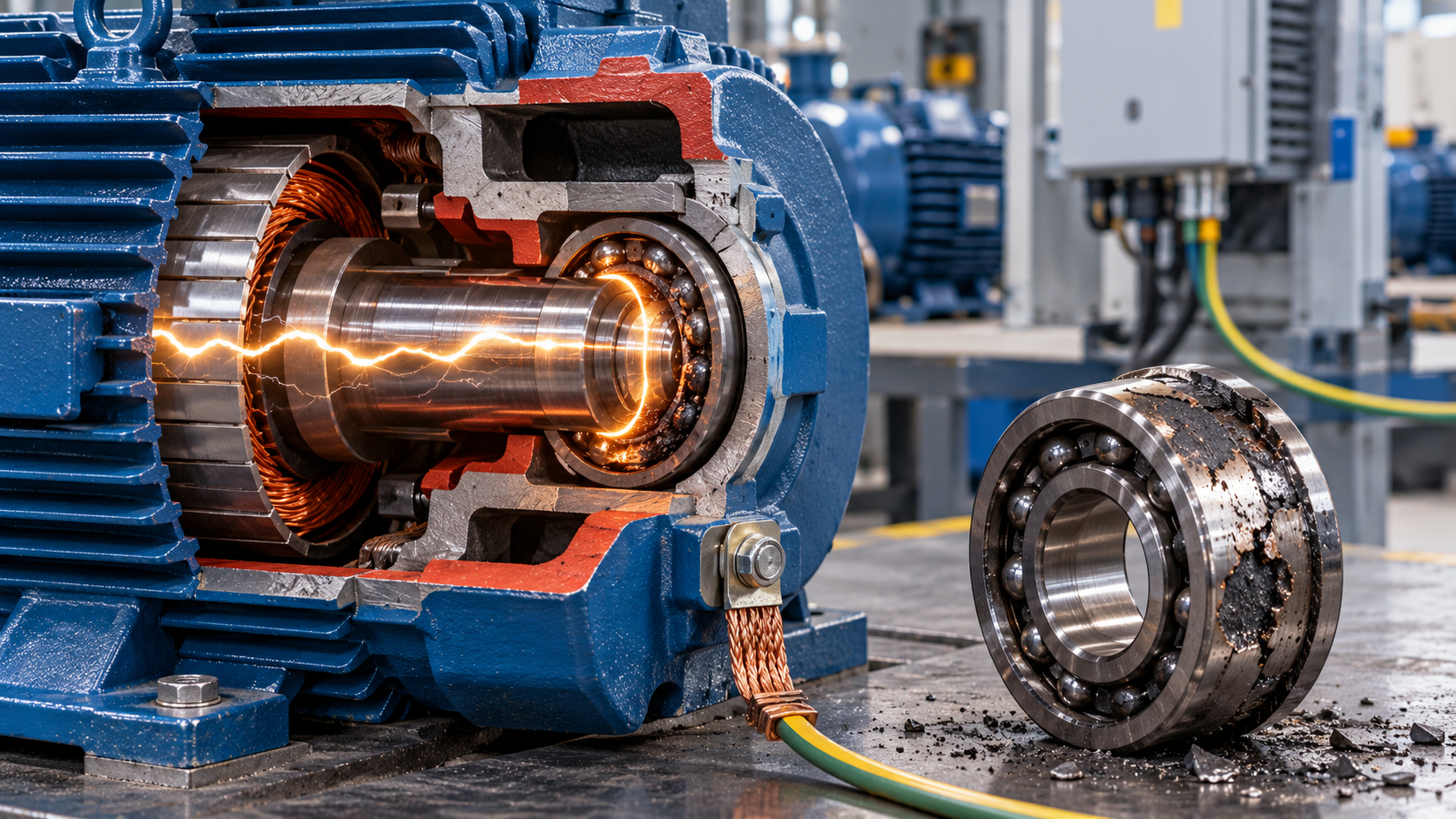
A motor is supposed to spin a shaft, not pass electricity through its own bearings. Under certain drive conditions it does exactly that, and the bearing becomes the easiest path to ground.
The damage it leaves is small at first, often no more than a dull grey patch on a raceway. Over weeks the patch grows into a pattern of fine ridges, the grease darkens, and the bearing starts to whine. By the time anyone notices, the surface is beyond saving.
The difficult part is that none of the usual suspects show up. Load is normal, fit is correct, and lubrication was fine. The bearing was fine too, until current found it.
The first machines to report it are usually the ones that just went onto a new drive. Nothing about the mechanical design changed, so the damage is often written off as a bad batch until the second set of bearings shows the same pattern.
02Where the Current Comes From
Motor bearings sit on a shaft that wants a different electrical potential from the housing around it. Several ordinary conditions create that difference, and they often appear together.
• Fast switching drives. A variable frequency drive switches its output thousands of times a second. The switching creates a small voltage between shaft and frame that the bearing has to bridge.
• A magnetic circuit that is not perfectly even. Small asymmetries in the stator and rotor mean the flux does not cancel perfectly, so a voltage appears along the shaft.
• Wiring and grounding practice. Long motor leads, missing shields, and a poor high frequency ground path all raise the voltage the bearing sees.
• Static build up. Belts and dry process equipment charge the shaft where no drive is involved at all.
The common thread is that something wants to equalise a potential, and the bearing sits on the shortest path. Detailed failure signatures are catalogued in our guide on bearing failure analysis.
03The Path Through the Motor
Current does not need a wire to cross a bearing. It passes from the shaft through the inner ring, across the lubricant film, into the outer ring, and out through the housing. The lubricant film is the part that suffers.
A grease film is only a few microns thick in a running bearing, and it is not a perfect insulator. When the voltage across it rises above what the film can hold, it breaks down in a tiny spark. Each spark vaporises a speck of metal and leaves a pit. Millions of small sparks, spread around the raceway, carve the pattern that gives this failure its name.
04What Electrical Damage Looks Like
Electrical damage has a signature that separates it from overload, contamination, or a bad fit. Once you have seen it, it is hard to mistake.
Washboard Ridges
The classic mark is a regular series of fine parallel ridges across the raceway, spaced close together and even in pitch. Engineers call the pattern fluting, and it forms because each spark pit becomes a place where the next ball contact sits slightly differently. The surface ends up looking like a worn record.
Dull Grey Frosting
Before ridges appear, the raceway takes on a flat, frosted, matte grey look that does not match the polished finish of a healthy bearing. Frosting is the early stage, and it is the point at which the failure is still cheap to prevent.
Grease That Turns Dark
The sparks also break down the grease around the affected zone. The lubricant darkens, turns gritty, and stops protecting the surface. At that point the bearing has two problems, electrical pitting and a failed lubricant, and it will fail fast.
05Ruling It Out
Electrical erosion is easy to confirm and easy to misdiagnose. The table below compares what you see in the motor with what that evidence usually means.
| What you find | Usually points to | Usually not |
|---|---|---|
| Even ridges across the raceway | Electrical erosion | Overload or a bad fit |
| Frosted matte raceway, grease still light | Early electrical damage | Contamination |
| Dark gritty grease in a cool motor | Electrical erosion breaking the lubricant down | Simply the wrong grease |
| Damage on both bearings | A current path through the whole shaft | One bearing running dry |
| Damage on one bearing only | Insulation or grounding already fitted on one end | A manufacturing fault |
06The Fixes That Work
The fix is always the same in principle. Give the current an easier route that does not pass through a bearing, or break the path where it cannot.
1. Improve the ground path. A good high frequency ground between motor frame and drive, with correctly shielded cable, removes the reason the current looks for the bearing.
2. Fit a shaft grounding device. A brush or ring on the shaft carries the current to frame without touching the bearing.
3. Insulate one bearing. An insulating coating on the outer ring of one bearing breaks the loop, so no current crosses either bearing.
4. Keep both ends sensible. Insulating both bearings can leave the shaft floating, so the usual approach is to insulate one end and ground the other.
5. Review the drive settings. Long leads, fast switching, and missing filters all raise the voltage the bearing sees.
Insulated bearings use the same standard sizes as any other motor bearing. Our 6204 bearing and 6205 bearing pages list the standard dimensions these motors run.
What We Need to Read a Failed Bearing
Photos of the raceway, taken in good light at an angle, and of the grease.
Which bearings failed, both ends or one, and how long they ran.
The drive type, the load, and whether anything else changed recently.
07What the Fix Does Not Change
Stopping the current restores the life the bearing was always supposed to give. It does not make a bearing more capable than its rating, and it does not fix a machine that had other problems underneath.
One Fault of Two
If the raceway shows both electrical marks and mechanical spalling, the current was one of two faults. Fixing the current will not repair the load, fit, or lubrication problem that produced the rest of the damage, and the bearing will keep failing for a different reason.
The same test covers the motor itself. A fretted housing, a shaft scored by a ring that has been spinning on it, or a grease that was never compatible with the duty are all separate repairs that have to be made while the motor is open.
08When to Replace Instead of Rebuild
A frosted raceway with clean grease is worth acting on, because the surface is still mostly intact and the fix will hold. Once ridges have formed, the geometry of the raceway has changed and the bearing will make noise even after the current is gone.
The same reasoning applies to the whole motor. Greasing intervals, fits, and the housing bore should be checked while the motor is open. Our 6305 bearing page lists the sizes that cover larger motor frames, and the deep groove ball bearing range covers the smaller frames.
Replacing a bearing in a motor that is still passing current only resets the clock. If the grounding and insulation have not been checked, the replacement will show the same frosted raceway after the same number of running months.
09Questions Buyers Ask
How do I know the failure was electrical?
Look for even ridges across the raceway, a frosted matte surface with clean grease, or dark gritty grease in a motor that never ran hot. Any of those three points to current rather than load.
Will a better bearing fix it?
No. A higher grade bearing in the same machine will erode just as fast, because the current is still crossing the raceway. Fix the path or insulate the bearing first.
Should I insulate both bearings in a motor?
Usually no. Insulating one end and grounding the other is the normal arrangement, because insulating both can leave the shaft without a defined path.
Does grounding the motor frame solve it?
It helps, and it is the first thing to check, but a poor high frequency ground or unshielded motor cable can leave enough voltage to keep damaging the bearing.
Can you supply an insulated version of a standard size?
Tell us the size, the drive, and which end failed. We will confirm the build that fits and quote it with the seal and clearance you need.
Send Us the Failed Bearing
Photos of the raceway and the grease are usually enough to confirm electrical erosion. Send the size, the motor, and the drive details and we will read the failure and quote a replacement built for the duty.