


 English
 French
 German
Bearing Inspection Report. What to Check Before You Accept
INCOMING GOODS
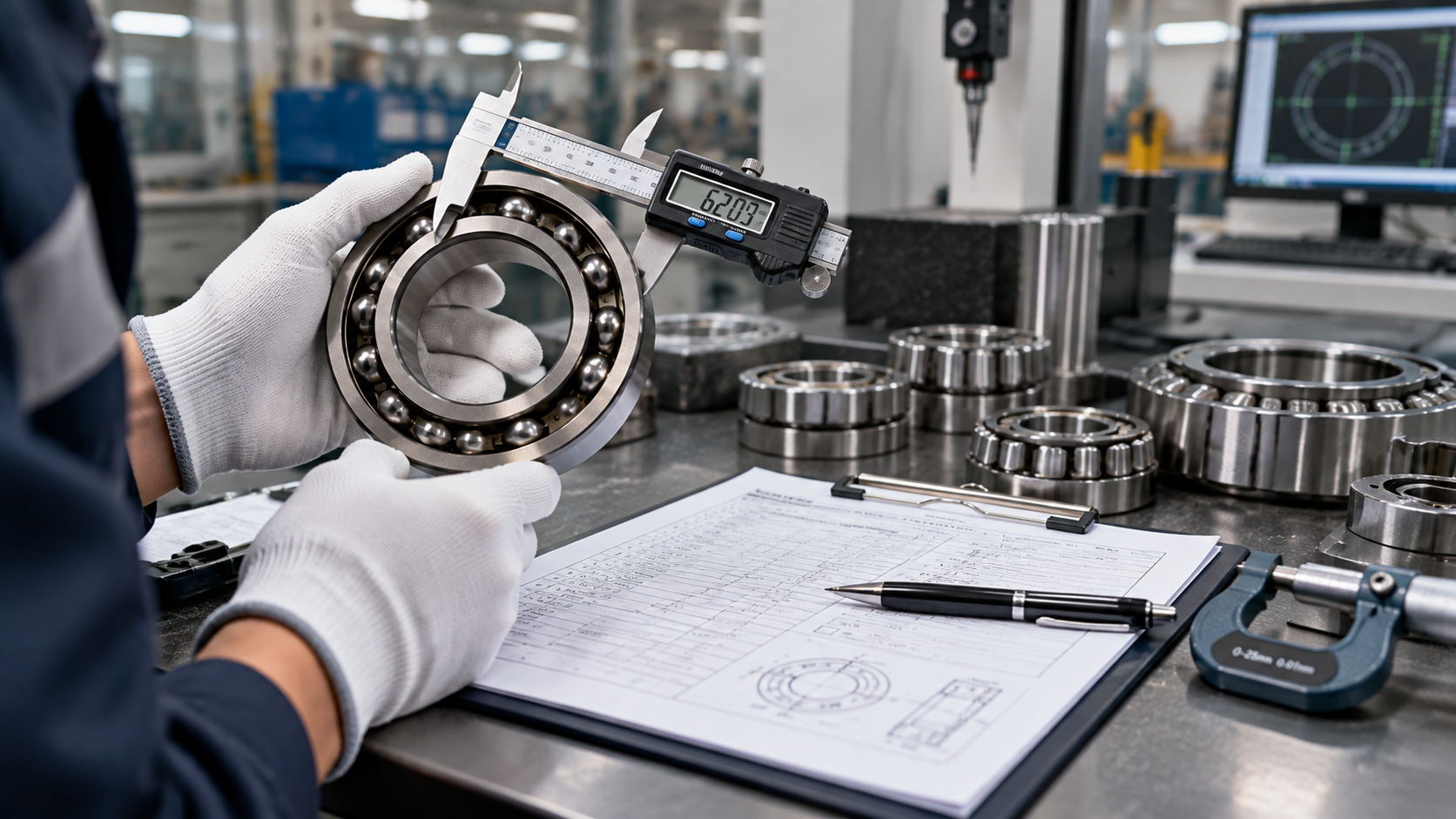
A bearing inspection report is the only written proof of what was measured on your rings before they left the factory, and it is the document an auditor asks to see years later. This walkthrough reads a typical sheet line by line, so you know which values deserve a real check and which ones you can skim.
The crate is open on the dock and a folded sheet comes out of the box with the parts. Most buyers check the part number and the count, sign the receiving slip, and file the paper without reading it. That works until a machine fails early or an auditor asks how you know the rings were in specification.
The sheet is a record of the measurements taken on that batch, and it lets you accept or reject with a reason instead of a hunch. The example below follows both product families, standard deep groove ball bearings and crossed roller rings, because one sheet covers both.
1Line 1 Dimensions and Bore Tolerance
The top of the sheet carries the three sizes everyone recognizes. A 6204 bearing reads 20 mm bore, 47 mm outside diameter and 14 mm width. Those numbers are the easy part, because they are printed on the box as well.
The line under them decides how the part fits your machine. Bore tolerance is the small window the finished bore is allowed to sit in after grinding. It is not the bore size, it is the room around it.
What a Bore Reading Tells You About the Shaft Fit
Your shaft has a tolerance window of its own, and the two windows are chosen to overlap. A tight pair gives you a press fit that holds the inner ring still, while a loose pair lets the ring creep and polish its seat. ABEC-1 and ABEC-3 are the accuracy grades printed on the Yuanhe data sheets, and each grade carries its own bore window. Our notes on shaft and housing fits walk through the pairing.
2Line 2 Radial Runout and Assembly Height
Radial runout is how far the ring surface wanders off a perfect circle while it turns. Put simply, it is the wobble a dial gauge sees as a probe rides on the ring. Small runout keeps a spindle steady, and large runout shows up as vibration in the finished machine.
Assembly height is the overall width of a ring after the rows and the retainer are put together. That value matters when rings are stacked side by side, or clamped between a housing shoulder and a cover plate, because the stack height sets the clamp.
How We Measure Runout on a Crossed Roller Ring
Yuanhe takes bore tolerance, radial runout and assembly height at four quadrant positions on every crossed roller bearing ring. Four readings instead of one show whether a ring is round or slightly egg shaped, which a single reading can hide. Those rings ship with preload already set.
3Line 3 The Clearance Group
Internal clearance is the small gap left between the rolling elements and the raceways when the bearing sits unloaded. You can feel it as a tiny amount of sideways movement in a ring that is otherwise tight and smooth.
| Group | What it means in a machine |
|---|---|
| C2 | Tighter than normal, for a cool running precision spindle. |
| CN | The normal class, and the default on most industrial fits. |
| C3 | Looser than normal, for housings that run warm. |
| C4 | The loosest of the four, for heavy heat or a long shaft. |
Why a C3 Ring Is Not a Defect
The inner ring usually runs warmer than the housing around it, and warm steel grows. As it grows the gap shrinks, and a bearing that started tight can end up pinched against itself once the machine reaches working temperature. A C3 group gives back the room that heat will take away. A C3 mark is a design choice, not a reject. The internal clearance guide covers how the classes are chosen.
4Line 4 Noise and Vibration
ISO 15242 is the measuring standard behind this line. It sets how a bearing is spun and how the vibration is picked up, so numbers from two labs can be compared. Z2 and V2 are the production grades most sheets show, and Z3 or V3 sit above them for quieter builds.
A noise reading earns its place on a fan, a pump or any axis that sits close to an operator. Nobody wants a whine in the room, and the grade line shows the factory was listening.
5Line 5 Material Certificate and Heat Number
Most Yuanhe rings are cut from GCr15 bearing steel, the same family as AISI 52100 on American drawings. Stainless options are available for wet air, washdown areas or food equipment where rust would be a problem.
A heat number points to the batch of steel melted in one furnace run. It is the thread that ties a finished ring back to the bar it came from, and it is why a certificate beats a general statement about steel grade. When a line is audited, the auditor wants that thread intact.
6Line 6 Grease Type and Fill Amount
Sealed bearings ship with grease inside, and the sheet says which grease and how much. Fill amount is a real number to read. Too little leaves the balls dry, and too much makes the grease churn, which runs the bearing hot.
NLGI grade 2 grease is the common choice for general industrial duty. A moulded polyamide cage, marked TN on a data sheet, is good to about 120 degrees C, so on a hot machine you check the cage and the grease together. The seal line changes the speed you can run, because a 6204 is rated 16,000 RPM open or shielded and 10,000 RPM once it carries 2RS contact seals.
7Line 7 Marking and Packing
The marking block is small and easy to skip, but it is what you compare against the shelf label later. It should carry the part number, the maker mark and a batch mark that matches the certificate in the box.
Packing gets one line for a good reason. A clean bearing that rattles loose in a carton arrives with dents in the raceway, and one rust spot does the same damage as a year of running.
8The Lines Buyers Miss Most
Three gaps show up again and again on sheets that arrive with a shipment.
A Report With No Clearance Group
The sheet lists sizes and a grade, then stops before the clearance class. A blank there usually means the standard class was fitted, but usual is not the same as written. On a hot housing, that missing line is what pinches the ring shut.
Runout Quoted Against the Wrong Grade
A runout value only means something next to the grade it was measured against, whether that is ABEC-1, ABEC-3 or a crossed roller class such as P5, P4 or P2. A runout figure with no grade beside it is decoration. Ask which class the reading was taken to before you compare suppliers.
A Certificate With No Heat Number
A certificate that states the steel grade but carries no heat number cannot be traced back to anything. It reads well on a page, yet it gives an auditor no path from the shipped part to the steel. For a regulated customer it is often a stop.
A spec check, no charge. Send the drawing or the specification for one line you buy. We will write back with the tolerance class, the clearance group and the inspection data we would hold for that part. Use the contact form and attach the print.
9Frequently Asked Questions
What is a bearing inspection report?
It is the record of what the factory measured on that batch and the values those parts passed. It covers sizes, runout, clearance, vibration and material, and it travels with the shipment.
Does every order need one?
That depends on your quality system. If you run incoming inspection, a sheet lets you sample against known limits instead of measuring everything yourself. If the part feeds a regulated line, ask for it on the purchase order.
Why does my report say C3?
C3 is a looser internal clearance than the normal class. It is the usual pick where the inner ring runs warmer than the housing, because heat grows the steel and closes the gap.
What does the heat number get me?
Traceability. It links the finished ring to the steel batch it was made from, which is what an auditor follows when a problem shows up in the field.
What if a line on the sheet is blank?
Treat a blank as a question, not a pass. Ask the supplier for the value before you release the parts to production, because a missing line is the one nobody can defend a year later.
READ THE SHEET FIRST
A report you can read is worth more than a report you file. On the next shipment you open, check the clearance group and the heat number before the box goes on the shelf.
Request a quote and send the drawing for one line you buy. We will answer with the inspection data we hold for that part.