
 English
 French
 German
What Is the Ball Bearing’s Potential and What Sets the Limit
Ball Bearing Potential
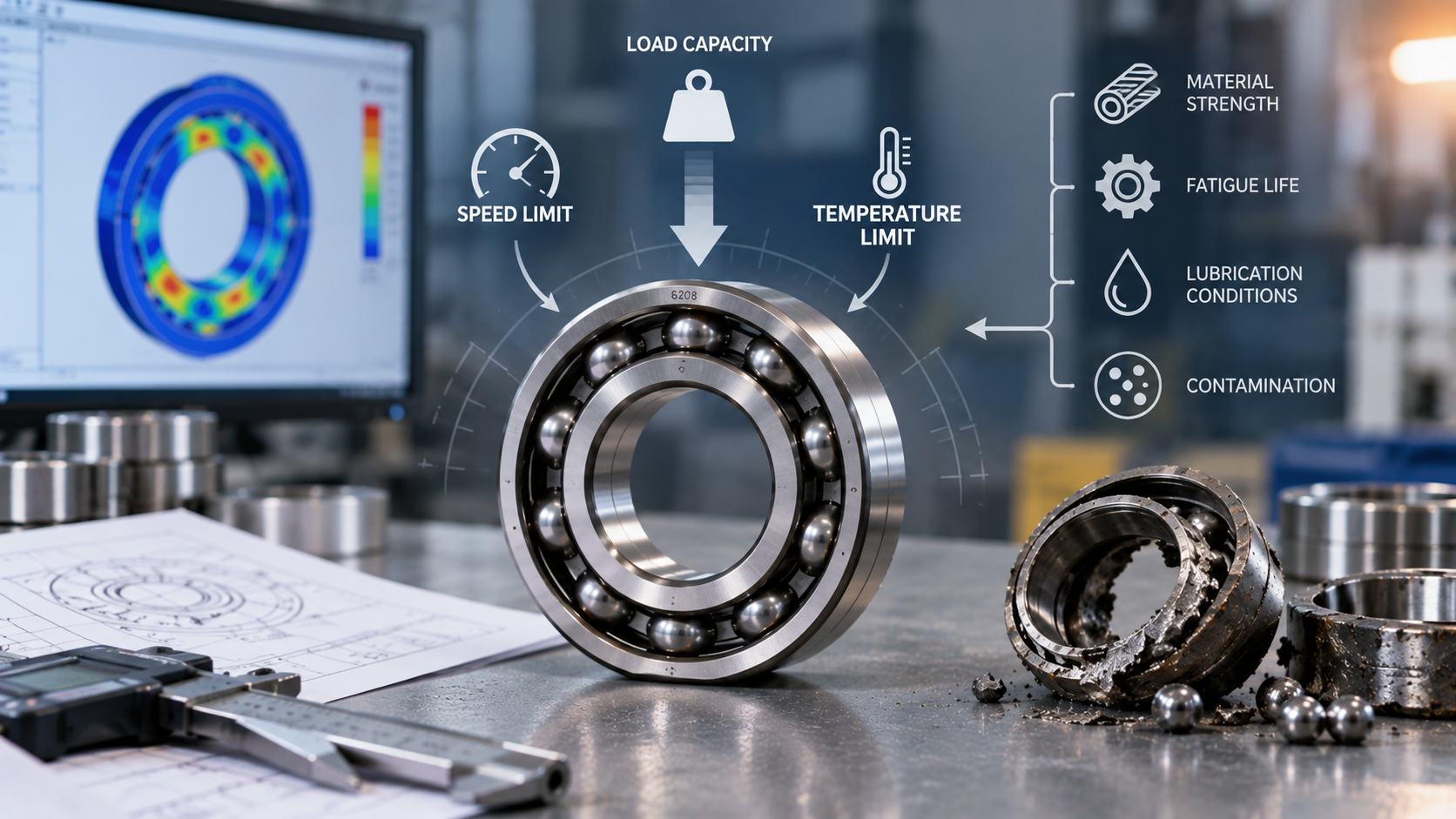
What is the ball bearing’s potential? It is the speed, load, precision and life the ring can reach before one of its own limits stops it, and on a deep groove ball bearing those limits move a long way with the series, the cage, the seal and the steel behind it.
A 20mm bore deep groove ball bearing is not one product. Yuanhe data sheets list five deep groove series at that bore, and the dynamic rating runs from 3.49 kN to 16.0 kN while the speed ceiling moves in the other direction. The same shaft size can be a thin high-speed ring or a medium duty workhorse, and the difference is the section.
This guide maps the potential of a deep groove ball bearing across five dimensions, shows where the ceiling sits inside each one, and marks the loads that end the discussion on a ball bearing altogether.
What a Ball Bearing’s Potential Measures
1Speed ceiling. How fast the ring can turn before the heat it makes outruns the lubricant.
2Load ceiling. The radial and axial load the raceway and ball complement can carry, which the section height sets first.
3Precision and noise ceiling. The runout and vibration the assembly holds, and how much of it survives the first years in service.
4Environment ceiling. The dust, water, heat and chemicals the seal and the steel can survive without losing the other four.
5Life ceiling. The hours the grease and the raceway deliver before the first lubricant or fatigue failure.
Supplier articles usually take one of these five and go deep. A bearing only reaches the lowest ceiling of the five, so the specification has to look at all of them together.
The Same 20mm Bore, Five Different Ceilings
| Series | Bore x OD x Width | Dynamic Cr | Static Cor | Max Speed |
|---|---|---|---|---|
| 6804 extra thin | 20 x 32 x 7 mm | 3.49 kN | 1.96 kN | 16,000 RPM |
| 6904 thin | 20 x 37 x 9 mm | 6.38 kN | 3.65 kN | 18,000 RPM |
| 6004 extra light | 20 x 42 x 12 mm | 9.36 kN | 5.10 kN | 18,000 RPM |
| 6204 light | 20 x 47 x 14 mm | 12.8 kN | 6.55 kN | 16,000 RPM |
| 6304 medium | 20 x 52 x 15 mm | 16.0 kN | 7.88 kN | 8,500 RPM |
Read the rating column and the potential of one bore size rises nearly five times. Read the speed column and the thin rings hold the highest figures, because a thin section leaves less steel in the raceway and more room for the ball to be guided cleanly at speed. That is the trade every designer meets: the same 20mm shaft takes an 6004 bearing or a 6304, and they are not interchangeable parts.
Speed Potential and What Sets the Ceiling
The catalogue figure is a ceiling rather than a working speed, and four choices inside the bearing move it. Sealing is the largest. The 6204 bearing runs to 16,000 RPM open or with metal shields, and the same ring drops to 10,000 RPM with 2RS contact seals, because a lip rubbing on the inner ring adds friction and heat with every turn.
The cage is the second. A moulded polyamide cage (TN) suits quiet running and fast reversing, while a steel cage takes more heat and heavier duty cycles. Clearance class is the third, with C3 usual on a shaft that runs warmer than its housing and C2 for a rigid low noise axis. Lubricant is the fourth, and in practice grease life sets the ceiling long before the steel does.
Load Potential and the Contact Angle Question
Radial potential comes out of the section height and the ball size, as the table above shows. Axial potential is a different story. A deep groove ring runs with a shallow contact angle, which lets it take thrust in both directions without a partner bearing, and that is why it holds the motor, gearbox and pump positions on so many machines. Widen the contact angle and axial capacity climbs while the speed ceiling drops, which is the trade the angular contact designs make.
What a ball bearing cannot do is carry a tilting moment. Offset the load far enough and deflection climbs quickly at the cost of accuracy. When an axis has to hold a real moment, a crossed roller bearing takes radial load, axial load in both directions and the moment in one ring instead.
Precision and Noise Potential
Precision potential is written in grades. Yuanhe data sheets list ABEC-1 and ABEC-3 on the standard bores, which covers the runout most industrial drives need and keeps the price at a production level. Noise follows the same logic. Z2 and V2 are standard production grades, and Z3 and V3 are reserved for the quietest builds, tested under ISO 15242.
The difference matters on an axis that has to settle quickly. Lower runout and a quieter ball path let the drive tune higher, which shortens settling time.
Material and Environment Potential
GCr15 bearing steel, equivalent to AISI 52100, is the standard raceway and ball material, and it covers most of the range. Stainless versions hold up where washdown and cleaning chemicals are part of the daily routine. Ceramic balls are the other route, since silicon nitride balls are lighter than steel balls, resist corrosion, take higher temperatures and insulate the shaft electrically, which matters on a motor where shaft currents would otherwise pass through the raceway. The comparison of ceramic and steel ball bearings sets out where that pays back and where it does not.
Sealing decides how much of that potential survives in the field. An open bearing runs coolest and takes the most grease. A metal shield (ZZ) keeps the coarse dirt out with little friction. A contact seal (2RS) keeps grease in and water out, at the price of speed and a little more heat. A non-contact or labyrinth seal sits between the two, and it is the usual compromise on a dusty line that still runs fast.
Where the Potential Stops
A tilting moment. Offset loads raise deflection fast, and the answer is a roller ring rather than a bigger ball bearing.
Misalignment. The design allows only a small amount of shaft deflection before the ball path runs to the edge of the raceway.
Contamination and grease loss. These end more bearings than fatigue does, on any line that handles dust, water or fine metal.
Running temperature. A hot housing closes the fitted clearance, which is the reason C3 exists, and heat also ages the grease faster than the duty cycle alone would.
Where the Full Potential Is Used
Electric Motors and Drives
The 6204 is sized for IEC frame 90 to 100 motors, which is why it turns up in pumps, fans and conveyors by the million. It carries 12.8 kN dynamic at 20mm by 47mm by 14mm, and it takes thrust in both directions from the same ring.
Robot Servo Shafts
Servo positions want speed, low friction and a quiet ball path rather than a large rating, so the light series does most of the work, with a light preload to stop ball sliding at low speed.
High-Speed Spindles and Thin Sections
Where speed is the whole point, the thin series wins. The 6904 turns to 18,000 RPM at a 9mm width, which leaves room in the housing for cooling and for the tool interface above it.
Food, Beverage and Medical Equipment
These lines combine washdown with a low noise requirement, so stainless steel rings, sealed builds and a grease that survives the cleaning cycle carry the application.
Frequently Asked Questions
What is the ball bearing’s potential?
It is the highest speed, load, precision, environmental resistance and life the bearing can hold at the same time. The ring only reaches the lowest of those five, so the specification has to be read as a set rather than one figure at a time.
Can one ball bearing size cover several load levels?
Yes, and that is the point of the series. A 20mm bore spans five deep groove series at Yuanhe, from 3.49 kN to 16.0 kN of dynamic rating. Order by bore size alone and you can end up with a fifth of the capacity the shaft needs.
How fast can a deep groove ball bearing run?
The data sheets run from 8,500 RPM on the medium 6304 to 18,000 RPM on the thin 6904 and the extra light 6004. Those figures assume open or shielded rings, so a contact sealed version runs lower and grease life sets the practical ceiling.
Does a sealed bearing give up potential?
It gives up speed, not life. On the 6204 the contact sealed version drops from 16,000 RPM to 10,000 RPM, and in exchange the grease stays in and the dirt stays out, which usually extends service life on a dusty line.
What ends a ball bearing before fatigue does?
Contamination, lubricant loss, misalignment and running temperature. Each of them removes one of the five ceilings early, and all four show up as noise, heat or lost accuracy before the raceway fails.
Send the Application Data
Send the shaft size, the load, the speed and the environment. Yuanhe manufactures deep groove ball bearings from 6800 thin series to 6300 medium series in GCr15 and stainless steel, open, ZZ or 2RS, with 500+ B2B clients and 12,000+ OEM projects behind the line.
Request a quote and the engineering team will come back with the series that matches your ceiling rather than your bore size.



Related Products