


 English
 French
 German
Stainless Steel Deep Groove Bearings for Food and Beverage Equipment
Stainless steel deep groove bearings keep food and beverage equipment running through washdown. Food and beverage plants are hard on bearings, with water and cleaning chemicals reaching every moving part. This guide explains when you need them, which grades matter, and how seals and lubrication fit in.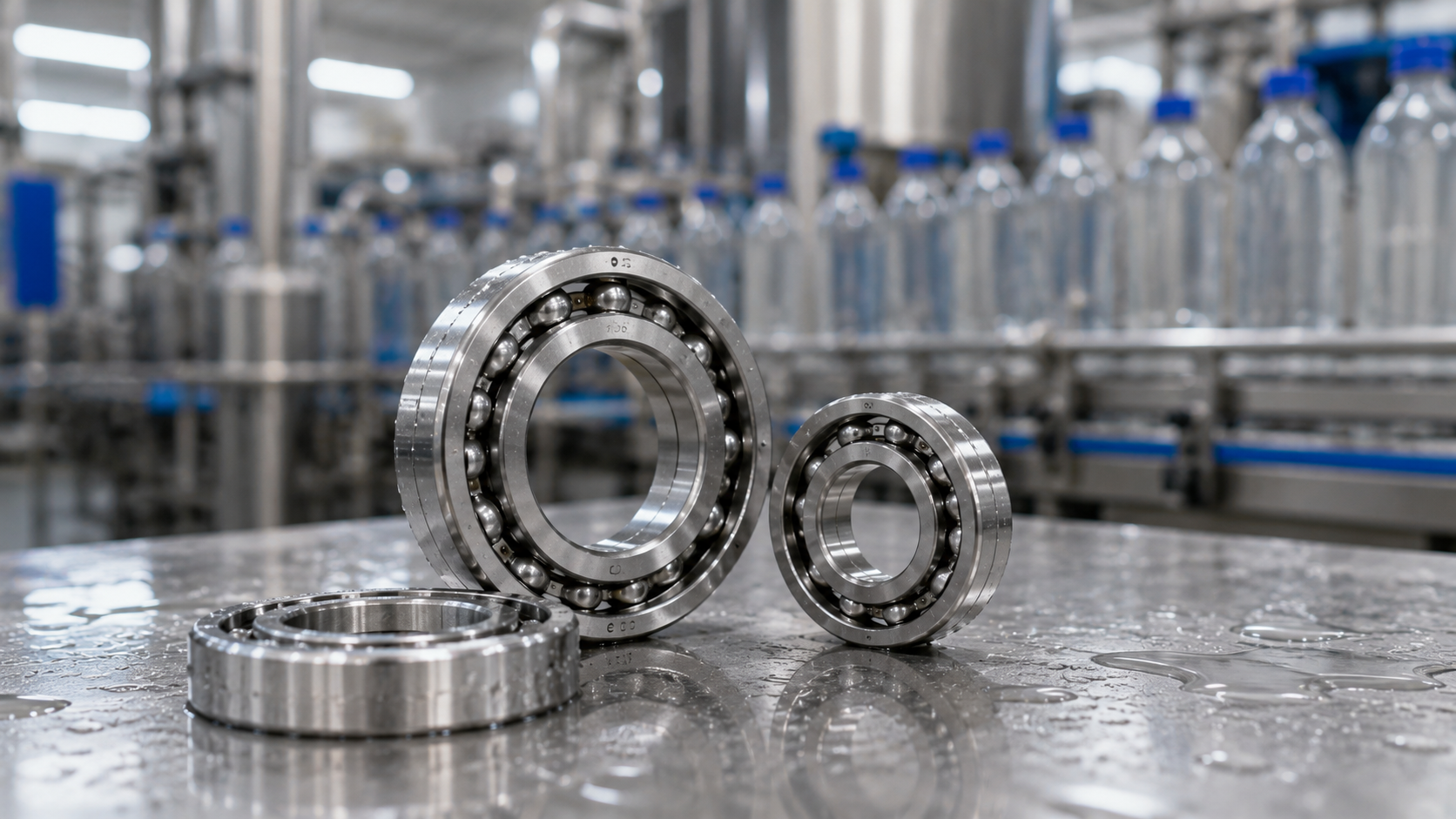
1Why Stainless Matters in Food Plants
Corrosion is the enemy in food processing. Moisture, steam, and cleaning chemicals attack ordinary bearing steel and cause rust. Once rust starts, the bearing runs rough, sheds particles, and eventually locks up.
Stainless steel resists that corrosion. A stainless deep groove bearing keeps turning in a washdown environment where a standard bearing would fail early. That is the core reason food plants specify stainless.
The Washdown Problem
Many food lines are cleaned with high-pressure water and sanitizing solutions. That washdown reaches every bearing on the line. A bearing that is not sealed and not corrosion-resistant will not survive long. Stainless steel plus the right seal is the standard answer for washdown areas.
Contamination and Safety
A rusting bearing can drop particles into the product, which is a food safety risk. Stainless bearings cut that risk. This is also why food-grade lubrication and sealed designs matter, not just the steel grade.
2Stainless Grades for Deep Groove Bearings
Not all stainless is the same. Two grades dominate in bearings, and they behave differently.
304 Stainless
304 stainless, also written as AISI 304, resists corrosion well but is not very hard. Bearings made from it carry lighter loads and cost less. They work where corrosion resistance matters more than load capacity.
440C Stainless
440C stainless is a hardenable grade. The races and balls can be heat-treated to high hardness, so the bearing carries more load while still resisting corrosion. 440C costs more than 304 but handles real working loads in food equipment.
316 Stainless
316 stainless adds even more corrosion resistance than 304 and is used in the most aggressive chemical environments. The right grade depends on how wet and how heavily loaded the application is.
3Where Deep Groove Bearings Do the Work
Deep groove ball bearings appear throughout a food or beverage line.
Conveyors
Conveyor rollers and drives run through washdown zones constantly. Stainless deep groove bearings keep the line moving through moisture and cleaning. Sealed versions are the common choice here.
Mixers, Fillers, and Pumps
Mixers, filling machines, and pumps all have rotating shafts that meet the product or the washdown spray. Stainless bearings on these shafts resist the moisture and help keep the process hygienic.
Packaging Equipment
Packaging machines run fast and get cleaned often. Stainless deep groove bearings handle the speed while standing up to the cleaning cycles.
4Seals and Food-Grade Lubrication
The steel is only half the answer. Seals and grease do the other half.
Sealed bearings keep water and cleaning chemicals out of the rolling elements. A rubber contact seal protects better in a washdown than a simple metal shield. Food-grade grease resists washout and does not contaminate the product if a small amount escapes.
Match the seal to the exposure. A bearing that takes direct spray needs a better seal than one that only sees occasional moisture. Getting this wrong shortens bearing life even when the steel is stainless.
5Food-Grade Lubrication
In a food plant, the grease inside the bearing matters as much as the steel. A grease that leaks into the product is a contamination problem, so food-grade grease is the standard.
Food-grade grease resists washout from cleaning and stays put inside the bearing. If a small amount does escape, it is formulated to be safe around food. This is different from general-purpose grease, which is not rated for food contact.
Pair food-grade grease with sealed stainless bearings and you have the standard setup for washdown duty. The seal keeps the grease in and the water out, and the grease keeps the balls running smoothly.
6Stainless vs Ceramic vs Plastic Bearings
Stainless is not the only corrosion-resistant option. Ceramic and plastic bearings fill other niches, and knowing the difference helps you choose.
Ceramic bearings use ceramic balls, often with steel or ceramic rings. They resist corrosion and run at high speed with less friction. They cost more and suit high-speed, clean, or specialty applications rather than heavy food-processing loads.
Plastic bearings use polymer rings and balls. They resist chemicals and never rust, but they carry light loads only. They work in low-load, wet, or chemical environments where metal is not needed.
For food equipment that carries real loads through washdown, sealed stainless deep groove bearings are the practical middle ground. They combine the corrosion resistance of stainless with the load capacity that ceramic and plastic cannot match.
7Specifying a Stainless Bearing
When you order a stainless bearing, a few details get you the right part.
State the size as bore, outside diameter, and width, or give the bearing number. State the stainless grade, since 304, 316, and 440C behave differently. State the seal type and whether the bearing needs food-grade grease.
Yuanhe supplies stainless options across the deep groove line, including common sizes like the 6005, 6203, 6204, and 6205. For standard steel bearings in dry areas, the regular deep groove ball bearings line covers the same sizes.
8Matching the Bearing to the Cleaning Routine
The cleaning routine decides the bearing more than anything else in a food plant.
A dry area with occasional wipe-down can use a sealed standard bearing. A line that is hosed down daily needs sealed stainless bearings with food-grade grease. A line that runs through a caustic wash needs a bearing rated for that chemical exposure.
Before you choose a bearing, describe the cleaning routine and chemicals to the supplier. The right bearing is the one that survives the clean, not just the run. Getting this match right is what keeps a food line running between cleanings.
9Common Questions
When do I need stainless bearings instead of standard steel?
What is the difference between 304, 316, and 440C stainless?
Can I use stainless bearings in washdown areas?
Does Yuanhe supply stainless deep groove bearings?