
 English
 French
 German
ZZ vs 2RS Bearings. Shielded vs Sealed Explained
At a Glance
ZZ vs 2RS bearings is the first decision in bearing closure selection. Every deep groove ball bearing needs protection against contamination. The choice between a metal shield (ZZ) and a rubber seal (2RS or RS) affects speed, temperature limits, grease retention, and service life. This guide compares the three closure types across five dimensions so you can match the right bearing to your operating environment.
ZZ Metal Shield
Non-Contact
0.05mm gap | Full rated RPM
2RS Rubber Seal
Contact Lip
95% RH barrier | Grease for life
RS Single Seal
One-Sided
Asymmetric protection
What Is a ZZ Shielded Bearing
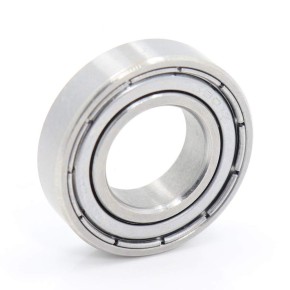
ZZ indicates a deep groove ball bearing with two metal shields, one pressed into each side of the outer ring. The shields are stamped from SPCC steel sheet, typically 0.3 mm to 0.5 mm thick depending on bearing size. A 0.05 mm to 0.10 mm gap remains between the shield bore and the inner ring shoulder. This non-contact design means zero friction from the shield itself.
ZZ Performance Snapshot
696 ZZ bearing: 44,000 RPM | Dynamic load: 1.35 kN | Grease retention: 60-70% over life | Temp range: -20°C to 120°C
The gap lets the bearing run at its full speed rating. The trade-off: that same gap allows fine dust particles under 0.05 mm and humidity to enter over time. ZZ shields protect against coarse debris like metal chips, sand, and fiber, but offer limited defense against water spray, coolant mist, or submicron particles.
ZZ bearings ship with a measured grease fill: 25% to 35% of the free internal volume for standard applications. At high RPM, centrifugal force pushes grease outward, and the shields retain roughly 60% to 70% of the original fill over the bearing’s service life. For clean, dry environments with moderate contamination risk, ZZ is the standard choice across electric motors, power tools, office equipment, and home appliances.
What Is a 2RS Sealed Bearing
2RS stands for two rubber seals, one on each side. Unlike ZZ shields, the seal lip makes light contact with the inner ring groove. The seal body is NBR (nitrile butadiene rubber) bonded to a steel insert for structural rigidity. The contact pressure is controlled to 0.02N to 0.05N per seal, adding a small friction torque that reduces maximum speed by 15% to 20% compared to the ZZ version of the same bearing.
2RS Performance Snapshot
696 2RS bearing: 37,000 RPM | Blocks particles down to 0.01 mm | Grease retention: 85-90% | Temp: -40°C to 100°C (NBR)
The contact lip creates an effective barrier. 2RS seals block particles down to 0.01 mm and prevent moisture ingress at relative humidity up to 95%. A 696 2RS bearing at 37,000 RPM still runs fast enough for most applications while keeping the factory grease fill intact at 85% to 90% retention over the bearing’s life. NBR seals operate from -40°C to 100°C. For higher temperatures, FKM (Viton) seals extend the range to 180°C, available through OEM customization.
⚠ Design Note
2RS bearings are factory-greased for life. The seals are not designed for removal or re-greasing. If your application requires periodic re-lubrication, choose ZZ with external grease ports or open bearings with a separate sealing system.
What Is an RS Bearing (Single Rubber Seal)
RS designates a single rubber seal on one side. The opposite side remains open or uses a metal shield, depending on the manufacturer’s configuration. This hybrid approach serves two specific use cases. First: applications where one side faces a clean cavity while the other side needs contamination protection, common in motor end bells and gearbox input shafts. Second: assemblies where the bearing must be pressed onto a shaft from the open side after the sealed side is already positioned.
RS bearings are less common in standard catalogs than ZZ or 2RS variants. Most engineers default to 2RS for full sealing or ZZ for maximum speed. RS becomes relevant when the assembly process or the load path dictates asymmetric protection, a detail that appears in roughly 5% of bearing applications based on OEM project data from Yuanhe.
ZZ vs 2RS vs RS. Full Comparison
| Parameter | ZZ Shield | 2RS Seal | RS Single |
|---|---|---|---|
| Seal Contact | Non-contact, 0.05-0.10mm gap | Light contact, 0.02-0.05N lip | Contact on one side |
| Speed Reduction | 0% (full rated RPM) | 15-20% below ZZ rating | 5-10% below ZZ rating |
| Particle Blocking | Blocks >0.05mm only | Blocks >0.01mm | Asymmetric |
| Moisture Resistance | Low (gap admits humidity) | High (≤95% RH) | Sealed side only |
| Grease Retention | 60-70% over life | 85-90% over life | Mixed |
| Temp Range (NBR) | -20°C to 120°C | -40°C to 100°C | -40°C to 100°C |
| Re-greaseable | No | No | Open side accessible |
| Typical Use | Electric motors, fans, power tools | Pumps, gearboxes, outdoor equipment | Motor end bells, gearbox shafts |
How to Choose Between ZZ and 2RS
1. Does the bearing face water, coolant, or condensation?
If the answer is yes, choose 2RS. ZZ shields cannot stop moisture. Even high-humidity environments (above 70% RH) will eventually draw water vapor into a ZZ bearing through thermal cycling. The 2RS contact lip forms a physical barrier. For washdown applications in food processing, specify stainless steel bearings with 2RS seals and food-grade grease.
2. Is the bearing running above 80% of its catalog speed rating?
If yes, ZZ is the safer choice. The 2RS seal friction generates heat. At 37,000 RPM, a 696 2RS bearing runs approximately 8°C to 12°C hotter than its ZZ counterpart under identical load. This temperature delta reduces grease life by roughly half, following the Arrhenius rate rule where every 15°C rise halves the oxidation rate constant of lithium soap grease.
3. What is the expected service interval?
For bearings that run continuously in clean, dry air with no scheduled maintenance, ZZ is adequate. The grease fill lasts 2 to 3 years under typical indoor conditions at 40°C. For outdoor equipment, agricultural machinery, or any application exposed to rain and dust, 2RS extends service life by 2x to 4x. The additional cost is roughly 8% to 15% at the component level.
Open Bearings. The Unshielded Baseline
For completeness, an open bearing carries no shields or seals. The balls and raceways are exposed. This configuration allows the highest possible speed because there is zero shield drag, but it demands an external sealing system built into the housing. Open bearings are used in oil-bath lubrication systems, precision spindles where every watt of friction counts, and gearboxes with pressurized oil supply. They require the user to supply their own grease or oil, making them unsuitable for sealed-for-life applications.
Open bearings are the starting point for custom lubrication strategies. If your application runs above 60,000 RPM or operates in a vacuum environment, an open bearing with specialty oil or dry lubricant may be the only viable option. For standard industrial applications, ZZ and 2RS cover over 90% of use cases without the added complexity of external sealing.
⚡ Choose ZZ When
Clean, dry environment. Speed above 80% rated RPM. Indoor electric motors, fans, and power tools.
🌿 Choose 2RS When
Moisture or dust present. Outdoor, agricultural, or washdown environments. Long maintenance intervals.
⚙ Choose RS When
One-sided contamination. Assembly requires open side access. Gearbox and motor applications.
Frequently Asked Questions
Can I replace a 2RS bearing with ZZ if I add external seals to the housing? +
Does the ZZ gap get larger as the bearing wears? +
What grease comes standard in ZZ and 2RS bearings from Yuanhe? +
Can I mix ZZ and 2RS in the same assembly? +
What is the price difference between ZZ and 2RS bearings? +
Need ZZ, 2RS, or RS bearings with custom clearance or grease?
Yuanhe manufactures deep groove ball bearings from 3 mm to 100 mm bore in ZZ, 2RS, RS, and open configurations. ABEC-3 and ABEC-5. GCr15 or AISI 440C stainless. C2, CN, and C3 clearance. Polyurea, fluorinated, or food-grade grease fill.



Related Products