
 English
 French
 German
What are the 4 types of ball bearings?
What are the 4 types of ball bearings? Four standardized designs cover most industrial rotating equipment: deep groove, angular contact, self-aligning, and thrust. Each type handles a specific combination of Each type handles a specific combination of radial load, axial load, speed, and shaft alignment. This guide breaks down all four with load ratings, mounting configurations, and selection criteria.
1. Deep Groove Ball Bearings
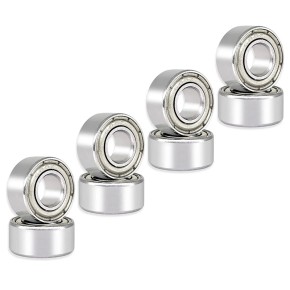
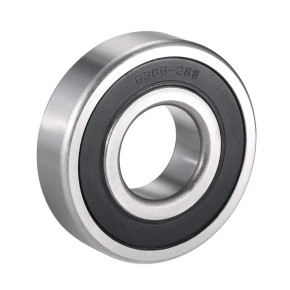
Deep groove ball bearings are the most produced rolling-element bearing worldwide. The raceway groove depth runs roughly 25% of the ball diameter, creating a contact ellipse that accepts radial loads as the primary input plus moderate axial loads in both directions, roughly 25-40% of the radial rating at low speeds. The Conrad-style assembly uses a filling notch to load balls between inner and outer rings; a pressed steel cage holds ball spacing at 6-9 balls depending on size.
Bore Range
1.5 – 1,320 mm
Speed Limit (25mm)
18,000 RPM
Axial Capacity
25-40% of radial
Sizes span from 1.5mm bore micro bearings to 1,320mm bore large-bore units. Standard materials are GCr15 (AISI 52100) through-hardened to 58-64 HRC. Sealing options cover open (no contact), ZZ metal shields with a 0.15mm radial gap, and 2RS nitrile rubber contact seals rated IP5X against dust ingress. Speed limits range from 8,000 RPM for a 6205 bearing open bearing to 100,000+ RPM for miniature 3mm-bore designs on oil-mist lubrication.
Deep groove bearings serve electric motors from 0.5 HP to 500 HP, alternators, gearbox input shafts, conveyor idlers, pumps, fans, and power tool spindles. They are the default choice when loads are predominantly radial and shaft alignment is controlled within 0.001 radians. Yuanhe deep groove ball bearings are manufactured from 3mm to 100mm bore with ABEC-3 or ABEC-5 precision grades.
When to switch
When axial load exceeds 50% of radial capacity or shaft misalignment reaches 0.5 degrees, deep groove bearings show elevated cage wear and raceway edge loading. Move to angular contact or self-aligning designs.
2. Angular Contact Ball Bearings
Angular contact ball bearings shift the raceway contact angle to convert a portion of radial load capacity into axial load capacity. The contact angle is the angle between the line connecting ball-to-raceway contact points and the radial plane. Standard angles are 15 degrees (C suffix), 25 degrees (A suffix), and 40 degrees (B suffix). A 40-degree contact angle delivers roughly 1.4x the axial capacity of a 15-degree design at equal ball count, at the cost of a 25-30% reduction in radial capacity.
Contact Angles
15deg / 25deg / 40deg
Mounting
Pairs (DB/DF/DT)
Speed vs Deep Groove
10-20% lower
These bearings are mounted in pairs because a single angular contact bearing accepts axial load in one direction only. Three pairing configurations cover most applications: back-to-back (DB) for moment stiffness, face-to-face (DF) for thermal expansion compliance, and tandem (DT) for heavy unidirectional thrust. Preload is set at assembly by grinding the ring faces. Light preload for high-speed spindles (2-5 micron axial clearance removal), medium for machine tools (5-12 micron), and heavy for axial rigidity in pump thrust blocks.
Applications include CNC spindle cartridges where 15-degree or 25-degree pairs run at 8,000-24,000 RPM under combined cutting forces, automotive wheel hubs where 40-degree duplex pairs handle cornering side loads, and helical gearboxes where the gear mesh produces an axial thrust component roughly equal to tan(helix angle) times tangential force. Angular contact ball bearings provide the combined load handling that deep groove designs cannot match above 50% axial ratio.
3. Self-Aligning Ball Bearings
Self-aligning ball bearings use two rows of balls running in a spherical outer ring raceway. The inner ring has two separate raceways with a common spherical outer surface, allowing the inner ring and shaft to tilt relative to the housing without forcing the balls against the raceway edges. Standard misalignment capacity is 2.5-3 degrees, which absorbs shaft deflection from long unsupported spans, housing bore misalignment from weld distortion, and foundation settlement in heavy machinery.
Misalignment
Up to 3deg
Row Count
Double Row
Load vs Deep Groove
20-30% lower
These bearings use a smaller ball diameter than equivalent-bore deep groove designs because two rows must fit within a similar cross-section. Dynamic load ratings are therefore 20-30% lower than a comparable single-row deep groove bearing. Cages are typically glass-fiber reinforced polyamide (PA66-GF25) or pressed steel. Standard bore range is 10mm to 120mm. Sealing is limited. Most self-aligning bearings run open with external housing seals, though 2RS sealed variants exist in smaller sizes up to 50mm bore.
Common applications include long-line shafting in paper mills and textile machinery where bearing spacing exceeds 1.5 meters, conveyor pulleys on uneven mounting surfaces, agricultural PTO shafts operating at variable angles, and ventilation fans where housing bores are machined in separate castings. The spherical outer ring also simplifies mounting. No precision alignment procedure beyond rough positioning. Self-aligning ball bearings solve the alignment problems that destroy rigid bearings on long shafts.
4. Thrust Ball Bearings
Thrust ball bearings carry axial loads exclusively. They use flat washers as raceways with a ball-and-cage assembly sandwiched between them. The shaft washer mounts on the rotating shaft with an interference fit; the housing washer sits in the stationary housing with a clearance fit. Single-direction designs handle axial load in one direction; double-direction designs use three washers and two ball sets for reversing thrust in applications like vertical pump motor shafts and crane hook swivels.
Load Direction
Axial Only
Speed Limit (25mm)
6,300 RPM
Min Axial Load
0.5% of static rating
Speed ratings for thrust ball bearings are significantly lower than radial bearings of equivalent bore. Centrifugal force throws balls outward at high RPM, and the flat raceway geometry provides no ball guidance at speed. A 51105 thrust bearing (25mm bore) has a limiting speed of approximately 6,300 RPM on oil, compared to 18,000 RPM for a 6205 deep groove bearing of the same bore. Above 50% of limiting speed, a minimum axial load of roughly 0.5% of the static rating must be applied to prevent ball skidding on the raceway.
Critical limitation
Thrust ball bearings work poorly under radial load. Even 10% of the axial rating applied radially can cause washer separation and cage damage. When combined loads are present, use angular contact bearings or tapered roller bearings instead.
Applications include vertical turbine pump thrust blocks, crane hooks, extruder screw thrust supports, rotary table axial bearings, and clutch release mechanisms. Yuanhe thrust ball bearings are available in single and double direction configurations from 10mm to 350mm bore.
Ball Bearing Type Comparison
How to Select the Right Ball Bearing Type
Now that you know what are the 4 types of ball bearings, the next step is matching each type to its optimal application. Start with these four decision factors.
1. Determine the load direction
Start with load direction. If the load is purely axial, thrust ball bearings are the direct match, but verify the speed stays below 50% of the limiting RPM to avoid ball skidding. If the load is predominantly radial with less than 30% axial component, deep groove bearings cover most general industrial applications at the lowest cost per unit of load capacity.
2. Check the axial-to-radial ratio
When combined radial and axial loads push past 30-40% axial ratio, move to angular contact bearings. Select the contact angle based on the axial-to-radial ratio: 15 degrees for ratios up to 0.5, 25 degrees for 0.5-1.0, 40 degrees for ratios above 1.0. Always mount angular contact bearings in pairs. A single bearing cannot handle reversing axial loads.
3. Assess shaft alignment conditions
If the shaft spans more than 1 meter between bearing centers or mounts on separate castings, self-aligning bearings absorb the inevitable misalignment. The tradeoff is 20-30% lower load rating versus an equivalent deep groove bearing of the same bore. Only pay this penalty when misalignment is confirmed. Precision-aligned shafts gain nothing from self-aligning bearings.
4. Verify speed and precision requirements
For electric motors under 100 HP running at 1,500-3,600 RPM with belt or coupling drive, deep groove bearings with C3 radial clearance provide the standard OEM configuration. For CNC spindles and grinding wheel shafts requiring sub-5-micron runout at 10,000+ RPM, ABEC-5 or ABEC-7 angular contact pairs with light preload are the industry standard.
Frequently Asked Questions
Which ball bearing type handles the highest speed? +
Can I use a single angular contact bearing instead of a pair? +
What causes deep groove bearings to fail under misalignment? +
Are thrust ball bearings suitable for combined loads? +
What bearing type works best for an electric motor? +
Need help selecting the right bearing type?
Send your application requirements. Yuanhe engineers will recommend the correct bearing type, size, and sealing configuration based on your load, speed, and environment.



Related Products