

 English
 French
 German
Sealed Crossed Roller Bearings for Collaborative Robots
Sealed crossed roller bearings for collaborative robots are specified around a contradiction. The bearing must seal against dust, oil mist, and cleaning wipes, yet it sits one meter away from a human hand and must start moving without a hesitation that the operator can feel. Resolve that contradiction and the joint runs maintenance-free for years. Resolve it poorly and the axis either drags, leaks grease onto the floor, or loses its factory preload to contamination.
This article looks at the collaborative robot from the seal inward. We skip the seal structure catalog and focus on the three decisions a cobot engineer makes: what the environment demands, how much seal contact the axis can afford, and how the seal interacts with preload and backlash. The mechanical basis of the bearing is the RAU series from Yuanhe: crossed roller bearings with integrated one-piece rings, spacer retainer, and factory-set preload, in a bore range from 20mm to 350mm.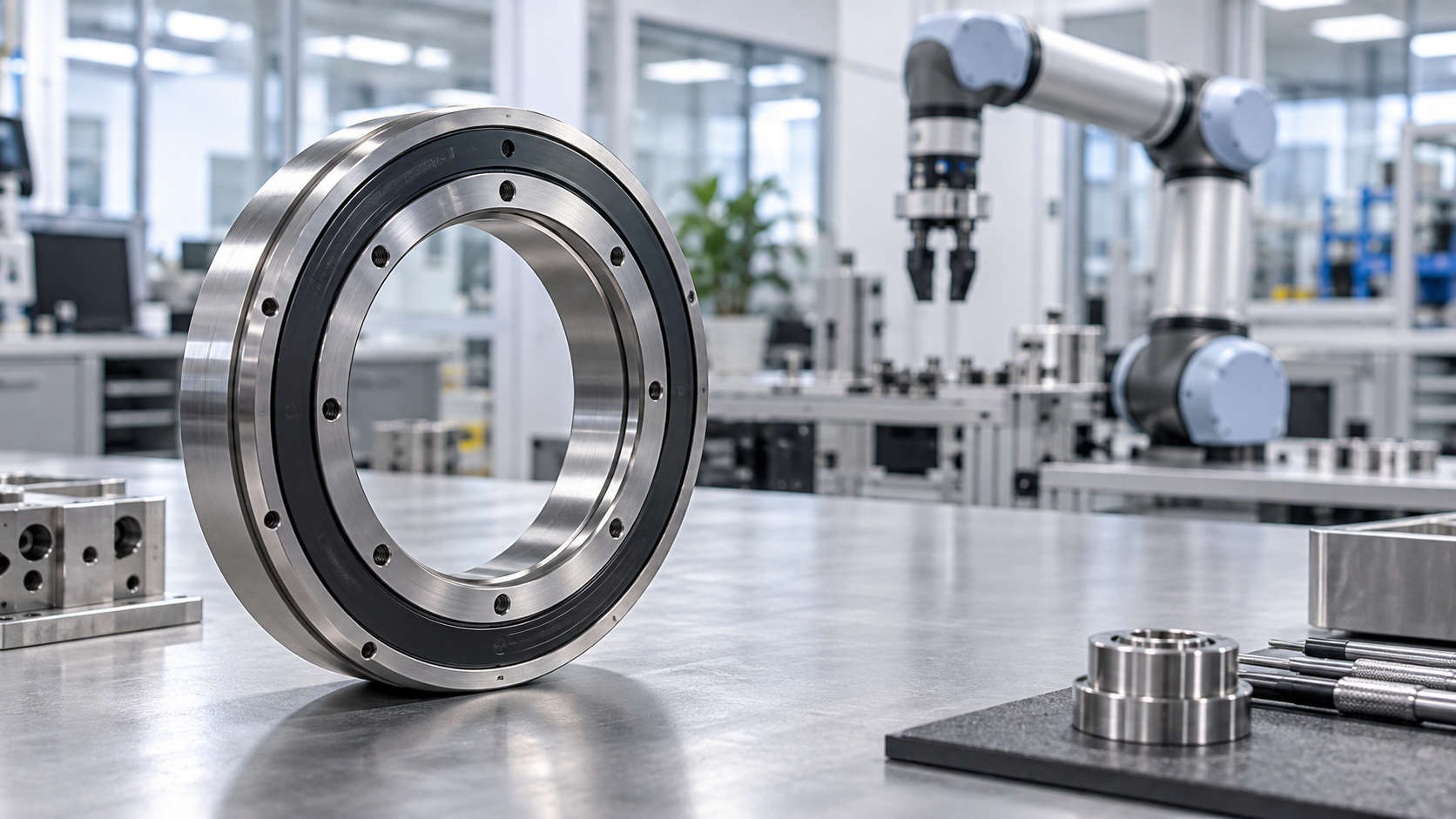
01Three Cobot Environments, Three Seal Priorities
Collaborative robots are marketed as one product, but they are deployed in environments with different contamination profiles. A seal specification that fits a tabletop assembly cell is wrong for a machine-tending cell next to a coolant mist source. The environment matrix below is the starting point.
| Cobot setting | Contaminant profile | Sealing priority |
|---|---|---|
| Hand-contact assembly cell | Skin oils, fibers from packaging, occasional dust from nearby traffic | Block fibers and oils while keeping breakaway torque low enough for direct-teach motion |
| Semi-clean electronics line | Fine airborne dust, solder fume residue, no washdown | Fine-particle exclusion with minimal torque penalty |
| General production floor | Oil mist, coolant mist, grit, wipe-down cleaning with solvents | Strong exclusion plus chemical resistance in the seal material |
Note what is absent from this table: continuous washdown. A cobot is not a food-grade washdown machine, so its seals do not need to survive high-pressure jets. They need to survive what actually happens on a factory floor: mist that settles, cloths that wipe, and grease that must stay where it was put.
02What Joint Motion Does to a Seal
A collaborative robot joint rotates over a limited arc and reverses constantly. A seal on that joint does not enjoy steady rotation; it flexes, unloads, and re-seats on every cycle. Each reversal is a moment when a lip seal can lift, suck air, and pull particles past the contact line. Each standstill is a moment when settled mist can creep into a static gap.
Short-stroke oscillation also means the seal lip wears the same arc repeatedly instead of distributing wear around the circumference. The practical result: seal selection for a cobot joint leans toward designs with stable contact pressure and proven behavior in reversing motion, and validation has to be done on the real duty cycle, not on a continuous-rotation rig.
03The Trade-Off Between Seal Drag and Breakaway Torque
Every seal that touches the ring consumes torque. In a cobot joint that torque has an outsized effect, because the motor must overcome it at every start and the controller feels it as a disturbance at every reversal. The engineering trade-off runs along one axis: how hard the seal presses on the ring.
| Seal contact level | Torque effect | Protection level | Where it fits |
|---|---|---|---|
| Light contact | Lowest drag, smoothest direct-teach feel | Stops coarse dust and fibers, not fine mist | Clean hand-contact cells |
| Medium contact | Measurable drag, still within servo compensation | Blocks fine dust and most oil mist | Electronics and light assembly lines |
| Firm contact | Highest drag, needs larger drive margin | Best exclusion of mist, grit, and solvents | Machine-tending cells near coolant |
The table is deliberately qualitative, because the correct answer is measured, not guessed. The discipline is to define the acceptable torque budget for the axis first, then select the highest-contact seal that fits inside that budget. If the first candidate exceeds the budget, the axis designer knows the trade is explicit: more protection costs drive size or cycle time.
04Seal, Preload, and Backlash Act as One System
In a preloaded bearing the seal is not an add-on; it is part of the torque and stiffness balance. An RAU bearing ships with factory-set preload, so the rollers are already in elastic compression and the joint has no free play at reversal. A seal that presses unevenly on the ring can fight that balance in two ways.
First, asymmetric seal drag can bias the running torque, which a servo reads as a torque ripple at low speed. Second, a seal that generates heat at high cycle rates warms the grease and changes its viscosity, and grease behavior is part of what keeps the preload contact stable over time. The seal choice therefore has to be evaluated together with the bearing, not bolted on afterward. The mechanics of preload and play in robot joints are covered in our article on crossed roller bearing preload and backlash in robot joints.
05Grease Retention and the Maintenance-Free Target
Cobot builders sell uptime. A joint bearing that needs re-greasing every six months defeats the purpose of a maintenance-free arm, so the seal has two grease jobs: keep contamination out and keep the charge of grease in. Grease loss is slower than contamination ingress but just as final: when the grease film degrades, the rollers run on metal and preload relaxes through wear.
The grease itself is part of the seal system. A grease with low oil bleed starves the raceway slowly; one with high bleed keeps the contacts fed but can migrate past a light seal. For a sealed cobot joint the sensible specification pairs a stable, low-bleed grease with a seal contact level matched to the operating temperature of the axis. The underlying protection strategies, including how seals are structured, are detailed in our guide on how to protect crossed roller bearings from dust and moisture.
06What a Sealed RAU Brings to the Joint
The RAU architecture gives the seal a stable platform to work on. Integrated one-piece rings mean no parting line where mist could wick into the raceway, and the spacer retainer keeps rollers evenly spaced so the seal lip runs against a consistent surface. Precision grades P5, P4, and P2 let the builder match runout to the accuracy class of the arm. Every bearing ships with dimensional inspection data: bore tolerance, radial runout, and assembly height at four quadrant positions.
Seal form and grease charge are application-matched rather than fixed, so a cobot builder specifies them against the environment matrix in section 01. What is fixed at the factory is the preload and the geometry; what is tailored is the interface between the bearing and the world.
07Validating the Seal on the Real Joint
Three checks catch most seal mistakes before a cobot ships. The first is a breakaway torque measurement on the assembled joint at operating temperature, repeated after the seal has run in. The second is a wipe-down test with the actual cleaning agent the customer uses, because solvents vary and an aggressive one can swell or shrink a seal lip. The third is a contamination challenge: run the joint in the dirtiest corner of the intended environment, or an accelerated dust test, and measure torque and runout drift over the target interval.
These checks belong on the validation plan because seal performance is duty-cycle specific. A seal that passed continuous-rotation testing can behave differently on a reversing short-stroke axis, which is exactly the motion a collaborative robot joint produces.
08Frequently Asked Questions
Do sealed crossed roller bearings need re-lubrication?
The design target for a cobot joint is a sealed-for-life charge, which is why grease retention is a seal requirement rather than a maintenance task. The grease charge and seal are matched so the axis runs to the robot’s service interval without re-greasing.
Will a seal increase the joint backlash?
No, if the bearing is preloaded. Backlash in a preloaded bearing is closed by roller contact, not by the seal. The seal can change torque, but it does not create free play. What the builder must watch is seal drag asymmetry, which the servo sees as torque ripple.
How do cleaning wipes and solvents affect the seal?
Solvent residues can attack the seal material over many wipe cycles. The practical rule is to specify the seal material against the actual cleaning agent and to validate with the real agent, since generic chemical compatibility tables do not capture every production cleaning fluid.
Can a sealed RAU bearing still be inspected on delivery?
Yes. The dimensional inspection data, including bore tolerance, radial runout, and assembly height at four quadrant positions, is measured at the factory before the seal is fitted, and the report ships with the bearing.
09Key Points for the Joint Designer
- Map the environment before choosing the seal: hand-contact, semi-clean, and general floor demand different contact levels.
- Set the torque budget first, then pick the highest-contact seal that fits inside it.
- Evaluate the seal together with preload and grease, because the three act as one torque and stiffness system.
- Validate on the real reversing duty cycle with the real cleaning agent, not on a continuous-rotation rig.
For the wider picture of how crossed roller bearings carry cobot and industrial robot axes, see our overview of crossed roller bearings for robot joints, which covers load cases across wrist, elbow, and shoulder positions.