

 English
 French
 German
Low-Noise Deep Groove Ball Bearings for Robot Actuators
Low-noise deep groove ball bearings are a specification item on robot actuators, not a hope. A collaborative arm works within an arm’s reach of a person. A camera gimbal carries a microphone a few centimeters from the bearing. A medical actuator runs in a room where staff listen for changes in machine sound all day. In each case the bearing is the smallest part in the acoustic chain and the hardest one to change after assembly. This article covers why actuators need quiet bearings, where the noise comes from, how quiet is measured and graded, and what the published Yuanhe noise classes mean for a joint design.
Selection is the subject here. If a bearing that ran quietly starts making noise in service, that is a diagnosis task, covered separately in the ball bearing noise causes diagnosis and replacement guide. The numbers cited below come from Yuanhe product pages for the deep groove ball bearings used in actuators.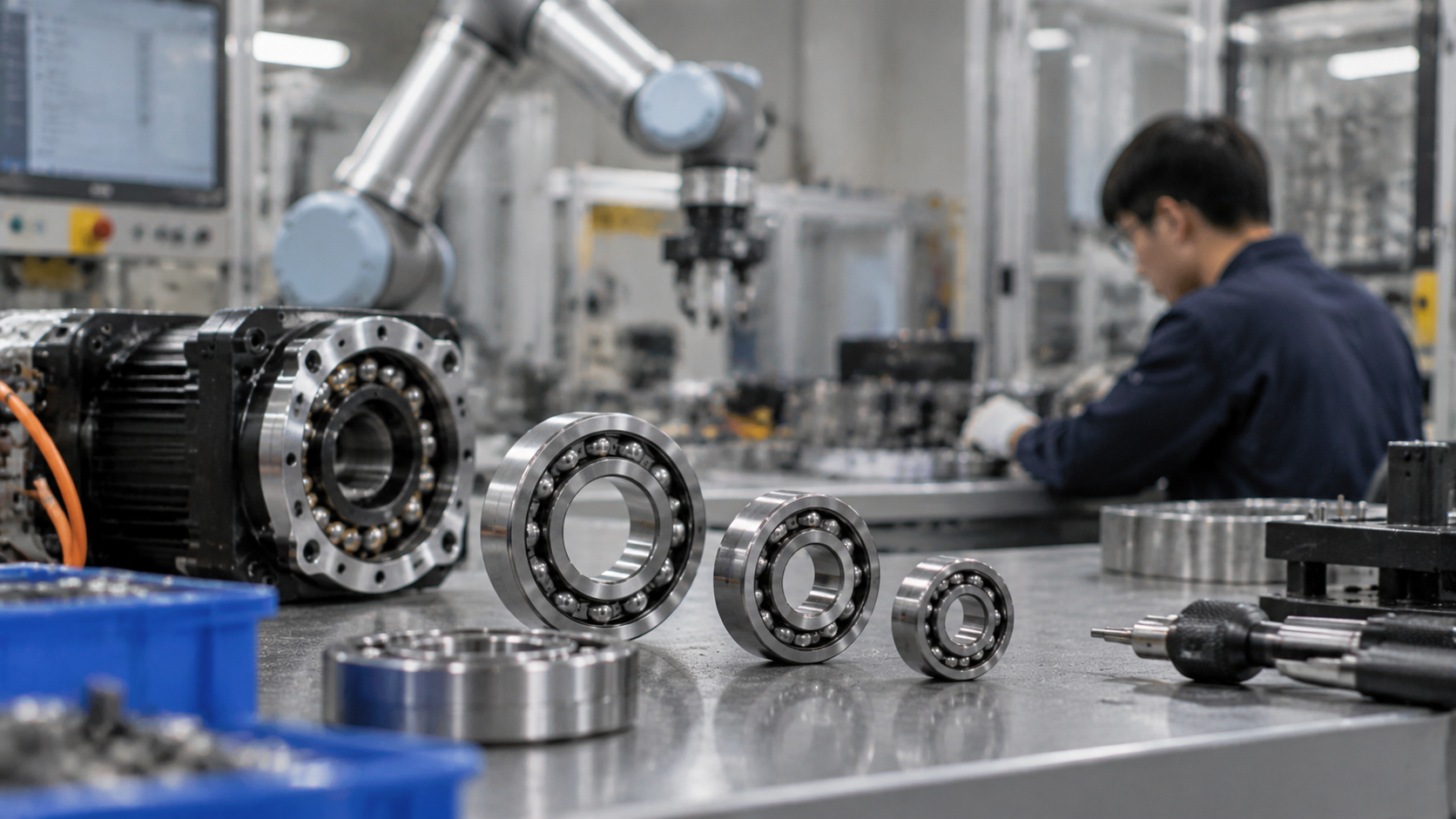
01Why a Robot Actuator Has to Be Quiet
Three amplifier effects make actuator noise audible out of proportion to its source energy.
Proximity is the first. Collaborative and humanoid robots share space with people who have no hearing protection and no expectation of mechanical noise. A bearing that would disappear inside an industrial cell becomes a nightly complaint on a desk robot. The deep groove bearings used in robot joints sit directly in that acoustic path.
Structure is the second. Actuator housings are thin aluminum shells sized for weight targets. They radiate bearing vibration efficiently, the way a guitar body radiates string vibration. The bearing excites the shell at ball pass frequency and the shell announces it.
Perception is the third. In cameras, medical devices, and home robots, buyers judge quality by sound. Two actuators with identical motion specs sound different, and the quieter unit wins the comparison test. Acoustic performance has become a purchasing criterion, which makes the bearing grade a design input rather than a factory afterthought.
02Where the Noise Comes From
Bearing noise is vibration transmitted through the housing and radiated as sound. The vibration sources sit inside the bearing, and each source has a signature.
| Source | What it does | Controlled by |
|---|---|---|
| Raceway waviness | Microscopic undulations excite vibration as balls roll over them | Grinding and finishing process |
| Ball surface texture | Adds high-frequency content to the rolling contact | Ball grade selection |
| Cage interaction | Pocket contact and guidance can rattle at light load | Cage material and pocket fit |
| Grease film | Lubricant starvation or channeling changes contact damping | Grease type and fill quantity |
| Contamination | Hard particles dent raceways and create repeating clicks | Clean assembly and sealing |
Raceway waviness dominates the audible range. A wave on the raceway acts like a tiny cam, pushing the ball set at a frequency set by the number of balls and the shaft speed. That frequency lands in the human hearing range for actuator speeds, which is why the grinding and finishing process, not the assembly line, decides the noise class of a bearing.
03How Bearing Noise Is Measured and Graded
Noise grading starts with a fixed measurement. Yuanhe product documentation for the 6204 bearing states the condition used for motor-grade sorting: vibration class is measured per ISO 15242, with the bearing running at 1,800 RPM under a defined axial load. The measurement speed and load matter because both shift the ball pass frequency and the contact state.
The result is expressed as a class pair. Standard production on the 6204 bearing achieves Z2/V2 vibration class, the medium-noise grade that covers general motor and industrial duty. For quiet-running applications, Z3/V3 class is available against specification, documented as low noise under 30 dB(A). Z3 sorting typically adds 48 hours to lead time because every bearing in the batch is individually noise tested, and the batch ships with dimensional and noise-test reports.
Grade notation reads left to right as the standard and the severity. Z2/V2 means medium-noise sorting, Z3/V3 means low-noise sorting with a tighter acceptance limit. The dB(A) figures attached to each grade are measured under the ISO 15242 reference condition, not in your housing.
04Choosing a Noise Grade for Each Joint
Grade selection follows the acoustic budget of the product, and the budget follows the listener.
| Product context | Typical grade | Why |
|---|---|---|
| Industrial arm, enclosed cell | Z2/V2 standard | Ambient machine noise masks the bearing |
| Collaborative arm, shared space | Z3/V3 low noise | People sit within arm’s reach, no masking |
| Camera gimbal and optics | Z3/V3 low noise | Microphones and sensors on the same structure |
| Medical and lab actuators | Z3/V3 low noise | Staff listen for changes in machine sound |
Two practical notes. First, the grade buys a quiet bearing, not a quiet assembly. A misaligned housing or an out-of-round seat loads the bearing unevenly and turns any grade noisy. Second, the low-noise grade costs lead time, not just money, so it belongs in the project schedule from the start rather than being requested after the first prototype noise complaint.
05What Production Does to Keep a Bearing Quiet
A quiet grade is earned in the process, not claimed at the end. Rings and balls in these sizes are GCr15 bearing steel, the AISI 52100 equivalent, through-hardened to HRC 60-64. Every batch passes 100 percent dimensional inspection, and noise-sorted batches carry individual test reports.
Grease is the second half of the quiet equation. Yuanhe offers low-noise polyurea grease specified for electric motor applications, tested below 35 dB(A) on the 6203 bearing size and below 30 dB(A) on the 6204 bearing, 6205, and 6206 sizes. The grease dampens the rolling contact and prevents the metal-to-metal excitation that dry or starved contacts produce. The 6204 product page lists a standard lead time of 7 to 15 days with batch dimensional and noise-test reports; the added Z3 sorting time belongs in the order plan.
06Specifying Quiet Bearings for an Actuator Program
A quiet actuator specification names four things: the model, the tolerance class, the vibration grade, and the grease. An example spec line reads: 6204, ABEC-3, Z3/V3 low-noise class, low-noise polyurea grease. Leave the grade out of the spec and the buyer accepts whatever the standard production class delivers.
| Model | Bore x OD x width | Cr dynamic | Noise options on the product page |
|---|---|---|---|
| 6203 | 17 x 40 x 12 mm | 9.58 kN | Low-noise grease tested below 35 dB(A) |
| 6204 | 20 x 47 x 14 mm | 12.8 kN | Z2/V2 standard; Z3/V3 under 30 dB(A) against specification |
| 6205 | 25 x 52 x 15 mm | 14.0 kN | Low-noise grease tested below 30 dB(A) |
| 6206 | 30 x 62 x 16 mm | 19.5 kN | Low-noise grease tested below 30 dB(A) |
Put the vibration grade and grease on the drawing when you request a quote. Yuanhe confirms the Z3/V3 sorting, the grease test level for the size, and the added noise-test lead time before production, so the actuator program keeps its acoustic budget and its schedule.
07Frequently Asked Questions
What is the difference between Z2/V2 and Z3/V3?
They are vibration classes with different acceptance limits. Z2/V2 is the medium-noise class that standard production achieves and covers general industrial duty. Z3/V3 is the low-noise class, defined on the Yuanhe 6204 page as under 30 dB(A), available against specification with individual noise testing per batch and about 48 hours of added sorting time.
Is the noise class measured as sound or as vibration?
Vibration. Yuanhe measures per ISO 15242 with the bearing running at 1,800 RPM under a defined axial load. The measured vibration level is expressed through the grade, and the dB(A) figures on the product pages are the acceptance levels attached to that measurement condition. The same bearing will produce different sound pressure in different housings.
Does the seal type change the noise class?
The vibration class is applied to the bearing build regardless of sealing form. Open, ZZ shielded, and 2RS sealed configurations are all available with the same sorting. At actuator speeds the raceway and ball finish dominate the measured class; the seal contribution is small. Choose the seal for the environment and the grade for the acoustics.
What does low-noise grease add to a quiet bearing?
Yuanhe offers low-noise polyurea grease for motor applications, with test levels below 35 dB(A) on the 6203 size and below 30 dB(A) on the 6204, 6205, and 6206 sizes. The grease changes how the rolling contact is damped. Pairing the Z3/V3 grade with the low-noise grease keeps the contact quiet instead of leaving the raceway finish to fight an unsuitable lubricant.
Can noise sorting fix a noisy mounting?
No. Sorting selects quiet bearings; it does not repair a misaligned housing, an out-of-round seat, or a bent shaft. Those conditions load the bearing unevenly and generate vibration no grade can pass. If an actuator tests noisy after assembly with a Z3/V3 bearing, check the mounting geometry before changing the bearing grade.
Is a low-noise bearing also a low-vibration bearing?
The two describe one measurement seen twice. Noise grades come from vibration measured per ISO 15242, and audible noise is what the housing does with that vibration. A Z3/V3 bearing keeps the excitation low. The housing, the mounting, and the surrounding structure decide how much of it reaches the ear. A quiet grade inside a resonant housing still sounds loud, which is why actuator acoustic design treats bearing grade and housing stiffness as one system.