

 English
 French
 German
Deep Groove Ball Bearings for Servo Motors in Robot Actuators
Deep groove ball bearings for servo motors in robot actuators support the rotor at two points: the drive end and the encoder end. Every torque command from the controller becomes a mechanical load on those two bearings. So does the weight of the rotor, the magnetic pull of the stator, and the reaction force from the gearbox. This article walks through eleven engineering checks behind that bearing choice. Each check ends with a measurable specification, not an adjective.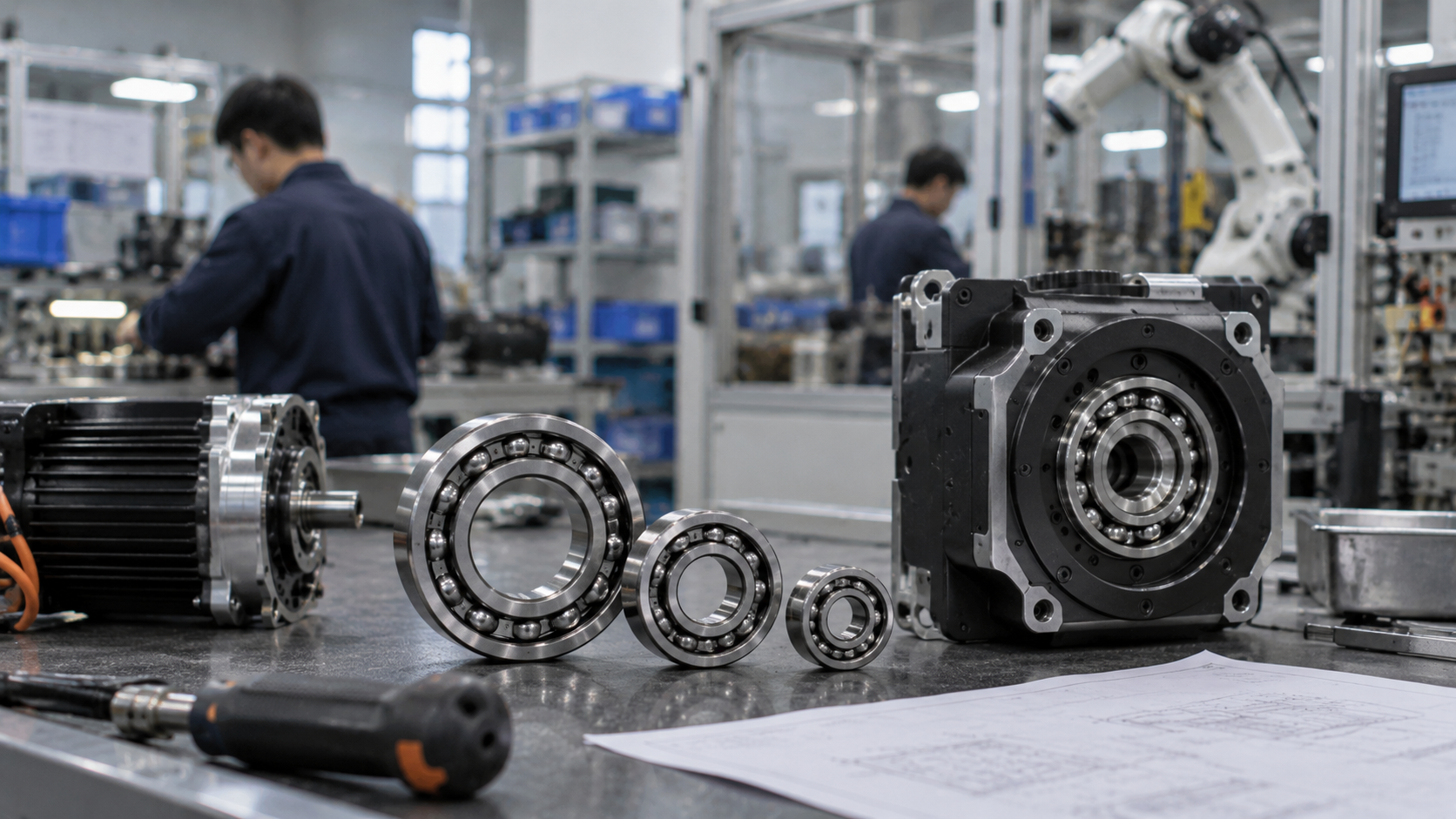
01Why Servo Motors Use Deep Groove Ball Bearings
A servo motor is a permanent-magnet synchronous machine sized to accelerate and hold a robot joint. Its rotor is short and stiff, and its speed range is wide. The bearing that suits it must carry radial load from rotor weight and magnetic pull, accept axial load in either direction, and spin quietly at high speed. One row of balls running in deep, continuous raceways does all of this in a single compact unit. That is why the deep groove ball bearing is the default rotor bearing across the servo industry, from 50W cartridge motors to multi-kilowatt axis drives.
Yuanhe manufactures deep groove ball bearings from miniature bores of a few millimetres up to large diameters, in chrome steel and stainless variants. The 6200 series alone covers the shaft steps most servo rotors use, from 17mm to 30mm bore.
02Where the Bearings Sit in an Actuator
A robot actuator stacks a servo motor, a speed reducer, and an output flange inside one housing. The motor rotor needs two bearings: one at the drive end, next to the reducer input, and one at the encoder end. The drive-end bearing is the locating bearing. It fixes the rotor axially and carries the gear reaction load. The encoder-end bearing floats axially in its bore so thermal growth of the rotor does not create preload.
| Actuator zone | Support component | Dominant load |
|---|---|---|
| Motor drive end | Deep groove ball bearing | Radial plus reducer reaction |
| Motor encoder end | Deep groove ball bearing | Rotor weight, light axial |
| Reducer output flange | Crossed roller bearing | Radial, axial, overturning moment |
The output flange of the same joint often rides on a crossed roller bearing, which carries the overturning moment of the arm. The rotor itself stays on deep groove ball bearings.
03Radial Loads, Axial Loads, and Raceway Depth
Raceway depth is what separates a deep groove ball bearing from a shallow-groove design. The deep, continuous grooves in both rings let the balls carry radial load and moderate axial load in both directions. A servo rotor rarely sees pure radial load. Magnetic pull adds a steady radial component. Helical teeth in the reducer add axial thrust, and cantilevered loads add moment at the shaft end.
Axial capacity has a limit. When the joint needs high axial stiffness or moment capacity at the output stage, a crossed roller bearing takes that job. Inside the motor, where loads stay moderate and speed stays high, the deep groove design stays right. The locating drive-end bearing fixes the rotor axially. The encoder-end bearing floats.
04High-Speed Running and Cage Design
Servo motors accelerate fast and reach the top of their rated band during tuning and rapid moves. The bearing must survive those speeds without skidding or overheating. The 6203 bearing, with a 17mm bore, is rated to 18,000 RPM in open or shielded form. The 6204, at 20mm bore, holds 16,000 RPM. Contact seals cut those ratings by roughly a third.
At those speeds the cage matters as much as the rings. Yuanhe fits a glass-fibre-reinforced PA66 cage as standard, machined brass for continuous duty above 120 degrees C, and pressed steel for high-volume builds. Ground raceways hold ABEC-1 or ABEC-3 tolerance as standard. Tighter grades go through drawing review.
05Low Friction for Precise Torque Control
Balls make point contact with the raceway. Point contact means low starting friction, low running friction, and repeatable breakaway torque. A servo drive reads that friction as torque error. Lower friction means cleaner low-speed contouring and a smaller dead zone when the axis reverses.
Sealing choice changes the friction balance. Non-contact steel shields add no drag at all, because the shield never touches the inner ring. Contact seals are different. Rubber lips ride on the inner ring and add torque and heat. On the 6204 the rise is 10 to 15 degrees C at rated speed, which is why the sealed rating drops from 16,000 RPM to 10,000 RPM.
06Noise and Vibration Limits
A robot arm is a noise and vibration amplifier. Bearing vibration at the rotor travels through the housing into the joint, and acoustic noise from the motor competes with the sensors that listen for anomalies. Servo-grade bearings are therefore sorted by vibration class, not just by dimension.
Yuanhe supplies motor-grade low-noise sorting as standard at Z2/V2 class, with Z3/V3 class available to specification. Vibration is measured per ISO 15242 at 1,800 RPM under a defined axial load. A low-noise polyurea grease grade, tested below 30 dBA on 6204-size bearings, is the standard fill for electric-motor service. Each production batch ships with dimensional and noise-test reports.
07Internal Clearance
Internal clearance is the slack left between balls and raceways after mounting. It decides how the bearing behaves once the shaft is pressed in and the motor warms up. Clearance groups are defined in ISO 5753-1: C2, CN, C3, and C4.
| Group | Typical application |
|---|---|
| C2 | Precision rotary axes with light fits |
| CN | Standard choice, ships as default |
| C3 | Electric-motor duty, hotter inner ring |
| C4 | Heavy interference fits on both rings |
Motor duty heats the rotor faster than the housing. The inner ring expands first, and the clearance that existed at assembly shrinks. If it shrinks to zero, the bearing preloads itself. Torque rises. Fatigue accelerates. That is why C3 is the motor-industry standard where the inner ring runs 10 to 20 degrees C hotter than the outer ring. An interference fit consumes clearance too. A press fit on the shaft alone can eat 0.005mm to 0.012mm of radial clearance, enough to push a borderline build from CN to C3.
08Sealing Options
A servo motor inside a joint housing is not exposed to rain or dust, but it is exposed to gear grease, assembly debris, and solvent from cleaning lines. The sealing decision trades protection against friction. Three configurations cover the range.
| Configuration | 6204 speed rating | Friction effect |
|---|---|---|
| Open | 16,000 RPM | None, housing seals the cavity |
| ZZ shields | 16,000 RPM | Zero, non-contact labyrinth |
| 2RS seals | 10,000 RPM | Contact lips, 10 to 15 degrees C rise |
ZZ shields use non-contact SPCC steel pressed into the outer ring. They block coarse debris without touching the inner ring, so the open speed rating stands. 2RS seals use nitrile rubber lips that ride on the inner ring shoulder. They keep grease in and solvent out. Continuous duty above 8,000 RPM points to ZZ shields with an external housing seal, because seal-lip friction grows with speed.
09Lubrication
Most servo rotors run grease-packed, sealed bearings because the joint housing offers no route for relubrication. The grease has to last the life of the motor. Yuanhe factory-fills sealed bearings with polyurea-thickened mineral grease at 25% to 30% of free internal volume, enough reserve for years of sealed service.
Four grease families cover the servo range. Standard polyurea handles minus 20 to 120 degrees C and suits general duty. Low-noise polyurea is the electric-motor grade, selected for quiet running. Fluorinated grease extends service to 150 degrees C for intermittent peaks. NSF H1 food-grade grease serves actuators that work near food lines.
10Bearing Life Under Robot Duty
Robot duty is punishing in a specific way: thousands of acceleration cycles per hour, each one a fresh load spike on the rotor bearings. Life calculations follow ISO 281, where fatigue life scales with the ratio of applied load to dynamic load rating. Grease life and contamination set the practical ceiling.
Load margin is the lever the designer controls. Yuanhe motor-bearing guidance treats 50% of the dynamic load rating as the ceiling for continuous resultant load. On the 6204, rated at 12.8 kN dynamic, that ceiling is 6.4 kN. Cross it and the next size up is the honest answer. Fatigue life collapses as the load ratio climbs. Temperature works the same way. Every extra 10 to 15 degrees C shortens grease life, which is why the sealing and clearance choices above feed into life.
11How OEMs Select the Bearing
Selection starts from the shaft, not from a catalogue page. Rotor shaft diameter fixes the bore. The 6200 series covers the standard steps: 17mm, 20mm, 25mm, and 30mm bores in the 6204 bearing, the 6205 bearing, and the 6206 bearing at increasing load capacity. From there the review is mechanical.
| Model | Bore x OD x Width | Cr dynamic | Cor static | Open speed rating |
|---|---|---|---|---|
| 6203 | 17 x 40 x 12 mm | 9.58 kN | 4.78 kN | 18,000 RPM |
| 6204 | 20 x 47 x 14 mm | 12.8 kN | 6.55 kN | 16,000 RPM |
| 6205 | 25 x 52 x 15 mm | 14.0 kN | 7.85 kN | 13,000 RPM |
| 6206 | 30 x 62 x 16 mm | 19.5 kN | 11.3 kN | 11,000 RPM |
The review sequence is fixed. Calculate resultant radial load at both bearing positions across the full duty cycle, including acceleration peaks. Check the result against 50% of Cr. Select ABEC-3 tolerance as the motor baseline, then C3 clearance when the thermal analysis shows a hotter inner ring. Choose ZZ shields above 8,000 RPM and 2RS below it unless the environment says otherwise. Specify the low-noise grease and the Z3/V3 noise class when the joint spec demands quiet running. Confirm the cage material against the temperature ceiling. Send the assembly drawing and duty cycle to the factory for a written proposal. The load calculation needs real inertia and the real cycle.
FAQFrequently Asked Questions
What clearance should a servo motor bearing use? +
Can one bearing carry both motor and gearbox loads? +
ZZ shields or 2RS seals for a robot servo motor? +
What noise class is standard for motor-grade bearings? +
When should the motor bearing step up one size? +
Send the drawing, not the adjective
Yuanhe reviews rotor assemblies against real load and duty data. Share the shaft drawing, the duty cycle, and the target noise class, and the engineering team replies with a bearing proposal, sample plan, and batch test reports.