
 English
 French
 German
Full Complement Ball Bearings and When the Extra Balls Matter
Bearing Design Desk
Full complement ball bearings put more balls into the same envelope than a caged bearing can hold, and that one change moves the rest of the specification with it.
The trade is not free. A bearing with no cage gains load capacity and stiffness, then gives back speed, lubrication margin, and service convenience. This page walks the trade in order, so a buyer can decide which side of it the duty sits on.
01What the Cage Was Doing in the First Place
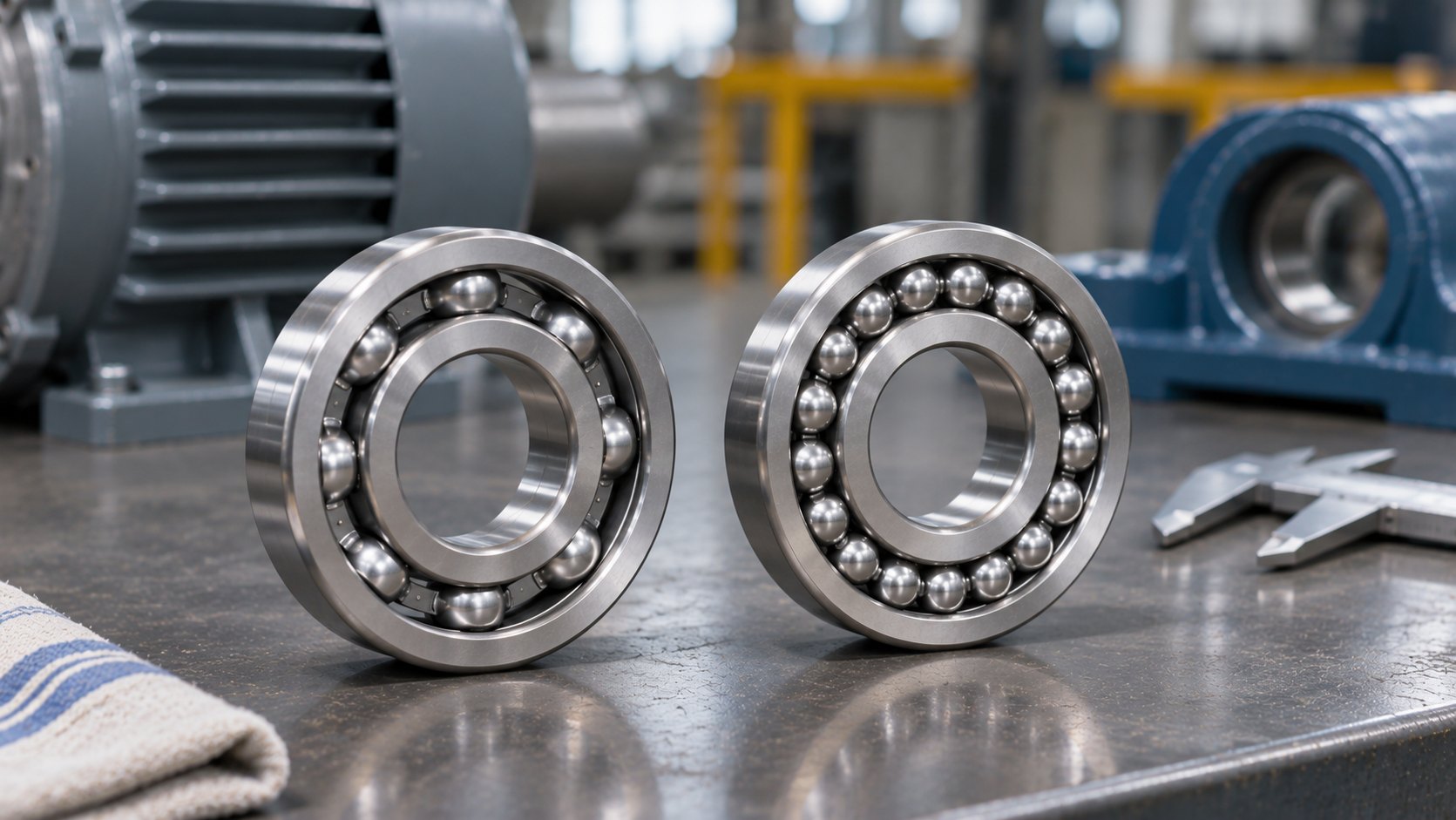
A standard deep groove ball bearing spaces its balls with a cage, sometimes called a retainer. The cage keeps the balls evenly spaced, stops them from touching each other, and holds the set together when the inner ring comes out of the housing.
Take the cage out and the gaps between balls can be filled. The rings take the last ball through a filling notch in one shoulder, or the inner ring is displaced far enough to slide the set in. Either way, the finished bearing has no separator between the balls.
The wider trade between families is set out in our article on deep groove ball bearing advantages and disadvantages.
02What You Gain and What You Pay
The comparison fits in three columns. Read down the middle and the design looks like an upgrade. Read the right hand column and the same rows explain why it is not.
| Part of the duty | What the extra balls give | What the design gives up |
|---|---|---|
| Load rating | More balls means more contact ellipses sharing the same load | Axial capacity falls where the filling notch interrupts a shoulder |
| Stiffness | Less ring deflection under the same load, which suits positioning work | Higher internal friction, and a starting torque that is harder to predict |
| Friction and heat | Nothing that helps | Neighbouring balls rub at opposite surface speeds, so sliding replaces rolling at every ball to ball contact |
| Speed | Nothing that helps | The sliding contact sets a lower ceiling than a caged bearing of the same size |
| Lubrication | More contact area to keep wetted | No cage to carry grease into the contact, so the film has to be fed by the grease path |
| Assembly and service | Fewer parts in the bill of materials | The set falls apart on removal, and one missing ball can go unnoticed |
That table answers the first question a buyer asks, which is whether more balls is better. The honest answer is that it is better on one axis and worse on four.
03Load Path and Stiffness
Load passes from one ring, through a ball, into the other ring. Each contact is a small ellipse, and the whole bearing deflects by the sum of those local deflections. Add balls and each ellipse carries less, so the ring moves less under the same load.
This is why full complement designs turn up in slow indexing tables, thin section pivots, and anywhere a tool has to hold position against a changing load. The gain is real, and a dial indicator on the housing will show it.
Where the stiffness actually comes from
Stiffness here is not a property of the steel grade. It comes from contact count and from preload. A full set of balls in a bearing with no preload can still feel loose, because the clearance is the distance the shaft travels before any ball takes load.
Crossed roller bearings solve the same problem another way, with cylindrical rollers at 90 degrees to each other on a single raceway. A full complement ball set is the cheaper answer when the load is moderate and the motion is slow. The comparison sits on our crossed roller bearing page.
04Friction and the Speed Ceiling
Two balls touching each other run in opposite directions at the contact point. One surface moves up as the other moves down, so the relative velocity there is twice the surface speed. That contact cannot roll. It slides, and sliding costs torque and heat.
In a caged bearing the same pair of balls never meets. The cage holds a gap, the balls roll on the raceways only, and friction stays where the design intended it.
A heat check you can run without instruments
Run the machine at its normal duty, then compare housing temperature against the same machine with a caged bearing, or against the opposite end of the same shaft. A full set unit that runs warmer at the same load is telling you the ball to ball contact is doing work.
Speed is the first thing the design gives up, and it gives it up quietly. The bearing does not fail at the moment speed rises. It runs hotter, the grease ages faster, and the failure arrives later under a different name.
05Lubrication With No Cage to Hold It
A cage is also a grease reservoir. It traps grease between its pockets, releases it slowly, and keeps a film on the ball path between relubrication intervals. Remove it and the free space inside the bearing changes shape.
Two habits follow. Use a grease that stays where it is placed, because there is no pocket to hold it against centrifugal throw. Then accept that the film has to be fed by the grease path rather than released from a reservoir, which shortens the interval on a hot duty.
If you are weighing a full set against a caged design for a housing that is already on the drawing, our engineers will check the ball count and the shoulder against your load case. Send the drawing and we will answer on the fit rather than on the catalog page.
06Fitting and Inspection at the Bench
A caged bearing arrives as one unit and leaves the housing as one unit. A full complement bearing does not. Once the inner ring is out, the balls are held only by gravity and grease, and the set will not go back together in the wrong order without damage.
Tie the set together, count the balls against the drawing, and keep the rings paired. On inspection, look for a polished flat near the pitch line where two balls have rubbed, and for a raceway track wider than the ball path should be.
The filling notch deserves a look on every teardown. A notch with a raised lip or a bruised edge has been taking load it was never meant to carry, which usually means the bearing went in with the notch on the loaded side.
07Three Duties That Justify the Design
Slow pivots that must not deflect
A welding positioner, a trunnion, or a rotary table that indexes and then holds still. The load is high, the speed is low, and the position has to stay put while a tool pushes against it.
Rings that cannot grow
Where the envelope is fixed by a housing that already exists, a full set raises capacity without a larger bore or outside diameter. Section thickness stays the same, and so does the shaft.
Shock load at standstill
A bearing that takes a hit while stopped has no film built up. More balls in contact means the hit is shared across more ellipses, and the ring dents less.
08The Duty Where the Cage Earns Its Place
A continuously rotating shaft above a moderate speed is the wrong home for a full set. Motor shafts, fan shafts, and pump shafts run for hours at a stretch, and ball to ball sliding becomes the dominant heat source. The cage looks like a part that could be deleted, and on that duty it is the part that keeps the bearing alive.
A 6204 bearing in a motor end bell, 25 mm bore and 47 mm outside diameter, is a good example of a size where the caged version is the default and should stay the default. If a customer asks for a full set in that position to gain load, the useful reply is that load was probably never the problem.
09Frequently Asked Questions
Is a full complement bearing the same as a filling slot bearing?
The two terms describe different things. Full complement describes the ball count. A filling slot is one way to load that count into the rings. A full set can also be assembled by displacing the inner ring, with no notch at all.
Can I drop a full set into a housing built for a caged bearing?
The envelope matches, so it fits. Check three things first: the speed, the lubrication path, and the axial load direction, because a filling notch removes shoulder support on one side.
Do full complement bearings always run hotter?
At speed, yes. At slow oscillation the ball to ball contact barely moves, and the extra load capacity usually wins. The dividing line is surface speed at the contact, not bearing size.
Why do the balls touch each other?
Because nothing separates them. A cage holds a gap between neighbours. Without it the balls sit against each other, and that contact point slides instead of rolling.
Can a full complement bearing take thrust load?
Less than a caged bearing of the same bore, and less again in the direction of the filling notch. Where axial load is part of the duty, a caged deep groove bearing or a crossed roller bearing is the safer choice.
Send the drawing, the load, and the speed.
We manufacture deep groove ball bearings and crossed roller bearings to drawing, and we will say when a full set helps and when it does not. Contact the engineering desk.



Related Products