
 English
 French
 German
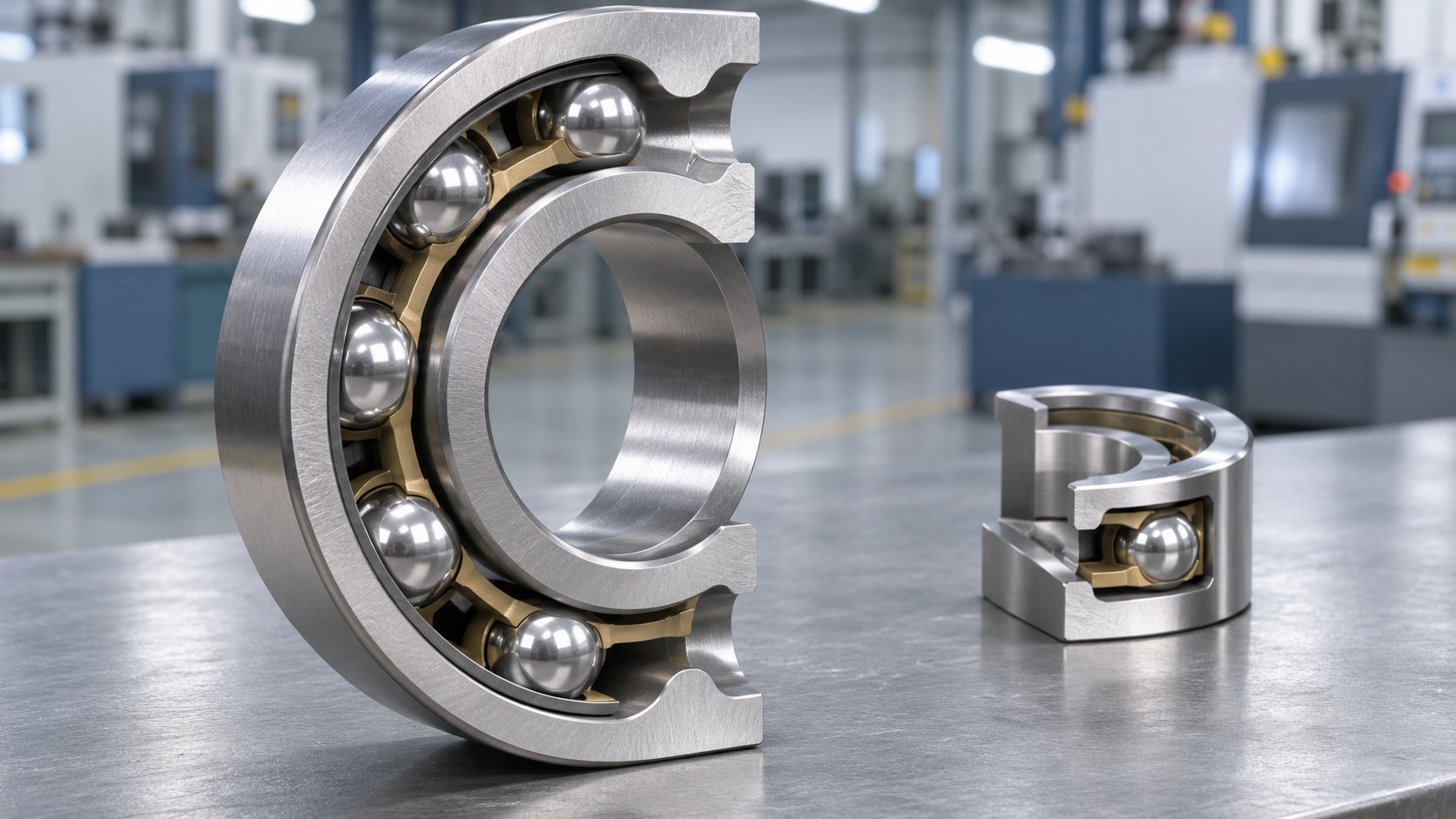
Deep Groove Ball Bearing Cross Section
Cutaway View
A deep groove ball bearing cross section is the fastest way to understand why the part carries both radial and axial load, and why two bearings that look identical from outside behave differently.
Cut one in half and you get seven features to read: the inner raceway, the outer raceway, the shoulder height, the ball, the cage, the seal or shield, and the chamfer. This guide names each one, explains the job it does, and shows what a poorly made version looks like in the same view.
01What a Cutaway Actually Shows
A section drawing removes half the part, so you see the wall thickness, the groove profile and the gap between ball and raceway. None of that is visible on an assembled bearing, and all of it decides how the part behaves under load.
The same view also exposes workmanship. Two bearings can share a designation and a dimensional envelope and still differ in groove finish, rivet set and seal lip clearance. Those differences show up in the section before they show up in service.
The parts described here apply across the deep groove ball bearing range. A familiar 6204 bearing shows all seven features at a size most plants already run.
02The Parts You Can Name
Seven features carry almost everything you need to judge a design. Read them in this order, from the load path outward.
| Feature | Job it does | How a weak version looks in section |
|---|---|---|
| Inner raceway | Takes the ball load and guides it | Groove off center, or a rough ground finish |
| Outer raceway | Takes the reaction load | Mismatched profile against the inner groove |
| Shoulder | Holds the ball and sets axial capacity | Low shoulder, thin land, shallow groove |
| Ball | Rolls and separates the rings | Visible flats, lapping marks, size scatter |
| Cage | Keeps the balls spaced and square | Loose rivet, sharp pocket edge, thin web |
| Seal or shield | Keeps grease in and dirt out | Wide lip gap, lip off the land, no spring |
| Chamfer | Clears the shaft fillet and eases fitting | Undersized, burred, or asymmetric |
03The Raceway Groove and Its Curvature
The groove is not a half circle that hugs the ball. Its radius is a little larger than half the ball diameter, which leaves a small gap and lets the ball roll with minimal sliding.
That gap is a design choice, not a defect. A groove that hugs the ball more tightly spreads the load over a wider contact patch and raises stiffness, at the cost of more friction and more sensitivity to misalignment. A looser groove runs cooler and tolerates more deflection, and carries less.
What the Groove Radius Changes
Radius affects three things at once. Stiffness rises as the fit tightens, friction rises with it, and the bearing’s tolerance for shaft deflection falls. That is why a precision spindle part and a conveyor part can share a bore and a designation prefix and still be different designs.
In the section you can see the consequence rather than the number. A deeply grooved part shows more of the ball enclosed by the ring. A shallow part shows the ball sitting higher, with more of it exposed above the shoulder line.
Why the Groove Is Ground, Not Just Turned
A turned groove leaves a spiral finish that the ball crosses thousands of times per minute. Grinding produces a finish with a direction that follows the rolling path, which is why raceway grinding and honing are separate operations from turning the rings.
In a section, a ground surface reads as a clean, continuous arc with a uniform wall behind it. A part that skipped a step often shows a wavy profile or a groove deeper on one side.
04The Shoulders and the Contact Angle
The shoulder is the land above the groove on each ring. Its height decides how much axial load the ball can push against before it climbs out of the groove. Deep groove parts have shoulders on both sides of both rings, which is why they take thrust in either direction.
At rest with no axial load, the contact between ball and groove is close to radial. Add thrust and the contact line tilts, the angle opens, and the load path shifts toward the shoulder.
Why a Deep Groove Takes Both Directions
Because both rings carry a shoulder on both sides. A part with one shoulder open takes thrust in one direction only and needs a partner bearing for the other direction. The section makes that difference obvious in one glance.
The price of the symmetric shoulder is that neither direction gets the full axial capacity of a design built only to take thrust. That trade is deliberate, and it is why a deep groove part suits a motor shaft rather than a position that carries thrust alone.
05The Cage in Section
The cage keeps the balls evenly spaced, stops them rubbing each other, and holds the set together during handling. In section you see its thickness, its pocket shape and how it is attached to itself.
• Riveted steel or brass cages show a formed rivet head on one side. A rivet that sits proud or off center is a assembly defect that will loosen.
• Snap or crown cages show fingers over the ball. Look for even finger length and a pocket that does not pinch the ball.
• Polymer cages show thicker walls and rounded pockets. Look for flash at the pocket edge and for a ball that sits proud of the pocket.
A cage is the cheapest part of the bearing and the most common cause of a noise complaint. A section that shows a thin web or a sharp pocket edge tells you the part was built to a price.
06Seals and Shields in Section
This is where the section earns its keep for anyone working in a wet or dusty plant. A shield is a metal disc with a small gap to the inner ring land. A seal has a flexible lip that touches the land, usually with a spring behind it.
| Type | What the section shows | What it keeps out | Cost in drag |
|---|---|---|---|
| Open | Nothing, the groove is exposed | Nothing | None |
| ZZ shield | Metal disc, gap at the land | Dust, coarse dirt | Low |
| 2RS seal | Rubber lip touching the land | Water, fine dust, washdown | Higher |
| Labyrinth | Interlocking grooves, no contact | Dust, splash | Very low |
The Lip Gap Tells You the Truth
On a sealed part, look at the lip and the land it runs on. A lip that barely touches has a short life in washdown. A lip that presses hard runs hot and pulls the speed limit down. Both are visible in section, and neither is visible on a shelf.
The land surface matters as much as the lip. A rough land wears the lip from the outside, which is why a seal that fails early often leaves a polished track on the inner ring rather than a torn lip.
07Chamfers, Fillets and Fit
The chamfer is the angled edge where the bore meets the face. It exists to clear the fillet radius on the shaft shoulder, so the bearing face can sit flat against the shoulder instead of hanging on the corner.
A section shows whether the chamfer is large enough for the fillet you plan. If the fillet is bigger than the chamfer, the ring contacts the shaft on a corner and the fit loosens under load, and it shows up later as fretting on the bore.
The same logic applies at the housing shoulder. Check the fillet against the outer ring chamfer before you approve a housing print. A 6203 bearing and a heavier series part in the same bore class can differ in chamfer size, which changes what the shoulder has to clear.
08What a Section Reveals About Quality
Four defects show up in a cutaway long before they show up in a vibration reading.
1. Raceway eccentricity. The groove is not concentric with the bore, so the ball path wanders. Visible as uneven wall thickness on one side of the ring.
2. Profile mismatch. The inner and outer grooves do not present the same curvature, so the ball contacts on an edge rather than across the arc.
3. Seal lip clearance. A gap where the drawing calls for contact, or contact where the drawing calls for a labyrinth.
4. Cage rivet set. A head that stands proud, or a joint that has already started to open.
A cutaway sample is also the only way to judge grease fill. Grease belongs in the free space, not packed through the whole cavity, because a full cavity churns and overheats.
09Checking a Sample or a Drawing
When a supplier sends a section drawing or a cut sample, run the same five checks every time. It takes a few minutes and catches most of what a dimensional sheet cannot.
• Wall thickness, both sides. Even thickness around the groove means the ring was machined concentric.
• Shoulder height, both rings. Low shoulders on a part sold as deep groove mean less axial capacity than expected.
• Groove arc, both rings. The arcs should mirror each other across the ball, with the ball seated evenly.
• Cage joint and pocket. Look for even rivet heads, even finger length, no flash and no sharp edge.
• Seal lip and land. Contact or gap should match the drawing, and the land should be smooth under the lip.
If the bearing has to be measured rather than cut, the guide to measuring a bearing covers the external checks. A section answers the questions that calipers cannot.
10Questions Buyers Ask About the Section
What are the main parts in a deep groove ball bearing cross section?
Inner ring with its raceway, outer ring with its raceway, the balls, the cage, the seal or shield, and the chamfers at the bore and the outside diameter. Each has a defined job in the load path or the protection of it.
Why does a deep groove bearing take axial load in both directions?
Because both rings carry a shoulder on both sides of the groove. The ball is held on both faces, so thrust from either direction meets a shoulder rather than an open edge.
What does the cage do?
It keeps the balls evenly spaced and square to the raceway, and it holds the ball set together during assembly and fitting. A worn cage shows up as noise and as uneven ball spacing.
Can a section show whether a bearing is precision grade?
Partly. Grinding quality, groove concentricity, cage finish and seal fit all show in a cutaway. The tolerance class itself has to come from the inspection report, but a rough section rarely belongs to a precision part.
Does Yuanhe supply cut samples or section drawings?
Yes. For a development project we can provide a section drawing with the groove, shoulder and seal details, and a cut sample where a physical check is easier than a print.
A designation tells you the family and the bore. A section tells you whether the part inside that designation was designed for your duty. That is the difference between buying a size and buying a bearing.
Send the drawing or ask for a section
If a groove profile, shoulder height or seal arrangement is unclear on a print, send it and we will mark up what the section would show. For existing parts, a photo of a cut sample is usually enough to start.
We can also supply a section drawing for a 6304 bearing or any other size in the range before you commit to a batch.



Related Products