
 English
 French
 German
Bearing Load Ratings. What Dynamic and Static Numbers Mean
Load Numbers
Bearing load ratings are the two numbers most often quoted and least often used correctly. One describes what the bearing can carry while it rotates for a long life. The other describes what it can survive without being turned at all. Confusing the two is one of the quiet ways a project ends up with the wrong part.
This page explains what each figure means, how the two relate, and how to use them when you compare sizes. The worked comparisons use published figures from our own deep groove ball bearing pages.
01Two Numbers, Two Different Jobs
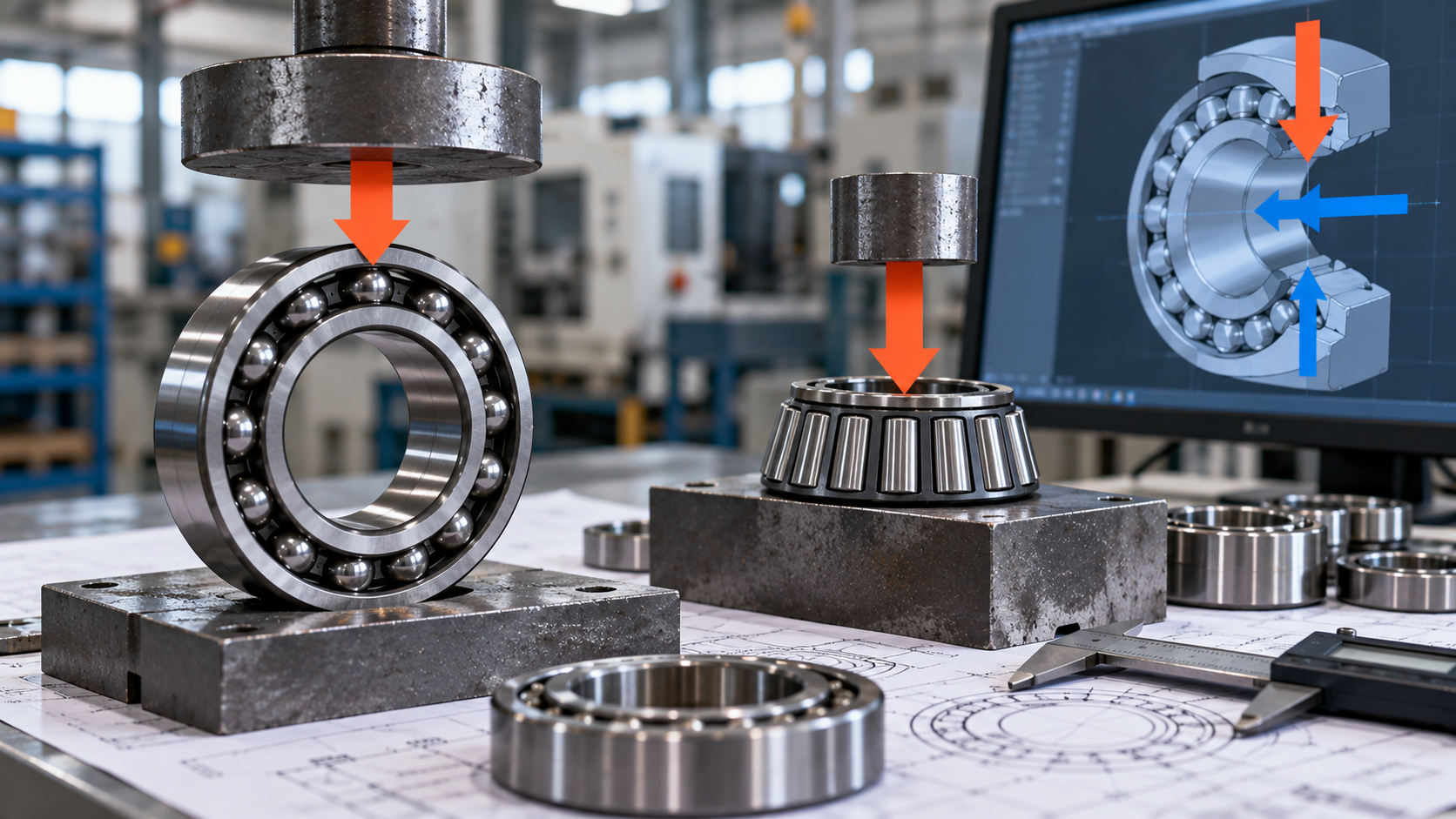
A bearing datasheet always shows a dynamic rating and a static rating. The dynamic figure is the load the bearing can carry through a long rotating life. The static figure is the load it can take while stationary, or while creeping slowly, without permanent damage to the raceway.
A machine tool spindle, a fan, a conveyor roller, and a pump shaft all spend their working life turning, so the dynamic figure is the one that sizes them. A crane hook, a parked robot arm, a bolted joint under a static preload, and a bearing that sits loaded for months without turning are sized on the static figure instead.
Both figures come from the same bore size, which is why a small bearing can look strong on paper and still be the wrong pick. The relevant number depends on what the machine does with it.
02What the Dynamic Rating Means
The dynamic rating, usually written C, is the load at which a group of identical bearings would reach one million revolutions under test conditions. It is not a breaking load and it is not a limit that must never be crossed. It is a reference point that lets an engineer predict how long a bearing will last at the load the machine actually applies.
Read it as a budget. If the applied load is well below C, life is long. If the applied load approaches C, life shortens quickly, because the relationship is not a straight line. That is why designers aim for a comfortable margin rather than matching the load to the rating.
Comparing Sizes at the Same Bore
The clearest way to see what the dynamic figure does is to line up bearings of the same bore and different series. All of the sizes below share a 20mm bore, and the only real difference is how much room the designer gives the bearing.
| Size | Bore, outer, width | Dynamic rating | Static rating |
|---|---|---|---|
| 6004 | 20 x 42 x 12mm | 9.36 kN | 5.10 kN |
| 6204 | 20 x 47 x 14mm | 12.8 kN | 6.55 kN |
| 6304 | 20 x 52 x 15mm | 16.0 kN | 7.88 kN |
| 6205 | 25 x 52 x 15mm | 14.0 kN | 7.85 kN |
The pattern is simple. As the outer diameter and the ball size grow, the bearing carries more, and the housing bore has to grow with it. The 6204 bearing carries more than the 6004 at the same bore, and the 6304 bearing carries more again. Our deep groove ball bearing range lists the full set of sizes and figures.
03What the Static Rating Means
The static rating, written in most catalogs as the basic static load rating, is the highest load the bearing can take while stationary without leaving a permanent dent in the raceway. Engineers call that dent brinelling. Once the surface is dented, the bearing makes noise when it finally turns, and the damage cannot be polished out.
Static limits matter more than most buyers expect, because the worst load a bearing ever sees is usually the one applied while the machine is parked. A robot arm holding a tool at full reach, a machine clamped during transport, a press frame at rest, and a bearing pressed into a housing all put load on a stationary raceway.
Why the Static Figure Is Often the Larger One
For most deep groove ball bearings the static rating is a fraction of the dynamic figure rather than a multiple of it, which surprises engineers who meet the terms for the first time. The two numbers are measured differently, so they are not directly comparable. The static rating only has to prevent denting, while the dynamic rating has to support a long rotating life.
04Matching the Rating to the Duty
The practical question is always the same. Does this bearing turn under load, or does it sit still under load? A straight answer to that question tells you which figure to check first.
Rotation Under Load
1. Continuous rotation. Size on the dynamic rating, with a margin for the worst load the machine will see.
2. Starts, stops, and holds. Check both. The rotating life sets the size, and the static figure confirms the bearing survives the holds.
3. Loaded but parked. Size on the static rating. This covers transport, clamping, and jigs that hold parts for long periods.
4. Reversing loads. Size on the dynamic rating and expect the retainer and the fit to matter as much as the rating.
5. Unknown duty. Give us the load, the speed, and the machine, and we will confirm the figure that applies.
Loaded While Parked
The parked case is the one that gets skipped. A bearing that sits under load for months will take a set if the load is above the static figure, even though it never turned a full revolution. Checking it takes one line on the drawing and prevents a whole class of early failures.
05What Lowers the Real Capacity
Published ratings assume a clean, well lubricated bearing in a correct fit. Real machines rarely stay in that condition, and the gap between the catalog figure and the working figure is where projects get into trouble.
| Condition | Effect on working capacity | What to do |
|---|---|---|
| Poor shaft or housing fit | Load concentrates on part of the raceway | Check the fit before blaming the rating |
| Dry or broken down grease | Surface damage starts well below the rating | Match the grease to the duty and the temperature |
| Angular misalignment | One side of the raceway takes most of the load | Correct the alignment or use a self aligning arrangement |
| Contamination | Dents and abrasive wear shorten life | Improve sealing and handling |
| Axial load on a radial bearing | Only part of the internal geometry helps | Send the load direction with the inquiry |
06Why the Direction of the Load Matters
A rating alone does not say which way the load pushes. A deep groove ball bearing is built for radial load, the load that pushes straight down through the shaft, and it handles a limited amount of axial load, the load along the shaft axis.
A belt drive pulls sideways on the shaft. A helical gear pushes along it as well as down. If a machine applies a large axial push, the radial figure on the drawing is not the whole story. Send the load direction along with the magnitude and we check both.
Radial, Axial, and Both at Once
Most real machines apply a mix of the two, and the mix changes with the duty cycle. A bearing that sees pure radial load at start up may see a strong axial push at full power, so the design has to cover the worst combination rather than the average.
What We Need to Check a Rating for You
Radial load and axial load, with the direction of each.
Running speed and whether the machine reverses.
Duty cycle, including how long the bearing is loaded while stationary.
07Reading Ratings Across a Catalog
Ratings are only useful in comparison. A figure quoted alone tells you nothing about whether a bearing is oversized or marginal.
The habit that pays off is to pull two or three sizes at the same bore and put them side by side. If the 6004 carries more than enough for the duty, there is no reason to move up to a 6304 and pay for a bigger housing. The guide on how long ball bearings last covers what the rating does to service life once the load is known, and the 6004 bearing page shows the smallest of the three sizes above.
08Common Ways the Numbers Get Misused
• Treating the dynamic rating as a maximum load. It is a reference for life prediction, not a wall.
• Ignoring the static case. Transport and clamping loads damage bearings while nothing moves.
• Comparing figures across different series only. Two bearings with the same bore can differ by a wide margin.
• Leaving out load direction. Axial load changes which geometry carries the load.
• Buying the biggest size that fits. Oversizing adds mass, cost, and friction without adding life.
09Questions Buyers Ask
Which rating should I use to choose a size?
Use the dynamic rating for anything that rotates under load, and the static rating for anything loaded while parked. Most machines need both checked, because transport and clamping loads happen while the bearing is stationary.
Does a higher rating always mean a better bearing?
No. A higher rating usually means a bigger bearing, which costs more and may not fit the housing. The right bearing is the one whose rating covers the duty with a sensible margin.
How do I compare the 6204 and the 6304 for the same job?
Compare the dynamic and static figures at the same bore, then check the outer diameter and width against the space you have. The 6204 suits a tighter housing and the 6304 carries more within a larger one.
Why does my bearing fail below its rating?
Fit, lubrication, alignment, and contamination usually account for it. A correct fit and a suitable grease recover most of the gap between the catalog figure and real life.
Can you confirm a rating for my application?
Send the radial and axial loads, the speed, and the duty cycle. We will confirm the size and the figure that applies, and quote it with the seal and clearance you need.
Send the Load and the Speed
Tell us the radial load, the axial load, the speed, and how long the machine runs at load. We will check the dynamic and static figures against your duty and quote the size that fits.