

 English
 French
 German
Types of Bearings. A Comprehensive Guide to Every Family
BEARING TYPES EXPLAINED
Types of bearings sort into two questions. What carries the load, a rolling element or a film of lubricant. And which way that load travels, radial, axial, or both at once.
This guide walks every major family, shows what each is good at, and marks where each runs out of room. It ends with the tables we use when a drawing arrives. For the two lines we build, that work starts at deep groove ball bearings.
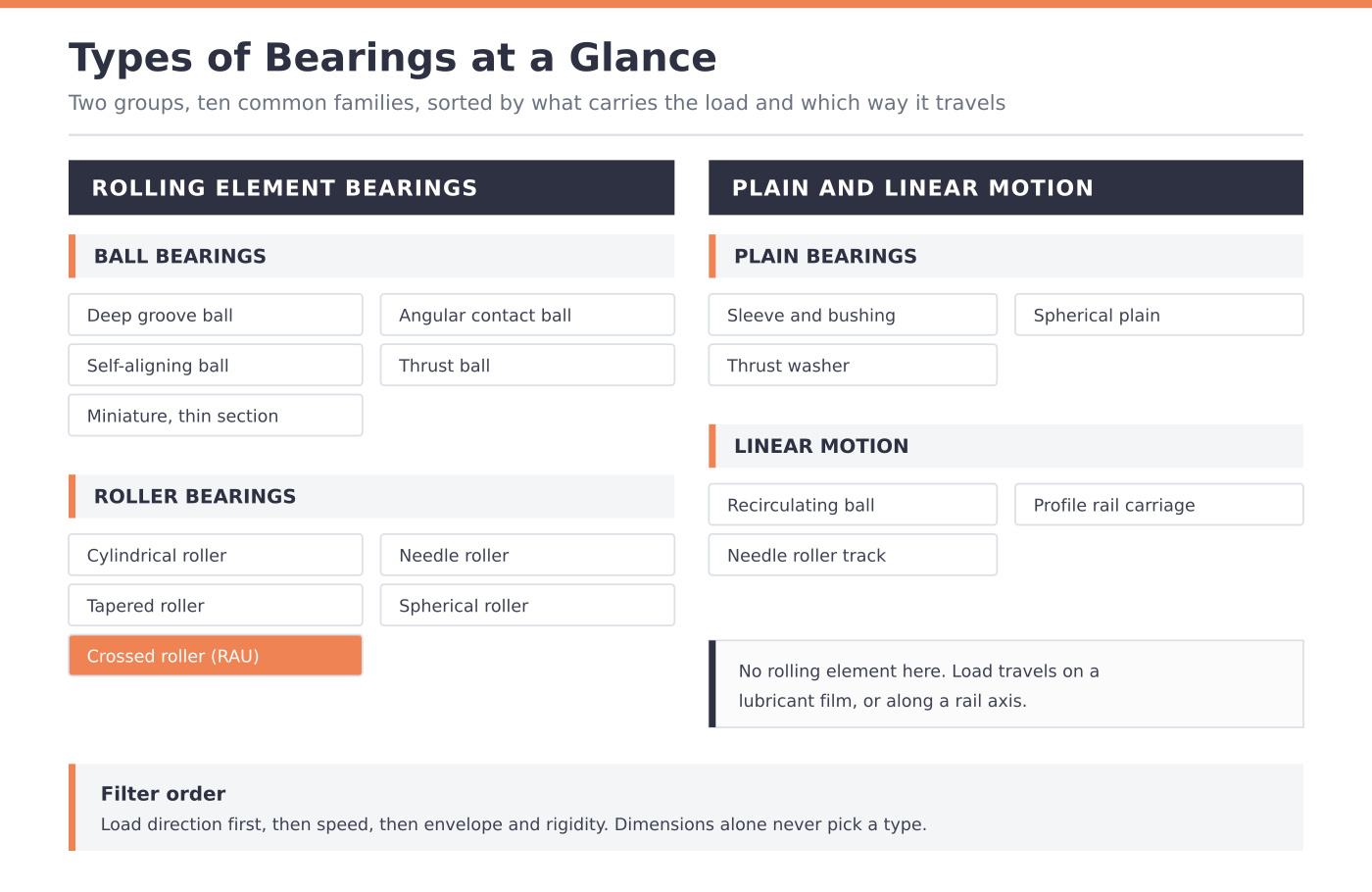
Catalogues push a list at you and leave the reasoning out. A type only makes sense next to the load case it was designed for. Read the last column of the table below first.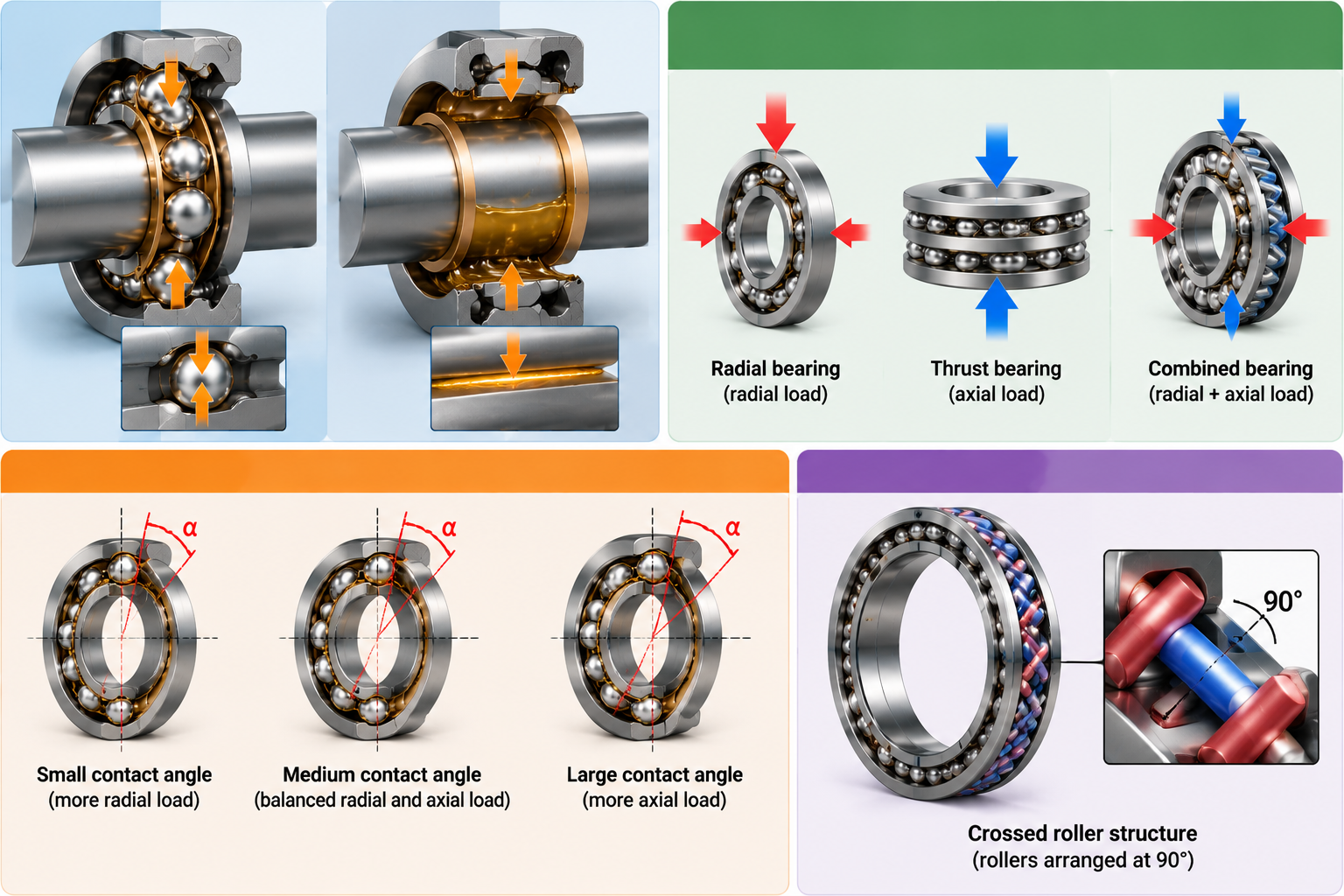
1How Bearing Types Are Classified
Every bearing sits on two axes. The first is the load carrier. Rolling element bearings pass load through balls or rollers. Plain bearings pass it through a sliding surface and a lubricant film.
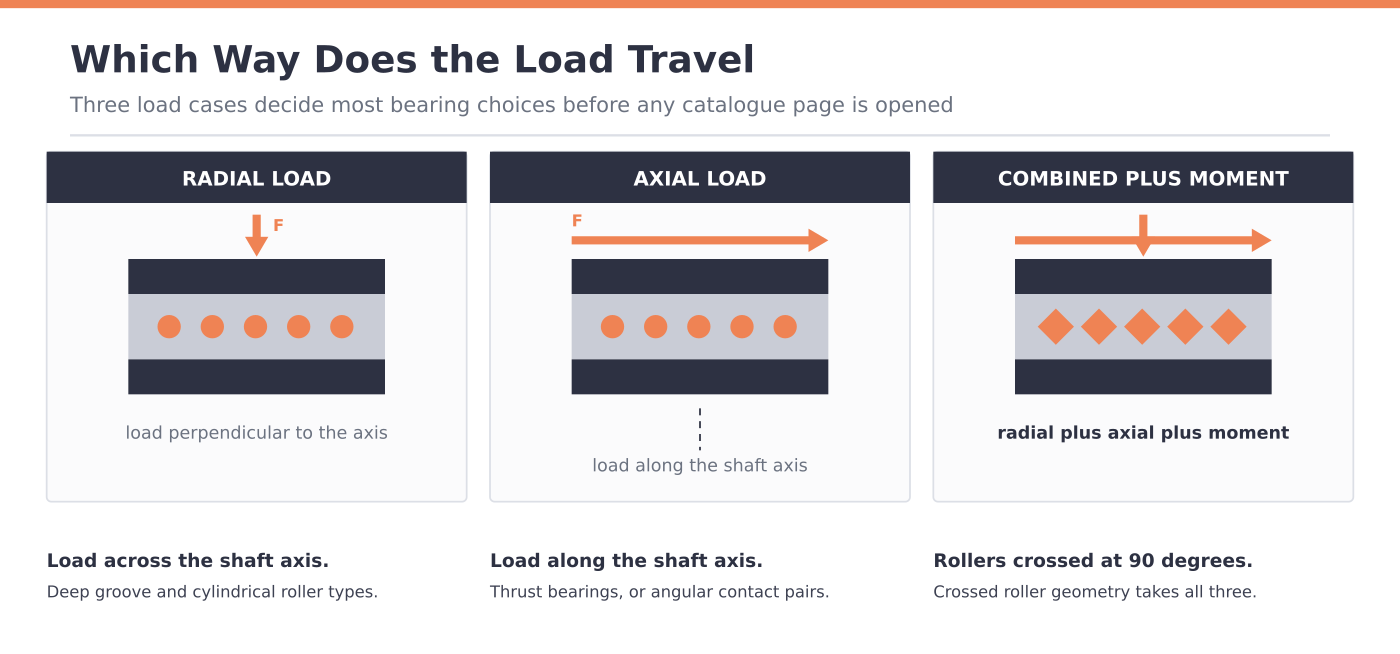
The second axis is direction. A radial bearing takes load across the shaft. An axial bearing, also called a thrust bearing, takes load along the shaft. A combined load bearing takes both at once. Contact angle decides how much of each a design accepts, and crossed roller geometry pushes it furthest, with rollers at 90 degrees to each other.
2Every Family in One Table
| TYPE | LOAD IT CARRIES | WHERE IT SHOWS UP | WHERE IT RUNS OUT |
|---|---|---|---|
| Deep groove ball | Radial, light axial | Motors, pumps, conveyors | Heavy thrust, shock |
| Angular contact ball | Radial, axial one way | Spindles, gearbox shafts | Used alone, backwards |
| Self-aligning ball | Light radial | Long shafts, fans | Axial load |
| Thrust ball | Axial only | Jacks, vertical shafts | Any radial load |
| Miniature, thin section | Light radial | Instruments, drones | Shock load, wide sections |
| Cylindrical roller | Heavy radial | Spindles, mill stands | Thrust without flanges |
| Needle roller | Small envelope | Piston pins, rockers | Misalignment, dirty oil |
| Tapered roller | Combined, one way | Wheel hubs, axles | Speed, setup error |
| Spherical roller | Heavy radial, some axial | Crushers, screens, mills | Precision running |
| Crossed roller | Radial, axial, moment | Robot joints, rotary tables | Long axial travel |
| Plain or sleeve | Radial, low speed | Linkages, hinges | Heat, first dry start |
| Linear, recirculating | Load along a rail | Machine slides, printers | Rotating shafts, one rail |
3Ball Bearing Types and What Each One Does
Balls touch the raceway at a point. Friction stays low, speed stays high, and the contact patch stays small.
Deep Groove Ball Bearings
The default choice in most machinery. The deep groove carries radial load and holds usable axial load in both directions. A 6204 bearing measures 20mm bore, 47mm outside diameter and 14mm width, with a dynamic rating of 12.8 kN and a static rating of 6.55 kN. It runs to 16,000 RPM open or shielded and 10,000 RPM sealed.
Sealing is the first decision inside the family. ZZ shields keep speed. 2RS contact seals keep dust and washdown water out at a speed cost. C3 clearance covers cases where the inner ring runs hotter than the outer ring.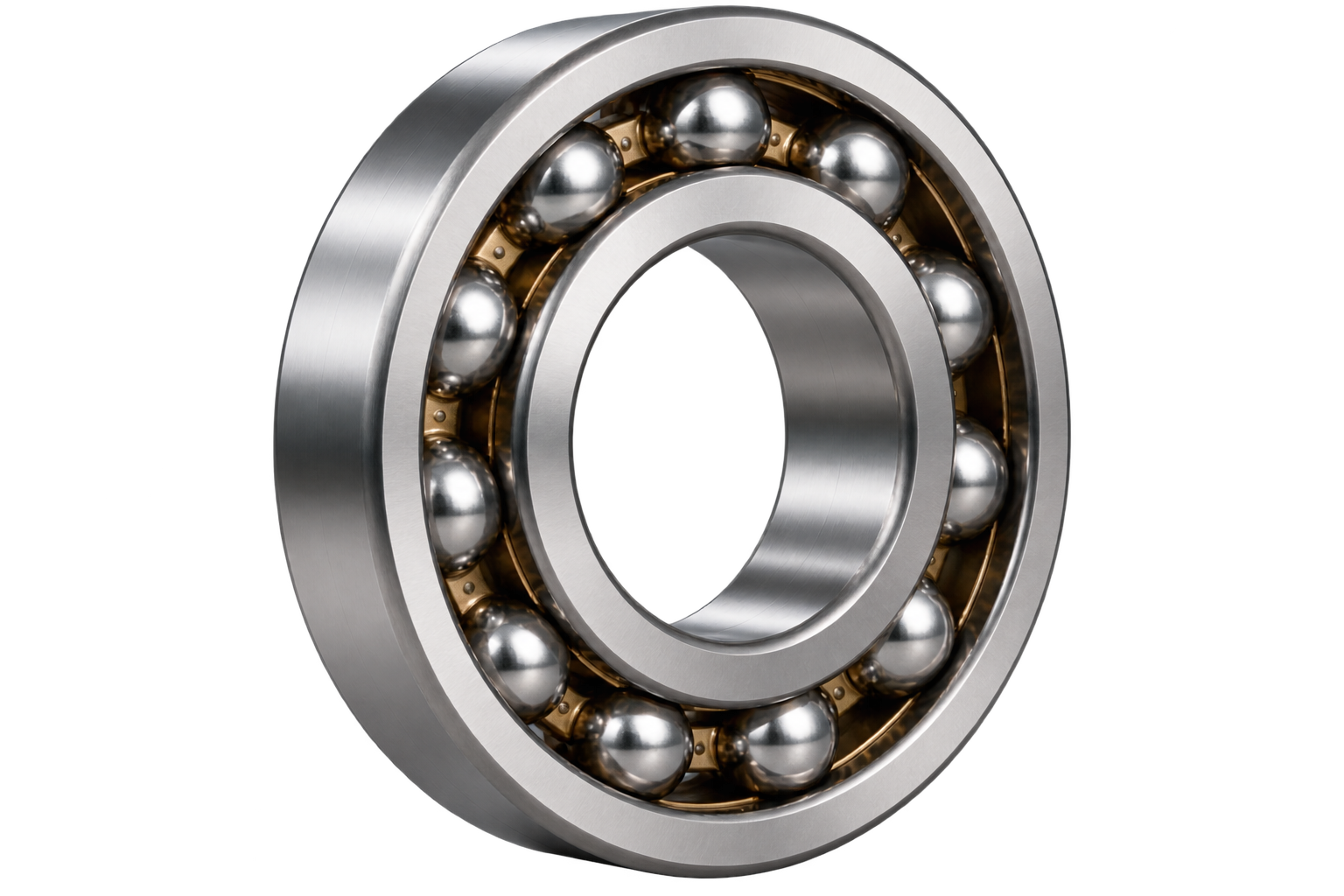
Angular Contact Ball Bearings
Shift the inner ring off centre and the ball contact line tilts. That tilt carries axial load in one direction, which is why these bearings travel in pairs. Fitted the wrong way round, they fail early. 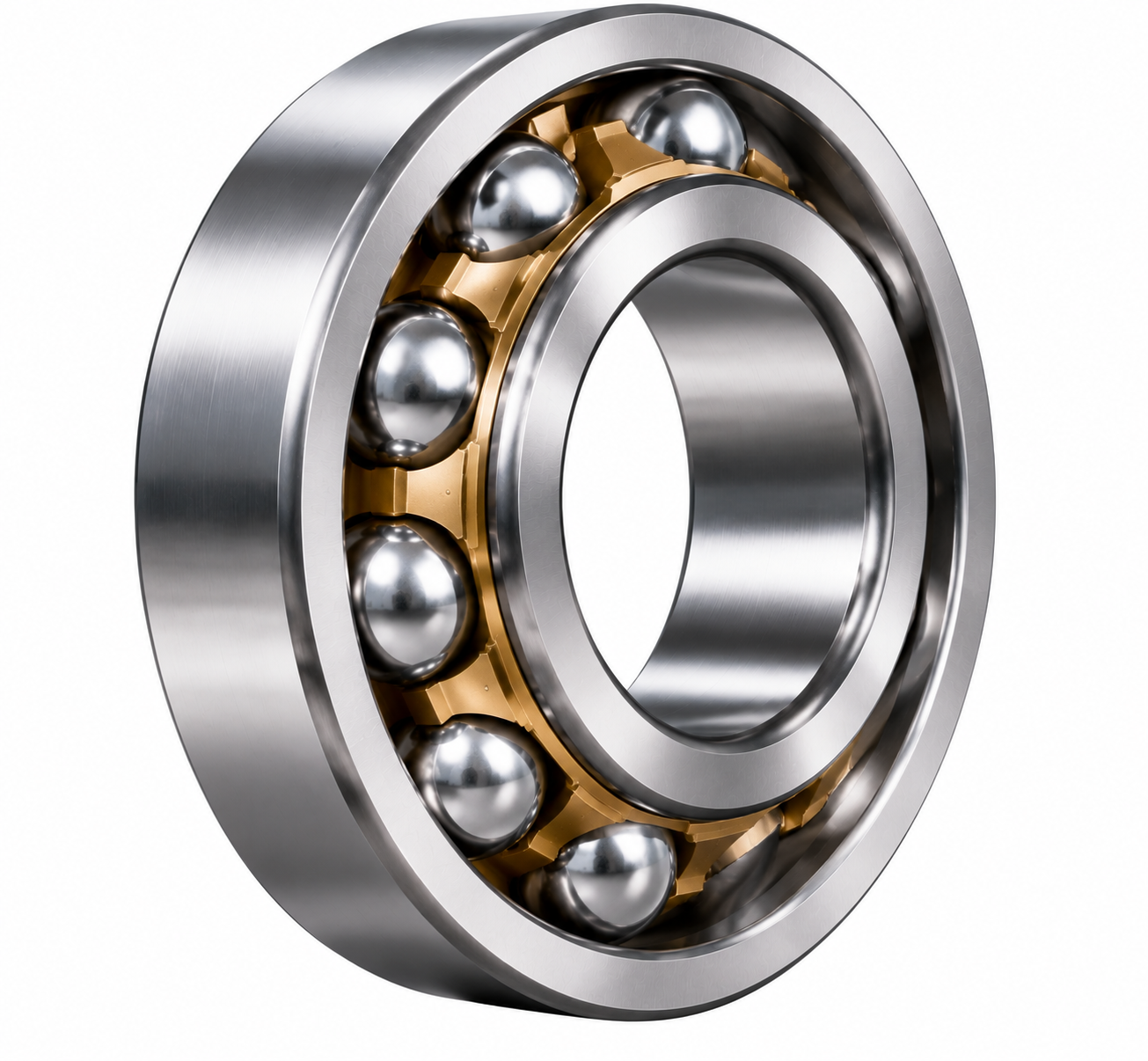
Self-Aligning Ball Bearings
Two rows of balls share a spherical outer raceway, so the inner assembly tilts a few degrees inside it. A deflecting shaft or a housing machined out of line does not load the bearing to failure. Axial load is unwelcome.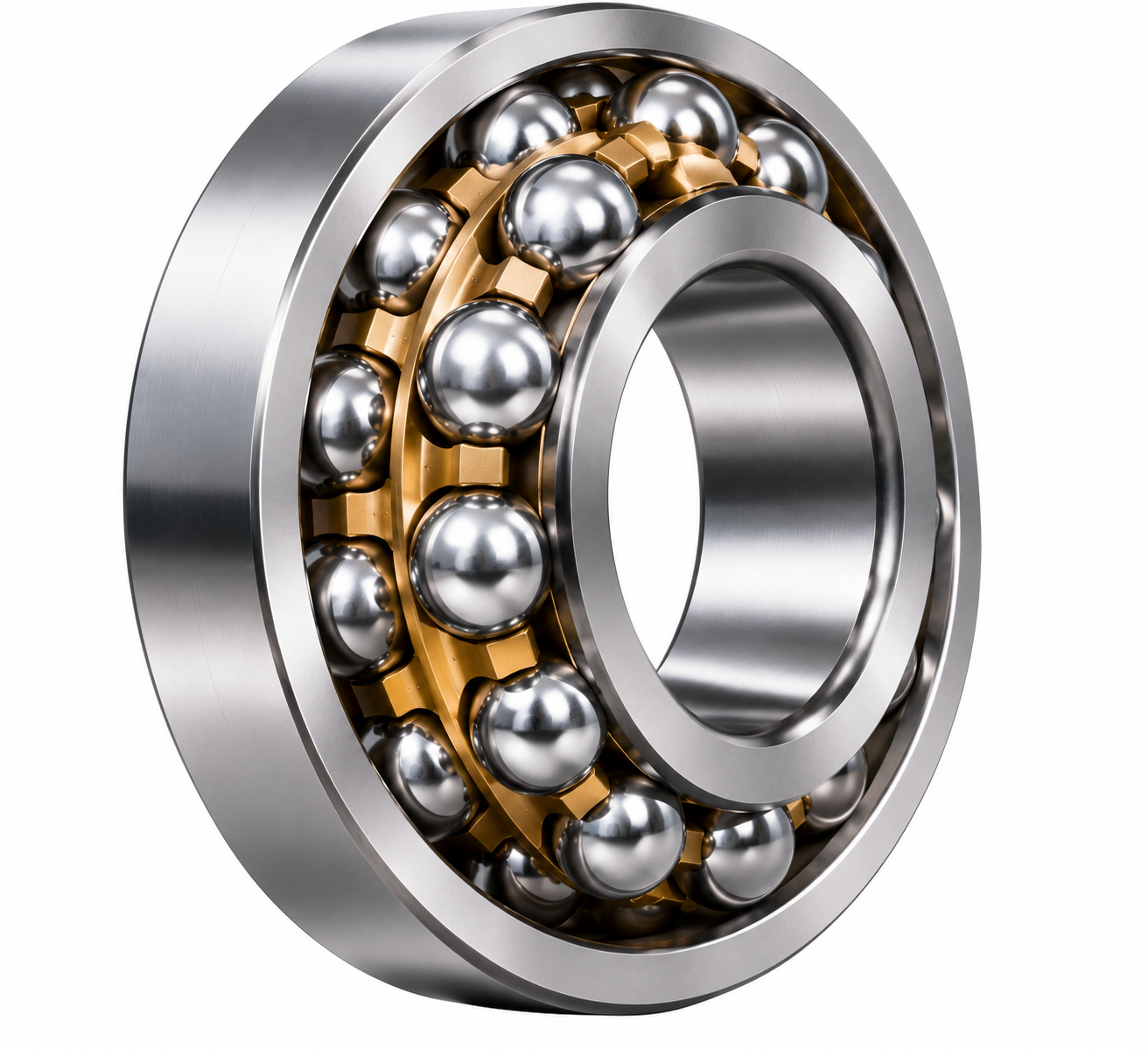
Thrust Ball Bearings
Built for pushing along the shaft and nothing else. Flat seats, one direction, no radial capacity worth counting. Radial load damages the raceway washer fast, so vertical designs pair them with a radial bearing.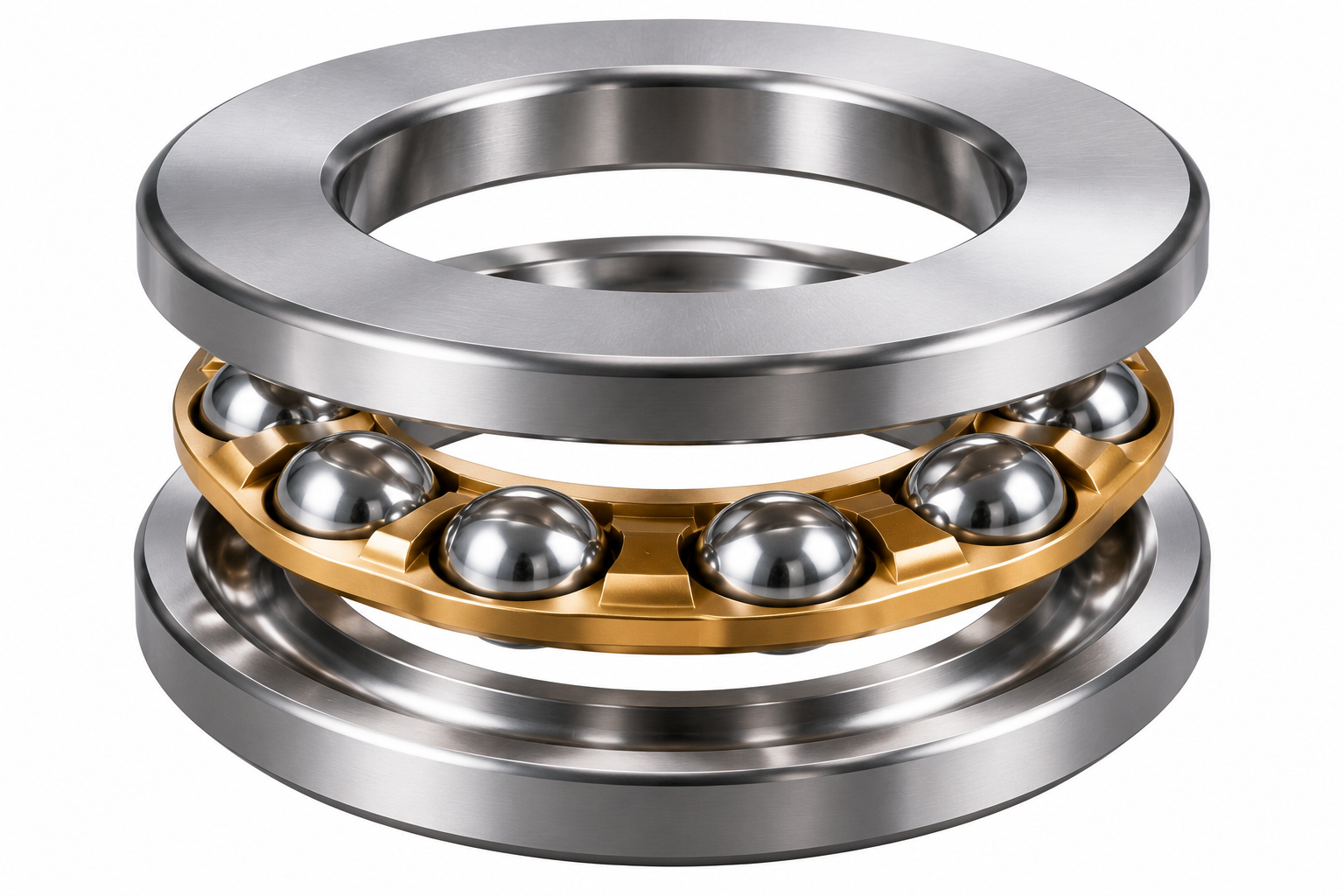
4Roller Bearing Types and What Each One Does
Rollers touch the raceway along a line instead of a point. Capacity rises, and the price is friction, heat and a lower speed ceiling.
Cylindrical and Needle Roller Bearings
A cylindrical roller sits parallel to the shaft and carries heavy radial load at high stiffness. Shrink the roller and drop the inner ring and the same idea becomes a needle roller bearing, fitting an envelope a few millimetres deep. Both want clean oil.
Tapered Roller Bearings
Tilt the roller and the contact lines meet at a common apex on the shaft axis. That geometry takes combined radial and axial load in one direction, which is why wheel hub bearings last so long. Preload is set at assembly, and a wrong setting fails in weeks.
Spherical Roller Bearings
Two rows of barrel shaped rollers run on a spherical outer raceway. High radial capacity and a few degrees of misalignment tolerance arrive in one package, which is why crushers use them. Precision running is not their strength.
Crossed Roller Bearings
Alternate rollers sit at 90 degrees to each other inside a single V-groove raceway. One ring set then carries radial load, axial load and tilting moment together. The integrated ring RAU design from crossed roller bearings arrives with factory preload and consistent runout, needs no field adjustment, and gives three to five times the moment stiffness of an equivalent ball bearing. Bore sizes run from 20mm to 350mm in grades P5, P4 and P2.
Sub-types split by raceway form and mounting style. The types of crossed roller bearings are worth reading before you specify one.
5Types That Use No Rolling Element
Plain bearings carry load on a sliding surface, quiet and cheap, tolerant of shock and of contamination that would destroy a ball. They also wear and cannot hold precision position.
Recirculating linear bearings are a separate family. Balls or rollers circulate inside a carriage travelling along a rail, turning a rotation problem into a translation problem. A moment load needs two rails.
6Matching the Type to the Load Direction
Load direction is the fastest filter you can apply. Work down this table first.
| LOAD CASE | TYPES THAT FIT | TYPES THAT FAIL |
|---|---|---|
| Radial only | Deep groove, cylindrical, needle | Thrust ball, thrust roller |
| Axial only | Thrust ball, paired angular contact | Needle roller, plain cylinder |
| Combined, one way | Tapered roller, angular contact pair | Self-aligning ball |
| Combined plus moment | Crossed roller, tapered pair | Single row deep groove |
| Misaligned shaft | Self-aligning ball, spherical roller | Cylindrical, needle |
| Oscillating, small angle | Crossed roller | Needle roller |
7Factors That Override the Type Choice
Two bearings can survive the same load and still not be interchangeable. These five factors settle it.
| FACTOR | WHAT IT CHANGES | USUAL ANSWER |
|---|---|---|
| Speed | Seals and cage material set the ceiling | Shields, PA66 cage, oil instead of grease |
| Precision | Runout and housing fitting work | ABEC-5 or P5 and above for spindles |
| Environment | Sealing, material, grease life | Food grade grease, stainless rings |
| Stiffness | Deflection under load, tool tip error | Roller types, factory preload, wider section |
| Envelope | Which series physically fits | Thin section, needle roller, crossed roller |
8How the Code Points to the Type
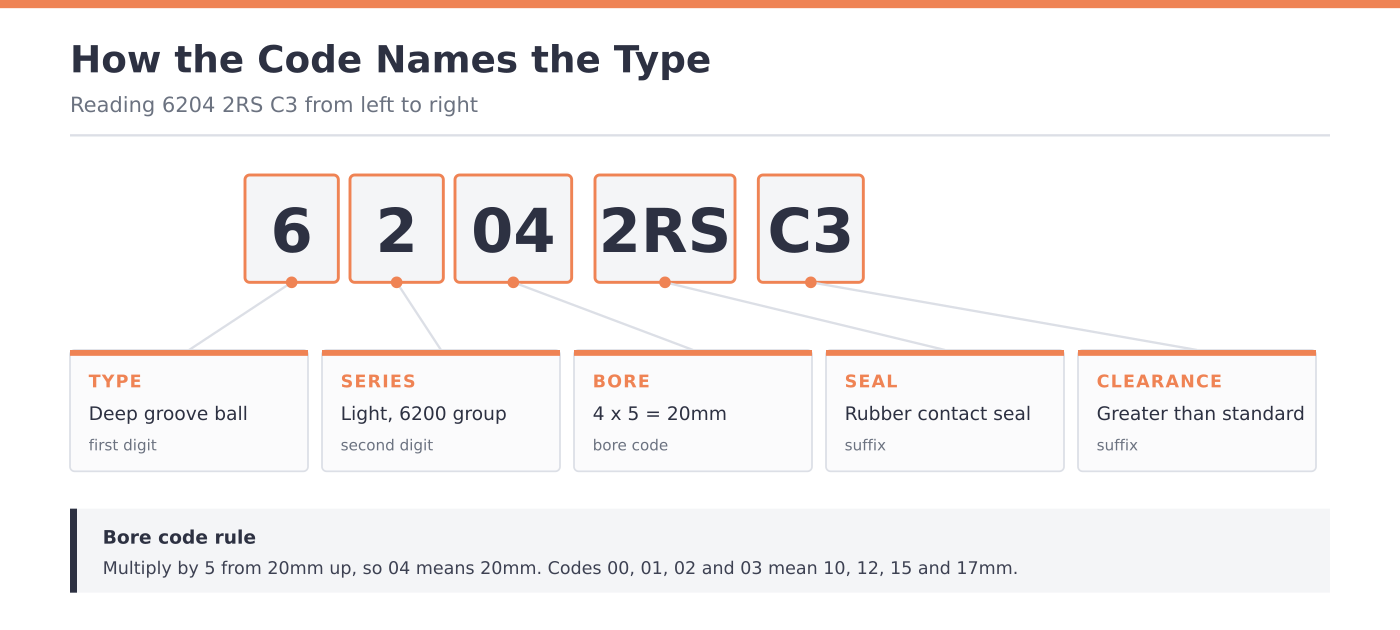
The first digit of a metric bearing code names the family. Code 6 means deep groove ball, 7 means angular contact ball, 3 means tapered roller, 2 means spherical roller. Letter code N means cylindrical roller and code 1 means self-aligning ball.
The last two digits give the bore. Multiply by five from 20mm up, so a 04 suffix means 20mm bore. The small end is the exception, where 00, 01, 02 and 03 mean 10mm, 12mm, 15mm and 17mm.
Suffixes carry the rest. Z is a shield, 2RS a contact seal, C3 extra clearance, TN a molded PA66 cage, P5 or P6 a precision class. The full breakdown sits in our guide on how to read a bearing code.
9Five Mistakes When Matching a Type to a Job
1Treating all ball bearings as one type. They differ in load direction, not just in price.
2Sizing on radial load alone. A machine that tilts or thrusts fails a bearing rated for radial load.
3Ignoring the housing fit. Heavy interference changes internal clearance. A loose fit lets the ring creep.
4Upgrading precision to fix stiffness. Tighter runout will not stop a shaft deflecting.
5Buying from the dimension chart only. Bore, OD and width can match while internals differ.
10Frequently Asked Questions
How many types of bearings are there?
Two groups, rolling element and plain, splitting into roughly ten families in general engineering use. They differ by element shape and load direction.
Which type carries radial and axial load together?
Deep groove ball bearings take light axial load both ways. Tapered roller and angular contact bearings take heavier combined load one way and work in pairs. Crossed roller bearings take radial, axial and moment load in one ring set.
What is the most common bearing type?
The deep groove ball bearing. It covers a wide speed range, accepts light thrust and drives most electric motors and pumps. Series 6000, 6200 and 6300 carry most of that work.
Can I swap a ball bearing for a roller bearing of the same size?
Only if speed, clearance and lubrication change with it. Roller types take more load, less speed and more oil. Bore and outside diameter alone are not enough.
Does Yuanhe build every type listed here?
Yuanhe manufactures two lines, deep groove ball bearings and RAU series crossed roller bearings, in ISO 9001:2015 certified production. Other families appear here so you can place them next to ours.
REQUEST A QUOTE
Send the bore, load case and speed for your application. We answer with the family, series and precision grade that fit. Yuanhe has supplied 500+ B2B clients and completed 12,000+ OEM projects.