


 English
 French
 German
What Is the Preload in a Bearing and How It Affects Life
Bearing Preload
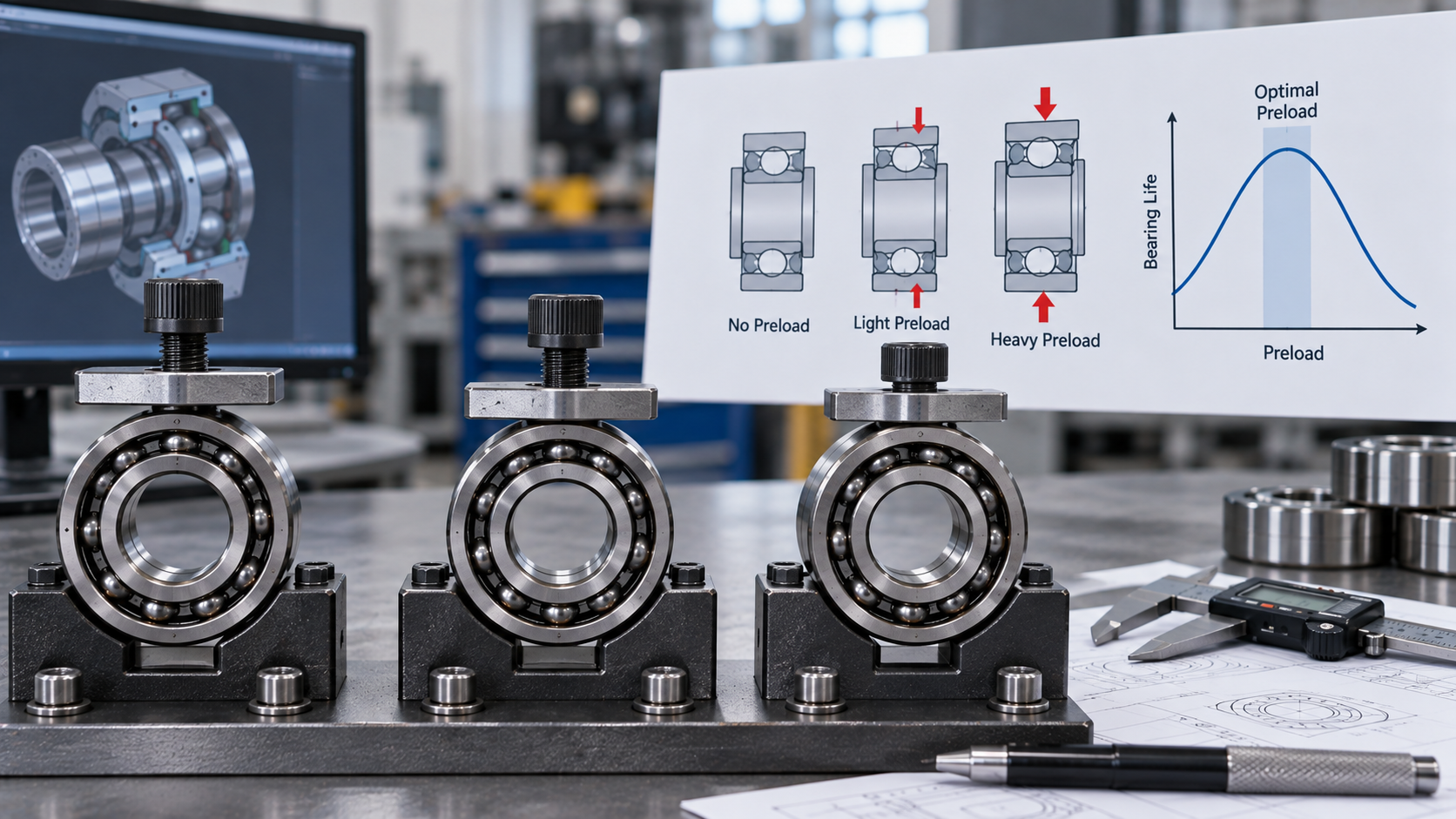
What is the preload in a bearing? It is the axial force already built into the bearing before it carries any working load, applied on purpose so the rolling elements stay in contact in every direction.
Most bearings leave the factory with a small internal clearance between the rolling elements and the raceways. Preload takes that clearance away and replaces it with a controlled force. The axis becomes stiffer, quieter and more repeatable, and the bearing gives up part of its load rating to get there.
This guide covers what preload does to the load zone, the four ways it gets set, the light to heavy range, and how each step up changes rigidity, friction and service life.
What Preload Does Inside a Bearing
A bearing with clearance under a radial load does not use all of its rolling elements. The shaft moves until a short arc of balls or rollers takes the load, and every element outside that arc sits idle. Preload removes that free movement. With the bearing already loaded, a wider arc of elements is in contact before the working load arrives, so the same load produces less deflection.
That is the whole mechanical argument for preload. It does not make the bearing stronger. It makes it stiffer and takes out the small movements that show up as noise, backlash and lost accuracy.
Preload and Clearance Are Two Ends of One Scale
Internal clearance is measured with the bearing unloaded and the rings free to move. Preload is the same measurement pushed past zero into the negative. This walkthrough of bearing internal clearance explained covers C2, CN, C3 and C4, and none of those classes tells you the preload. Clearance is a manufacturing output. Preload is a decision made later, at manufacture or at assembly.
In a crossed roller bearing the preload is ground in at the factory. The rings are finished to a set interference, so the axis is stiff from the first installation and no field adjustment follows.
Four Ways Preload Gets Set
| Method | Force | Set By | Fits When | Watch Out For |
|---|---|---|---|---|
| Ground in at manufacture | Fixed | Bearing maker | Volume builds, one part number per axis | Cannot be changed after delivery |
| Matched pair under an axial clamp | Fixed | Assembly | Two bearings share one load path | Ring faces and clamp force need control |
| Spring or wavy washer | Constant | Design | Thermal growth changes the stack | Force comes from the spring, not a nut |
| Shims and spacers | Fixed, tunable | Assembly | Prototypes and low volume builds | Every rebuild needs a new measurement |
Light, Medium and Heavy Preload
Preload is quoted either as an axial force in newtons or as a share of the bearing’s basic dynamic load rating. Levels run from a light setting that only removes clearance up to a heavy setting that approaches the working load itself.
| Level | What It Does | Where It Fits | What It Costs |
|---|---|---|---|
| Light | Removes clearance and stops skidding | Servo motor and gearbox shafts | A small share of the load rating |
| Medium | Holds the axis stiff under working load | Robot joints, positioning stages, rotary tables | More friction, less speed headroom |
| Heavy | Maximum rigidity at slow speed | Slow heavy axes, indexing tables | The largest heat penalty |
Stiffness does not climb in step with preload. The gain flattens as preload rises, while friction and heat keep climbing at the same rate. The useful setting is the lightest level that still holds the accuracy target.
How Preload Changes Rigidity
Moment stiffness decides where the tool ends up, and it is where crossed roller bearings separate from ball designs. Cylindrical rollers sit at 90 degree alternating angles in a V raceway and make line contact across both rings. Yuanhe quotes three to five times the moment stiffness of an equivalent ball bearing for the RAU series, with tool center point deflection under 0.01mm at full payload on articulated arm axes.
RAU series bearings run from a 20mm to a 350mm bore in 5mm, 8mm and 13mm wide sections, at P5, P4 and P2 accuracy grades, all delivered with factory-set preload. A wrist axis with little room left between the gearbox and the housing is usually a case for the 5mm series rather than a taller ring.
How Preload Changes Life, Friction and Speed
Preload enters the life calculation directly. The equivalent load in the L10 formula carries the preload force, so a heavily preloaded bearing has less rating left for the working load, and the static safety factor of C0 over static load falls with it.
Friction torque rises with preload and running temperature follows. Grease pays for that first, since it ages faster at higher temperature, so a preloaded axis may need a different lubricant and a shorter relubrication interval than the same bearing run loose.
Speed headroom drops as well, because a preloaded unit runs hotter at the same speed, which is why a fast slew axis is rarely preloaded heavily. Too little preload fails the other way. Balls slide instead of rolling at light load, and the raceway shows the smearing that goes with it.
What Preload Looks Like at the Axis
Shoulder and Elbow Axes
These axes carry a tilting moment along with the load. One preloaded crossed roller ring takes radial load, axial load in both directions and the moment at the same time, so the design loses the clearance stack that comes from pairing bearings.
Wrist Axes
Section height is the binding constraint here, not capacity. A thin crossed roller ring holds the moment stiffness while leaving room for the gearbox and the cable routing.
Servo Motor and Gearbox Shafts
These positions run fast and see almost no moment, which makes deep groove ball bearings the right pick. A typical robot servo shaft uses the 6204 bearing at 20mm by 47mm by 14mm or the 6205 at 25mm by 52mm by 15mm, held with a light spring or clamp preload to stop the elements sliding at low speed.
Precision Rotary Tables and Positioning Stages
Indexing accuracy comes from stiffness rather than speed, so these axes sit at medium preload on an accurately ground seat. Capacity is not the constraint. The RAU 20013, at a 200mm bore in a 13mm section, carries 25.8kN dynamic and 54.7kN static, which shows how much load fits into a thin ring.
Symptoms That Point at the Wrong Preload
| Symptom | Likely Cause | First Check |
|---|---|---|
| Rattle at low load, error on reversal | Preload lost, clearance back | Axial play with a dial gauge |
| Housing warm after a short run | Preload too high, or both rings clamped | Friction torque, fit on each ring |
| Dark grease and fretting on the raceway | Micro sliding under a light load | Preload level, grease type and fill amount |
| Lost motion that returns once warm | Clearance class against thermal growth | Operating temperature against fitted clearance |
How to Specify Preload on a Drawing
Five fields carry the intent, and each one takes a decision away from the shop floor.
1Preload level or axial force. Name the level, and give the force in newtons where the design allows it.
2How it is applied. Ground in, spring, shim stack or clamp. The method decides who controls the final number.
3Clearance class for each bearing. C2, CN or C3 on a paired layout, with the reason written next to it.
4Accuracy grade and runout target. P5, P4 or P2 on a crossed roller ring, with the seat flatness callout that goes with it.
5Inspection data. Bore tolerance, radial runout and assembly height. Yuanhe measures all three at four quadrant positions and ships the sheet with every crossed roller bearing.
Send the load, speed and temperature range with the drawing, since lubricant and fill amount are chosen from those three numbers.
Frequently Asked Questions
What is the preload in a bearing?
It is an axial force applied before the bearing carries any working load. The force keeps the rolling elements loaded in every direction, removes internal clearance and holds the axis stiff from the first turn.
Is preload the same as negative clearance?
For a fixed preload, yes. The measurement that shows a positive clearance on a loose bearing reads as interference once the preload is applied. A spring preload works differently, because the force stays constant while the ring position can still change with temperature.
Does more preload always mean higher stiffness?
Stiffness rises with preload, but the gain flattens. Friction torque and running temperature keep climbing at a steady rate, so past a point extra preload buys very little stiffness and costs a lot of heat.
Can a standard deep groove ball bearing be preloaded?
Yes, with a spring or a clamped pair. The amount stays light, because the design runs with internal clearance and a shallow contact angle. Preloading a deep groove bearing hard enough to rival a roller design is not a practical route.
How do I know if the preload is too high?
Running temperature and friction torque climb first, and grease discoloration follows. A unit that runs warmer than its neighbours on the same duty is the earliest signal, and it costs nothing to check.
Send the Axis Drawing
Preload is a number, not a feel on the clamp nut. Send the drawing with the load, the speed range, the operating temperature and the accuracy target. Yuanhe manufactures deep groove ball bearings and RAU series crossed roller bearings with factory-set preload, under ISO 9001:2015 process control, with 500+ B2B clients and 12,000+ OEM projects behind the line.
Request a quote and the engineering team will come back with a preload level and a section height for each axis.