

 English
 French
 German
Integrated Ring vs Separated Ring Crossed Roller Bearings
Integrated ring vs separated ring crossed roller bearings differ in how the races are made. Crossed roller bearings handle combined loads in a thin, rigid package, which is why they show up in robots, rotary tables, and precision instruments. The two main designs differ in how the races are built and how the bearing mounts. This guide explains the difference and helps you choose.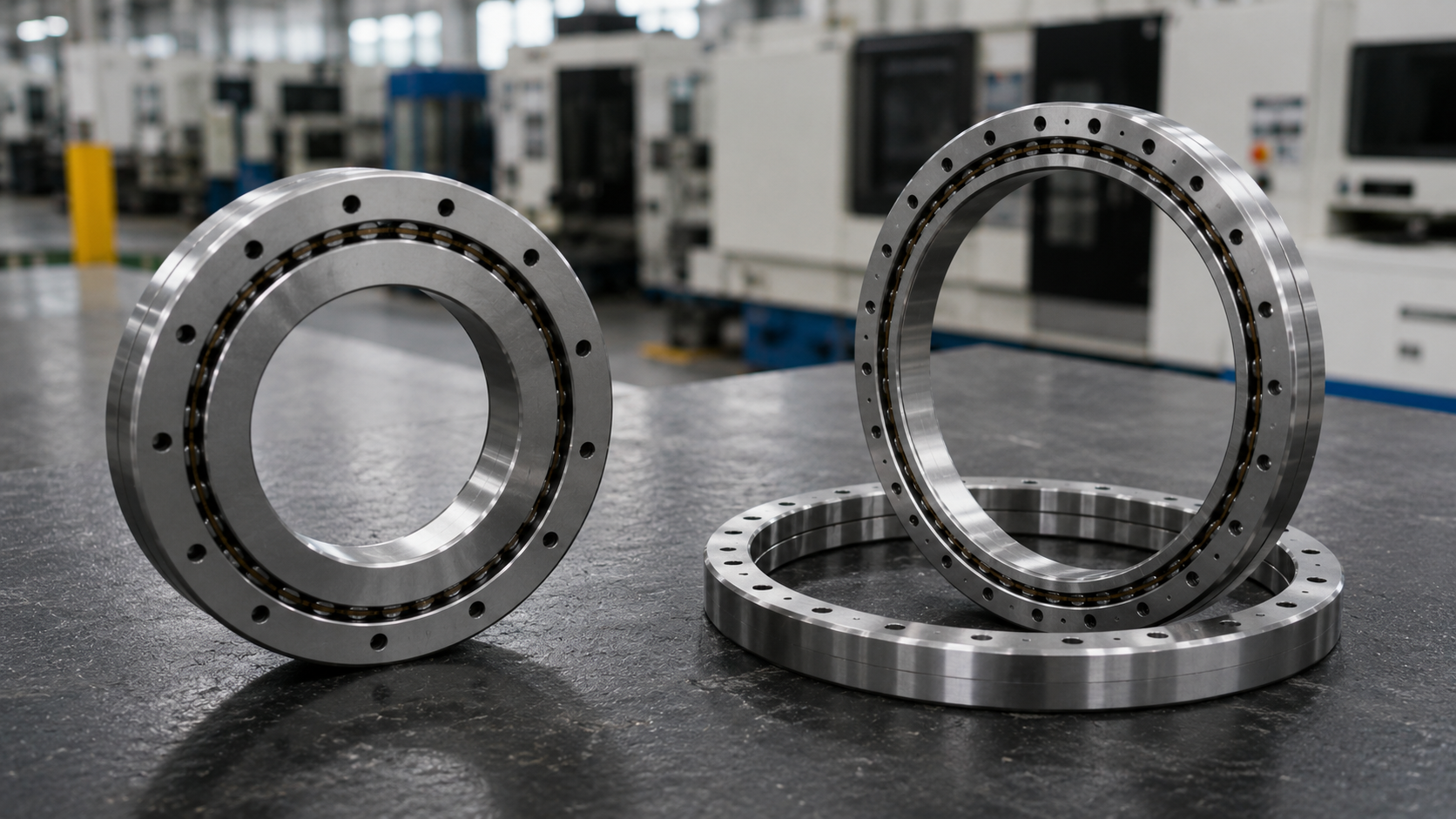
1What a Crossed Roller Bearing Does
A crossed roller bearing uses cylindrical rollers arranged at right angles to each other in a single raceway. That crossed layout lets one bearing carry radial load, axial load, and tilting moment at the same time. A single crossed roller bearing can replace a pair of ordinary bearings in a compact space.
Because the rollers are crossed, the bearing is also stiff. The load path is short and direct, which is what precision machines want when they position a part or hold it rigid under load.
2Integrated Ring vs Separated Ring
The key difference between the two designs is how the inner and outer rings are made.
Integrated Ring
An integrated ring design machines the raceway directly into a single-piece inner and outer ring. There is no bolted or clamped joint in the ring itself. This gives a stiffer, more uniform structure because the raceway is one continuous piece.
The Yuanhe RAU series is an example of an integrated ring crossed roller bearing. The inner and outer rings are each one piece, with the factory preloading the bearing before it ships. That preload removes internal clearance and gives the bearing its stiffness right out of the box.
Separated Ring
A separated ring design builds the raceway from separate pieces that are bolted or clamped together. This can make assembly and mounting more flexible, since the ring can be opened during installation.
The trade-off is that a bolted joint is a potential point of flex and assembly error. A separated ring can be slightly less stiff than a one-piece ring, and it depends on correct bolt torque to perform as intended.
3How They Compare
The table below lays out the main differences.
| Factor | Integrated Ring | Separated Ring |
|---|---|---|
| Ring structure | One piece per ring | Joined or clamped pieces |
| Stiffness | Higher | Slightly lower |
| Mounting | Factory preloaded, bolt in | More assembly steps |
| Consistency | Uniform raceway | Depends on assembly |
For most precision applications, the integrated ring design wins on stiffness and consistency. The separated ring earns its place where the mounting or assembly process specifically needs a ring that can be opened.
4Choosing Between the Two
Three factors usually decide which design you need.
Space and Stiffness
If the machine needs maximum stiffness in a compact envelope, the integrated ring is the better choice. The one-piece raceway and factory preload give the most rigid result for the space.
Mounting Simplicity
An integrated, factory-preloaded bearing bolts straight into the machine with no internal assembly. That saves time and removes a source of error. If your assembly process favors a preloaded unit, integrated is the simpler path.
Assembly Flexibility
If the design requires opening the ring to fit it around other parts during assembly, a separated ring may be needed. This is the main reason to choose the separated design.
5Preload and Stiffness in Practice
Stiffness is the main reason to choose a crossed roller bearing, and preload is what delivers it.
A bearing with internal clearance has a small amount of free play. Under load, that play shows up as flex and movement. Preload removes the clearance by keeping the rollers in constant contact with the raceways, which makes the bearing stiffer and more accurate.
An integrated ring bearing is often preloaded at the factory, so the stiffness is built in before it ships. That removes a source of assembly error and gives consistent performance from the first part.
6Typical Applications of Each Design
The two designs tend to land in different places.
Integrated ring bearings dominate precision positioning, such as robot joints, rotary tables, and machine tool indexers, where stiffness and accuracy matter most. The one-piece ring and factory preload suit these demanding jobs.
Separated ring bearings appear where the assembly process needs the ring to open around other parts, or where the design benefits from a bolted structure. They are less common in the highest-precision work but still serve where assembly flexibility is the priority.
7How the Ring Design Affects Mounting
The ring design changes how the bearing goes into the machine.
An integrated ring bearing arrives as a single unit and bolts into place, which keeps mounting simple and consistent. A separated ring may need to be opened and reassembled around other parts, which adds steps and the risk of assembly error.
For most designs, the simpler integrated ring is the better default. The time saved on mounting, and the consistency of a factory-preloaded unit, outweigh the assembly flexibility a separated ring offers. Reserve the separated design for the specific cases where the ring must open.
For the supporting shafts and housings in these assemblies, standard deep groove bearings such as the 6203bearing, 6204bearing, 6205bearing, and 6206bearing are often used alongside the crossed roller bearing.
8Getting the Most From a Preloaded Bearing
A factory-preloaded crossed roller bearing is built to a set internal load, and handling it right keeps that setting intact.
Do not press on the rollers or through the raceways during mounting, since that can change the preload or damage the rolling elements. Mount the bearing on clean, flat surfaces, and torque the mounting bolts evenly. Uneven bolt torque flexes the ring and can affect accuracy.
Keep the bearing clean and sealed once mounted. The preload and stiffness are set at the factory, and the main job after that is keeping contamination out so the bearing stays precise.
9Common Questions
What is the difference between integrated and separated ring crossed roller bearings?
What does factory preload mean?
Which design is more accurate?
Does Yuanhe make integrated ring crossed roller bearings?
Is an integrated ring bearing harder to mount?
Why does factory preload matter?



Related Products