


 English
 French
 German
What Is a Crossed Roller Bearing
What is a crossed roller bearing? It is a rotary bearing built for stiffness and accuracy. It uses cylindrical rollers arranged at right angles to each other inside two rings, so a single bearing carries radial load, axial load, and tilting moment all at once. That is what the name means and why the design exists. This guide explains the parts, how it works, and where it fits.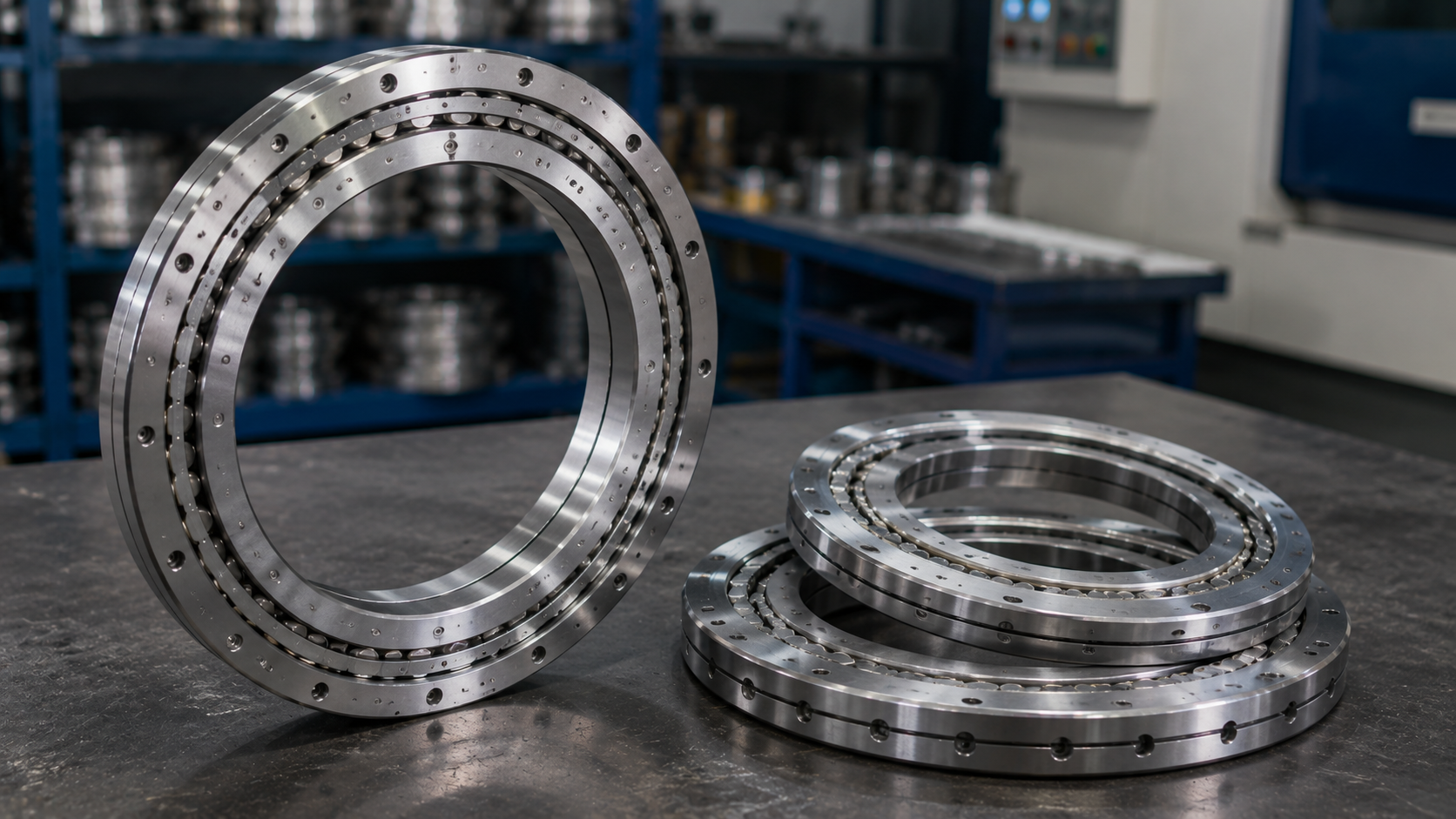
1What the Name Means
The word crossed describes the rollers. In a normal roller bearing, all the rollers line up in the same direction. In a crossed roller bearing, each roller sits at a right angle to its neighbor. One points along the bearing axis, the next points across it, and the pattern alternates around the ring.
That crisscross is the whole idea. Because rollers face two directions, the bearing resists force in two directions without adding a second bearing. The crossed layout is what turns a single ring into a load handler for every axis.
2The Parts Inside
Four parts make up the bearing. Understanding them makes the rest of the design easier to read.
Inner Ring
The inner ring sits on the shaft or the rotating part. Its raceway is the track the rollers run on. On the Yuanhe RAU series, the inner ring is one machined piece, not a bolted assembly. A one-piece ring keeps the raceway round and true, which is the foundation of the bearing’s accuracy.
Outer Ring
The outer ring mounts to the housing or the stationary side. It carries the matching raceway and, together with the inner ring, forms the V-shaped groove the crossed rollers ride in. The outer ring is usually the part that bolts to the machine structure.
Rollers
The rollers are short cylinders of hardened steel. Each one is set at ninety degrees to the next. They roll along line contact with the raceways, which is what gives the bearing its stiffness and load capacity compared to balls. The roller geometry is the heart of the design.
Spacer or Cage
A spacer or cage keeps the rollers evenly spaced so they do not touch each other. Even spacing keeps the load even and the rotation smooth. Some designs use a cage, and some use small spacers between rollers. Either way, the goal is the same: no roller rubs its neighbor.
3How It Differs From a Ball Bearing
The obvious difference is the rolling element. Balls make point contact with the raceway. Rollers make line contact. Line contact spreads the load over a larger area, so a crossed roller bearing is stiffer and carries more load in the same size.
The other difference is the crossed layout itself. A ball bearing usually handles one main load direction well. The crossed rollers handle combined load in every direction without extra bearings. The comparison guide covers the tradeoffs in full.
4The RAU Integrated Design
Yuanhe builds crossed roller bearings in the RAU series, where each ring is a single integrated piece. There is no bolted joint in the ring. Preload is set at the factory, so the bearing arrives ready to mount without on-site adjustment.
The one-piece construction keeps runout low and stiffness high. It also removes the most common mounting mistake, which is setting the preload wrong by hand. Factory preload means the bearing behaves the same every time it is installed.
5Where You Will See One
Crossed roller bearings appear wherever a machine must rotate under load and stay accurate. Robot joints use them to hold an arm steady through a move. CNC rotary tables use them to index a workpiece. Medical imaging gantries use them to swing an X-ray source smoothly around a patient. Each application depends on the same core properties of stiffness and accuracy.
Deeper looks at specific uses are in the guides for robot joints and CNC rotary tables.
6How the Load Flows Through It
When a load pushes on the shaft, it travels from the shaft into the inner ring, through the rollers, and out to the outer ring and the housing. Because the rollers alternate direction, the load splits between the two sets. One set of rollers catches the radial and axial force, and the crossed set catches the moment that tries to tip the assembly.
The load path is short and direct. There is no second bearing and no intermediate structure to add flex. That short path is part of why the bearing stays stiff. Every roller in the ring shares the load, so no single roller carries the whole force.
This load sharing is what makes the crossed roller bearing reliable in service. A bearing that concentrates load on a few rollers wears those rollers fast. A bearing that spreads the load across the whole ring wears evenly and lasts longer.
7Materials and Sealing
The rings and rollers are made from GCr15 chromium bearing steel, hardened and ground for a smooth raceway. The hardness lets the raceway resist denting under repeated load, and the smooth finish keeps friction low. Both matter for a bearing whose whole job is stiffness and accuracy.
Sealing is the second material question. A sealed crossed roller bearing carries contact seals that keep grease in and dirt out. An open bearing has none and relies on the housing for protection. For a robot joint or a scanner gantry in open air, sealed is the default. For a clean, oiled machine tool enclosure, open runs freer.
For wet or corrosive duty, stainless steel rings and rollers replace chromium steel. Stainless holds up to washdown and humidity but carries slightly less load. The material and the seal are chosen together, because they both answer the same question: what environment will this bearing live in.
8Why It Replaced Two Bearings
Before crossed roller bearings, a rotary joint often needed a radial bearing for the shaft load and a separate thrust bearing for the axial load. Two bearings meant two housings, two mounts, and twice the alignment work. The crossed roller bearing collapses that stack into one ring.
Replacing two bearings with one does more than save space. It shortens the load path, which reduces flex, and it removes the alignment error between two separate bearing seats. The result is a stiffer, more accurate assembly with fewer parts to machine and assemble.
That consolidation is why the crossed roller bearing spread so fast through robot arms and precision tables. It solved a layout problem and a stiffness problem at the same time, with one part instead of two.
9Common Misunderstandings
One common misunderstanding is that a crossed roller bearing is just a ball bearing with rollers. It is a different design with a different load path. The crossed layout is what gives it the ability to carry moment and combined load in one ring, something a ball bearing cannot match.
Another is that RAU is a split between separate part types. It is not. RAU is one integrated series with one-piece rings and factory preload. The name identifies the family, not a division inside it.
A third is that accuracy grade and stiffness are the same thing. They are related but separate. The grade sets runout and rotational accuracy. Stiffness comes from the roller contact and the ring design. A bearing can be accurate but not stiff, or stiff but not accurate, so both specs must be checked.
10Frequently Asked Questions
Why is it called crossed? +
Is a crossed roller bearing the same as a ball bearing? +
What does RAU mean? +
Need a crossed roller bearing specified to your design? Send your drawing for a quote.