


 English
 French
 German
Robotic Bearings. A Guide to Types, Loads and Selection
Robotic Bearings
Robotic bearings sit inside every axis of a machine that moves on its own, at the joint that turns, the motor shaft that drives it, and the flange that carries the payload.
A robot asks more of a bearing than a pump or a conveyor does. The load arrives at the end of a lever, it reverses thousands of times a shift, and the position of the tool depends on how little the bearing deflects. That combination is why the bearing choice drives the accuracy of the whole machine.
This guide covers what separates a robotic bearing from a general purpose one, where each of the two bearing families fits, and how six robot classes use them. It closes with the four numbers and five questions that decide the part number.
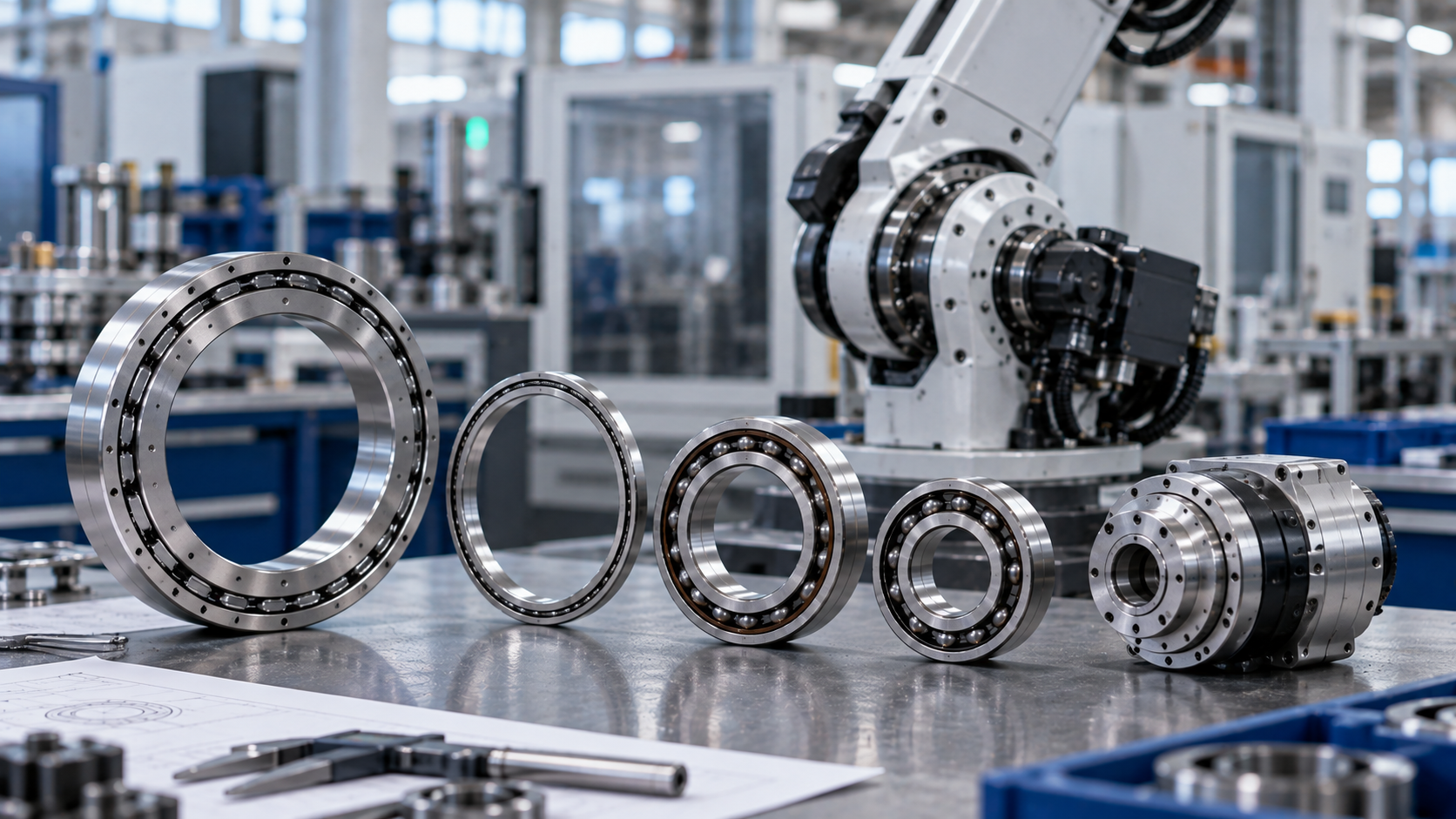
What Separates a Robotic Bearing from a General Purpose One
1The moment load sizes it, not the radial load. A payload held far from the axis turns a modest weight into a large tilting moment, and that moment decides the bearing.
2Deflection shows up at the tool. Every micron of tilt at the wrist turns into position error at the end effector, so stiffness matters more than rating.
3The duty cycle reverses. A robot axis starts, stops and reverses all shift, so the bearing sees load in both axial directions and a high cycle count.
4Space is the tightest constraint. Cables and hoses run through the axis, so a robotic bearing is usually thin with a large bore rather than a compact block.
The Two Families That Cover a Robot
| Bearing | Load It Takes | Typical Position | What It Does Not Like |
|---|---|---|---|
| Crossed roller bearing | Radial, axial in both directions and tilting moment in one ring | Shoulder, elbow, wrist, rotary base, lift stages | A taller section and a seat that is not flat and rigid |
| Deep groove ball bearing | Radial load plus moderate axial load, at speed | Servo motor shafts, gearbox input and output, encoders | Offset loads, which push deflection up quickly |
Those two families cover the joints and the drive train, which is where the load and the accuracy problem both live. Many robot designs still use a pair of ball bearings in a joint, and the trade is real: a pair costs more stack height, more parts and a clearance stack that has to be shimmed, while one preloaded crossed roller bearing takes radial load, axial load both ways and the moment together.
Where Robotic Bearings Sit in Six Robot Classes
Six Axis Industrial Arms
The shoulder and elbow carry the arm plus the payload, so they take the largest moment and usually take a crossed roller ring. The wrist has the least room, which is where the 5mm section of the RAU series earns its place. The drive train is ball bearing territory: a typical servo shaft runs the 6204 bearing at 20mm by 47mm by 14mm or the 6205 at 25mm by 52mm by 15mm.
Collaborative Robots
Lower payloads, lighter arms, and joints that sit next to people. The moment is smaller than on an industrial arm, but the axis still has to hold position without creeping, and the joint usually needs sealing against dust and washdown.
SCARA Robots
A SCARA splits the problem. The horizontal arm rotates on a fixed axis with a real moment at the outer end, while the vertical axis runs on a ball screw or a belt. The rotary joints take a crossed roller ring and the motor and screw ends take deep groove ball bearings.
Delta and Parallel Robots
These machines move fast with a light structure. Acceleration dominates the load, and the base rotary axes see it as a reversing moment. A thin crossed roller ring holds that moment in a shallow section without adding mass to the moving frame.
Humanoid and Legged Robots
Every joint behaves like a robot arm joint in miniature: hip, knee, ankle, shoulder and wrist all carry an offset load, and all of them need the same stiffness. Section height is the binding constraint, and the actuators behind them are built around the same servo shaft sizes.
AMR and Mobile Robots
Mobile platforms put the load in a different place. Drive wheel hubs and lift columns see radial load and thrust rather than a large moment, so ball bearings do most of the work, with a crossed roller ring where the lift stage has to stay square under an offset pallet.
The Four Numbers That Decide the Bearing
Four figures separate one candidate from another, and all four belong on the drawing.
The moment load. Take the worst payload at the worst reach. Compare it with the static rating C0 of the ring, and keep the static safety factor at 2 or above.
Moment stiffness. Yuanhe quotes three to five times the moment stiffness of an equivalent ball bearing for the RAU series, with tool center point deflection under 0.01mm at full payload on articulated arm axes.
Accuracy grade. P5, P4 and P2 cover the range for crossed roller rings. P5 carries general automation, and P4 or P2 goes on the axes that have to hold a tight position.
Section height. RAU series rings run from a 20mm to a 350mm bore in 5mm, 8mm and 13mm wide sections. RAU 2005 gives a 20mm bore in a 31mm outside diameter, and RAU 20013 carries 25.8kN dynamic and 54.7kN static in a 13mm section.
Five Questions Before You Pick
1What is the worst tilting moment on the axis? Payload times reach, plus the arm’s own weight at full extension.
2Does the axis hold position without a brake? If it does, clearance is not acceptable on that axis.
3How much section height is left? The housing drawing has already answered this one, and it sets the series.
4What accuracy does the process need? A pick and place cell and a dispensing head sit at different grades.
5What speed and temperature does it run at? Those two numbers set the clearance class, the cage and the grease.
Mistakes That Repeat in Robot Programs
Three failures come back often, and none of them is a bearing defect. The first is sizing on radial load alone, which leaves the arm visibly drooping under a full reach payload. The second is stacking two ball bearings where one crossed roller ring belongs, which adds a clearance stack that keeps drifting after every rebuild. The third is mounting a precision ring on a seat that was machined like any other housing, because a thin ring reflects every flatness error straight into runout.
How Robotic Bearings Ship
Every crossed roller bearing leaves Yuanhe with dimensional inspection data: bore tolerance, radial runout and assembly height measured at four quadrant positions, with factory-set preload that needs no adjustment on the line. That data matters on a robot axis, because the joint is assembled once and then expected to hold position for years.
The same logic runs through the ball bearing side of the range, where the shaft sizes are standard: the 6204, the 6205, and the smaller sizes behind the encoder and brake. History on those parts reaches 500+ B2B clients and 12,000+ OEM projects, under ISO 9001:2015 process control.
Frequently Asked Questions
What are robotic bearings?
They are the bearings inside a robot axis. The term covers the ring that carries the joint moment, the bearings behind the servo motor and gearbox, and the small bearings at the encoder and brake. Most robot axes use a crossed roller bearing at the joint and deep groove ball bearings in the drive train.
Which bearings are used in robot joints?
Crossed roller bearings on the joints that carry a real moment, which covers most shoulders, elbows and wrists. Lighter joints and short reach designs sometimes run a pair of deep groove ball bearings instead. This comparison of crossed roller bearings for robot joints walks through the difference.
Do robot joints need preloaded bearings?
The joints that hold position do. Preload removes the free movement that shows up as lost motion on reversal, and on an RAU series ring the preload is ground in at the factory, so the joint is stiff from the first installation.
Can one crossed roller bearing replace two ball bearings?
On a moment loaded axis, usually yes. One ring takes radial load, axial load in both directions and the tilting moment, which removes the clearance stack and the shimming that come with a pair.
Which accuracy grade do robot axes need?
P5 covers general automation, and P4 or P2 goes on axes that measure, dispense or place parts with a tight tolerance. The grade is chosen per axis rather than per machine, because a base axis rarely needs the same precision as a wrist.
Send the Axis Drawing
Send the drawing with the payload, the reach, the section height you have left and the accuracy target. Yuanhe manufactures deep groove ball bearings and RAU series crossed roller bearings with factory-set preload for robot and automation builders, with inspection data shipped alongside every ring.
Request a quote and the engineering team will come back with a bearing type and a section height for each axis.