
 English
 French
 German
Deep Groove Ball Bearings in Printing Machinery
Press Room Notes
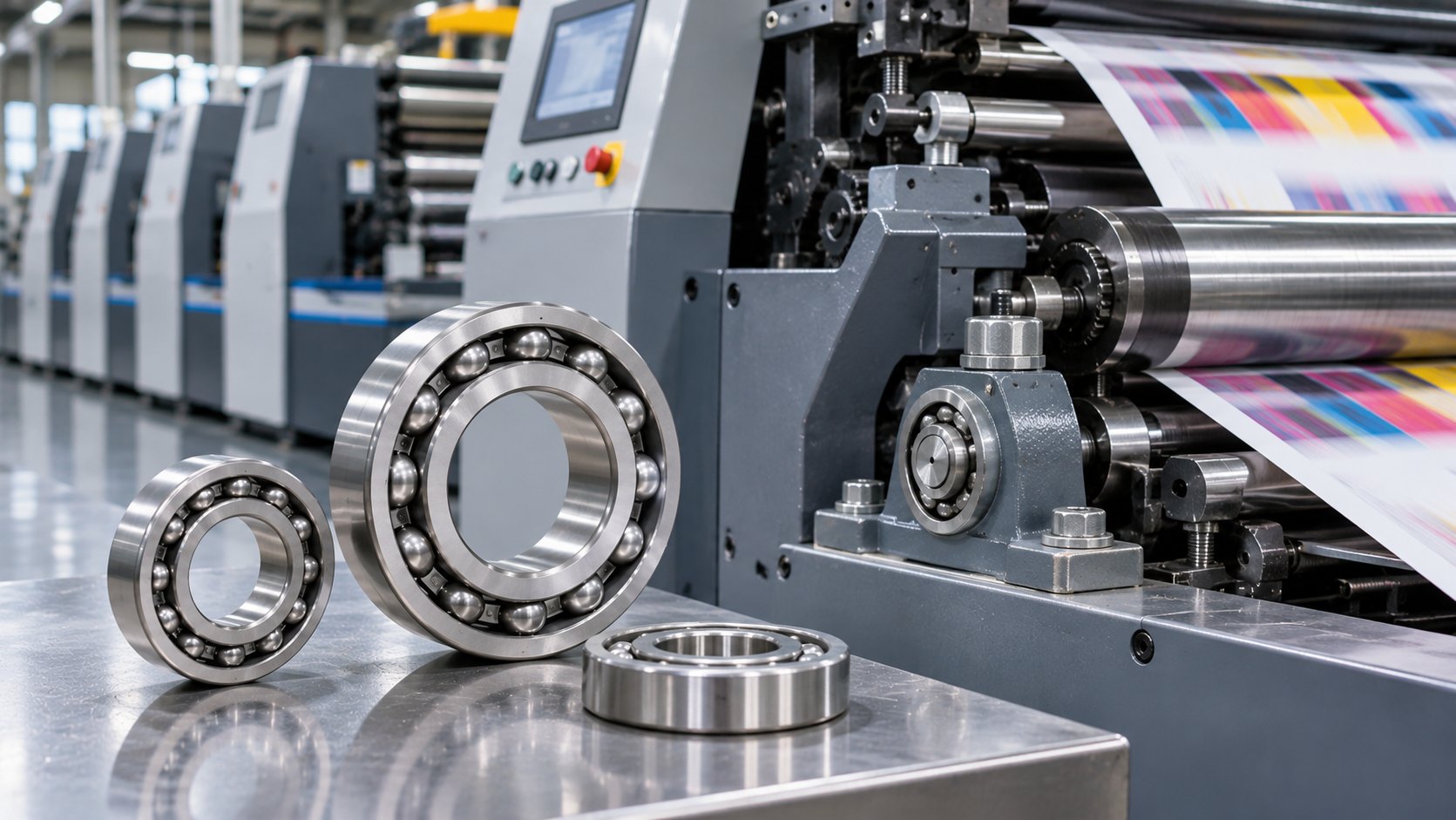
Bearings for printing machinery are chosen for register, not for load. A press bearing carries very little weight, and a few microns of movement at the wrong moment shows up as a doubled dot on the sheet.
That is why a bearing that would be fine in a fan or a conveyor can be wrong in a press. The loads are light, the speeds are moderate, and the tolerance for play in the print direction is close to zero.
01What Makes a Printing Press Hard on Bearings
A sheetfed offset press is a chain of cylinders that must stay in time with each other. Every cylinder is driven through gears, and every cylinder sits on bearings that position it relative to the next one.
Three conditions do the damage over a press life. Paper dust builds up on seals. Ink mist and dampening solution settle on exposed surfaces. And the machine runs at production speed for long shifts, so small errors accumulate into visible print defects.
The bearing also has to be quiet. A press hall is loud already, and a bearing that adds a whine at a particular speed is hard to find later. Noise is a symptom worth chasing before it becomes a print problem.
A deep groove ball bearing suits most of these positions for plain reasons. It carries radial and axial load together, it comes in the small bores a cylinder end needs, and it is available in tight clearance classes without moving to a different bearing family.
02The Infeed Section
The infeed lifts one sheet at a time from the pile and hands it to the feed board. Vacuum suckers, feed rollers, and a short tape run do the work, and none of them carry much load.
Load at the sheet separator
Loads here are light and mostly radial, with a small axial component from the side guide. A deep groove ball bearing handles both directions without a second bearing, which is why this section rarely needs anything else.
What the section does need is protection from paper dust. A shielded bearing keeps the coarse fibers out, and a sealed bearing keeps out the fine chalk coating that comes off coated stock. On a press running coated paper all week, the sealed version pays for itself.
03Transfer Cylinders and Gripper Shafts
Transfer cylinders carry the sheet from one printing unit to the next. Each cylinder has a gripper shaft that opens and closes at speed, and the shaft rides in small bearings at both ends of the cylinder.
These bearings see a reversing load each revolution as the grippers open and close. The load is small, but the cycle count is enormous, and any play shows up as a sheet arriving slightly late at the next unit.
Register accuracy starts at the bearing
Register is the alignment of one color on top of another. It depends on every cylinder holding its angular position, and a bearing with internal clearance lets the cylinder move before the gripper takes up the load. A tighter clearance class, matched to the fit, is the usual answer.
The housing fit matters as much as the bearing. A bearing pressed into a worn housing can rotate in the bore, and the wear accelerates from there. Check the bore when a cylinder is out for service, not only the bearing.
04Ink Rollers and Dampening Trains
Ink rollers transfer a thin film from the duct to the plate. They oscillate sideways while turning, and the bearings at their ends sit in the middle of the ink path.
This is the dirtiest position on the press. Ink mist settles on everything, dampening solution carries fountain concentrate, and cleaning solvents reach places the design never intended. A standard shielded bearing will pass ink into the raceway within a few months.
Sealed bearings are the default here, and the seal compound has to tolerate solvent. Where the design allows it, a bearing with a stainless or coated outer ring lasts longer in wash up conditions. The same reasoning applies to 6004 size bearings used on small ductor rollers.
05The Delivery End
The delivery takes the printed sheet, slows it, and stacks it. Chain grippers, suction wheels, and a blower bar do the work, and the loads stay low.
The risk at this end is different. A bearing that throws grease will mark the last sheets of a run, and the defect appears after the ink is down. Grease bleed onto the sheet path is a quality failure, not a maintenance one.
Chain wear is the other slow problem. A stretched chain changes the timing between the gripper and the pile, and the stacker starts to jog sheets that used to land square. Check chain tension when a delivery bearing is replaced. Sizes in the 6204 bearing range are common on gripper shafts, and at that position a low bleed grease matters more than a higher grade.
Choose a grease with low bleed for any position above the sheet path, and avoid overfilling housings in this section. A small amount of excess grease in a delivery bearing can spoil a whole stack before anyone notices.
06Sealing Against Ink Mist
Ink mist behaves like a fine aerosol. It travels on air currents, settles on cool surfaces, and creeps along shafts by capillary action. A shield blocks paper dust and does very little against mist.
Why a shield is not a seal
A metal shield is a gap with a baffle. It keeps out fibers and splashes, and it lets air through. A rubber lip seal closes that gap, which is what a mist laden atmosphere needs. Using a shielded part in an ink roller position is a false economy.
Where a sealed bearing cannot be fitted, a housing with a proper labyrinth and a drain path is the next best answer. The drain matters, because a cavity that fills with solvent will push contamination inward on the next wash up.
07Grease or Oil for a Press Bearing
Most press bearings are greased for life. The maintenance window on a production press is short, and a sealed unit that never needs a grease line is worth more than the slight life advantage oil might offer.
Low speed changes the grease choice
Press cylinders turn slowly compared with a motor, so churning is not the problem it would be at high speed. What matters is staying put, resisting washout, and not bleeding oil onto the sheet.
A lithium complex or polyurea grease with a synthetic base oil covers that mix. Where a position runs warm, such as a unit near a dryer, the synthetic base oil earns its place. Where the press runs cold on a winter morning, the same grease still releases oil at startup instead of channeling.
08Building a Spare List by Station
Press spares are usually bought by size, which is how a store ends up with forty bearings and not the one that stops the line. Build the list by station instead, with the failure history next to each entry.
Group by station, not by size
A gripper shaft bearing and a delivery bearing of the same bore are not interchangeable in practice. One needs tight clearance and a sealed lip, the other needs low bleed and a light fill. Listing them as one line hides that difference until the night shift fits the wrong one.
Record what actually failed, at which station, and after how many shifts. Two seasons of that record tells you which positions deserve a spare on the shelf and which can wait for a planned order. A size such as the 6203 bearing or the 6305 bearing may appear at six stations with six different requirements.
Send us the station list and we will mark each line with the seal type, clearance class, and grease fill that fits it. The press room inquiry form takes a photo of the parts book page as well as a written list.
09Frequently Asked Questions
Do press bearings need a precision class above standard?
Not everywhere. Gripper shafts and transfer cylinders benefit from tighter clearance and a clean running fit, while infeed and delivery positions usually run standard parts.
Why do ink roller bearings fail so fast?
Because they sit in ink mist and solvent. The bearing is usually sound, and the lubricant has been displaced by contamination that got past a shield.
Can I replace a sealed bearing with a shielded one to save cost?
Only away from ink and dampening. In a mist laden position the shield lets contamination in and the saving disappears at the first unplanned stop.
How do I reduce press noise without changing the whole bearing spec?
Start with the positions closest to the operator and check clearance, fit, and grease fill. A bearing that is too full runs louder than one filled correctly.
Does paper grade affect bearing life?
Yes. Coated stock sheds a fine mineral dust that reaches seals, and recycled stock carries more fiber. Both shorten the interval between seal related failures.
Quote by Station
Send your press model and the stations you want to cover. We will quote by position, with the seal type and clearance class written against each line.
For the wider picture on machinery duty, read our packaging machinery guide. Press and packaging lines share most of the same contamination problems.